

58
Chemical Oceanography, 4th Edition
measurements. Recently, Millero et al. (2008) reexamined the composition of seawater and
gave a value of 35.165 g/ kg, which is in good agreement with the Lyman and Fleming
(1940) estimate. This estimate is in reasonable agreement with the estimate made for the
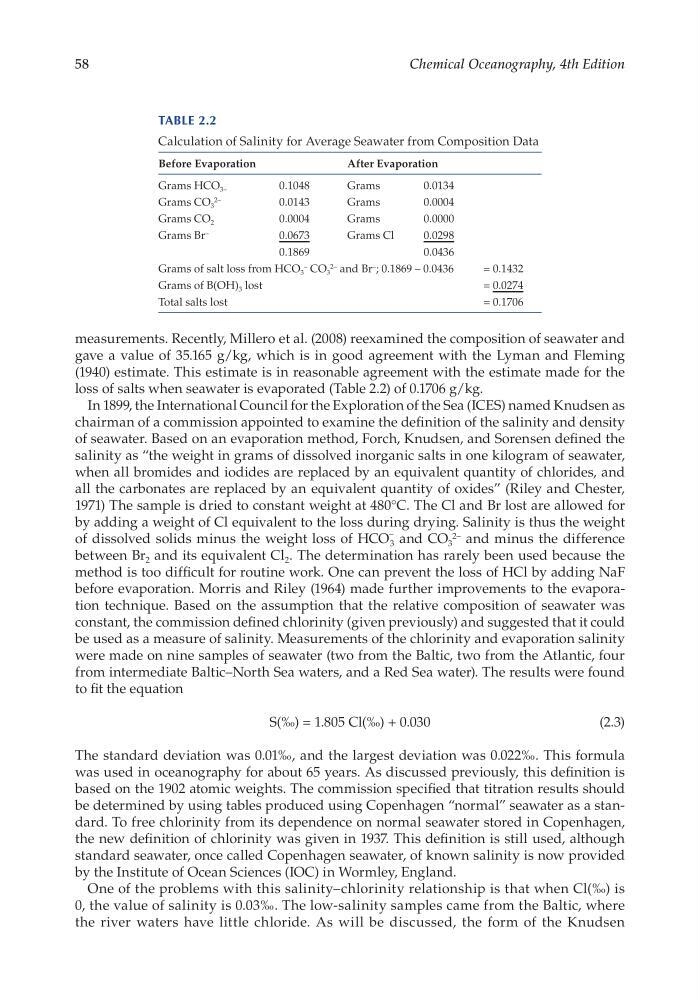
loss of salts when seawater is evaporated (Table 2.2) of 0.1706 g/ kg.
In 1899, the International Council for the Exploration of the Sea (ICES) named Knudsen as
chairman of a commission appointed to examine the definition of the salinity and density
of seawater. Based on an evaporation method, Forch, Knudsen, and Sorensen defined the
salinity as “the weight in grams of dissolved inorganic salts in one kilogram of seawater,
when all bromides and iodides are replaced by an equivalent quantity of chlorides, and
all the carbonates are replaced by an equivalent quantity of oxides” (Riley and Chester,
1971) The sample is dried to constant weight at 480°C. The Cl and Br lost are allowed for
by adding a weight of Cl equivalent to the loss during drying. Salinity is thus the weight
of dissolved solids minus the weight loss of HCO
–
3 and CO 3
2– and minus the difference
between Br 2 and its equivalent Cl 2 . The determination has rarely been used because the
method is too difficult for routine work. One can prevent the loss of HCl by adding NaF
before evaporation. Morris and Riley (1964) made further improvements to the evaporation technique. Based on the assumption that the relative composition of seawater was
constant, the commission defined chlorinity (given previously) and suggested that it could
be used as a measure of salinity. Measurements of the chlorinity and evaporation salinity
were made on nine samples of seawater (two from the Baltic, two from the Atlantic, four
from intermediate Baltic–North Sea waters, and a Red Sea water). The results were found
to fit the equation
S(‰) = 1.805 Cl(‰) + 0.030
(2.3)
The standard deviation was 0.01‰, and the largest deviation was 0.022‰. This formula
was used in oceanography for about 65 years. As discussed previously, this definition is
based on the 1902 atomic weights. The commission specified that titration results should
be determined by using tables produced using Copenhagen “normal” seawater as a standard. To free chlorinity from its dependence on normal seawater stored in Copenhagen,
the new definition of chlorinity was given in 1937. This definition is still used, although
standard seawater, once called Copenhagen seawater, of known salinity is now provided
by the Institute of Ocean Sciences (IOC) in Wormley, England.
One of the problems with this salinity–chlorinity relationship is that when Cl(‰) is
0, the value of salinity is 0.03‰. The low- salinity samples came from the Baltic, where
the river waters have little chloride. As will be discussed, the form of the Knudsen
Table 2.2
Calculation of Salinity for Average Seawater from Composition Data
Before Evaporation
After Evaporation
Grams HCO 3–
0.1048
Grams
0.0134
Grams CO 3
2–
0.0143
Grams
0.0004
Grams CO 2
0.0004
Grams
0.0000
Grams Br –
0.0673
Grams Cl
0.0298
0.1869
0.0436
Grams of salt loss from HCO 3
– CO 3
2– and Br – ; 0.1869 – 0.0436
= 0.1432
Grams of B(OH) 3 lost
= 0.0274
Total salts lost
= 0.1706
Chemical Oceanography, 4th Edition
measurements. Recently, Millero et al. (2008) reexamined the composition of seawater and
gave a value of 35.165 g/ kg, which is in good agreement with the Lyman and Fleming
(1940) estimate. This estimate is in reasonable agreement with the estimate made for the
loss of salts when seawater is evaporated (Table 2.2) of 0.1706 g/ kg.
In 1899, the International Council for the Exploration of the Sea (ICES) named Knudsen as
chairman of a commission appointed to examine the definition of the salinity and density
of seawater. Based on an evaporation method, Forch, Knudsen, and Sorensen defined the
salinity as “the weight in grams of dissolved inorganic salts in one kilogram of seawater,
when all bromides and iodides are replaced by an equivalent quantity of chlorides, and
all the carbonates are replaced by an equivalent quantity of oxides” (Riley and Chester,
1971) The sample is dried to constant weight at 480°C. The Cl and Br lost are allowed for
by adding a weight of Cl equivalent to the loss during drying. Salinity is thus the weight
of dissolved solids minus the weight loss of HCO
–
3 and CO 3
2– and minus the difference
between Br 2 and its equivalent Cl 2 . The determination has rarely been used because the
method is too difficult for routine work. One can prevent the loss of HCl by adding NaF
before evaporation. Morris and Riley (1964) made further improvements to the evaporation technique. Based on the assumption that the relative composition of seawater was
constant, the commission defined chlorinity (given previously) and suggested that it could
be used as a measure of salinity. Measurements of the chlorinity and evaporation salinity
were made on nine samples of seawater (two from the Baltic, two from the Atlantic, four
from intermediate Baltic–North Sea waters, and a Red Sea water). The results were found
to fit the equation
S(‰) = 1.805 Cl(‰) + 0.030
(2.3)
The standard deviation was 0.01‰, and the largest deviation was 0.022‰. This formula
was used in oceanography for about 65 years. As discussed previously, this definition is
based on the 1902 atomic weights. The commission specified that titration results should
be determined by using tables produced using Copenhagen “normal” seawater as a standard. To free chlorinity from its dependence on normal seawater stored in Copenhagen,
the new definition of chlorinity was given in 1937. This definition is still used, although
standard seawater, once called Copenhagen seawater, of known salinity is now provided
by the Institute of Ocean Sciences (IOC) in Wormley, England.
One of the problems with this salinity–chlorinity relationship is that when Cl(‰) is
0, the value of salinity is 0.03‰. The low- salinity samples came from the Baltic, where
the river waters have little chloride. As will be discussed, the form of the Knudsen
Table 2.2
Calculation of Salinity for Average Seawater from Composition Data
Before Evaporation
After Evaporation
Grams HCO 3–
0.1048
Grams
0.0134
Grams CO 3
2–
0.0143
Grams
0.0004
Grams CO 2
0.0004
Grams
0.0000
Grams Br –
0.0673
Grams Cl
0.0298
0.1869
0.0436
Grams of salt loss from HCO 3
– CO 3
2– and Br – ; 0.1869 – 0.0436
= 0.1432
Grams of B(OH) 3 lost
= 0.0274
Total salts lost
= 0.1706