

27
Descriptive Oceanography
1.4.3 Pacific Ocean Waters
Surface water circulation in the Pacific is similar to the Atlantic (see Figure 1.36). In the
North Pacific, there is a clockwise gyre, and in the South Pacific, there is a counterclockwise gyre. The equatorial currents are more distinguishable in the Pacific because of its
larger size. The North and South Equatorial Currents flow toward the west and represent
parts of the two major gyres. Both are driven by the trade winds. The North and South
Equatorial Countercurrents flow toward the east. The North Equatorial Current has surface speeds of 25 to 30 cm s –1 and volume flows of 45 Sv. The Equatorial Countercurrent
has speeds of 35 to 60 cm s –1 except in the spring (March and April), when it decreases to
20 cm s –1 . The countercurrents extend to depths of 1500 m and have volume transports as
high as 60 Sv. At the equator, there is an undercurrent called the Cromwell Current, which
is below the sea surface (200 m in the west to 40 m in the east). It is only 0.2 km thick but
300 km wide and has a length of 14,000 km. The speeds are up to 170 cm s –1 , and the maximum volume transports are 70 Sv (the average is 40 Sv). This current was discovered by
Buchanan in 1886 during the Challenger expedition but was forgotten until rediscovered
by Cromwell, Montgomery, and Stroup in 1952.
No major transport of water from the South to North Pacific Ocean occurs near the equator in the Pacific. The North Pacific does have a strong western boundary current like the
Atlantic. It is called the Kuroshio Current and Extension. Its volume flow is about 65 Sv. It
also meanders like the Gulf Stream, and eddies or rings are formed. The California Current
Antarctic
Zone
70°S
60°
50°
40°
Subant.
Zone
Subtrop.
Zone
Subtrop.
Conv.
S. Atl.
Central
Ant.
Conv.
Ant. Sfc. Water
A n t .
A n t .
Int er.
Wate r
B o tt o m
Shelf
Water
2000
4000
m
Water
Deep
Water
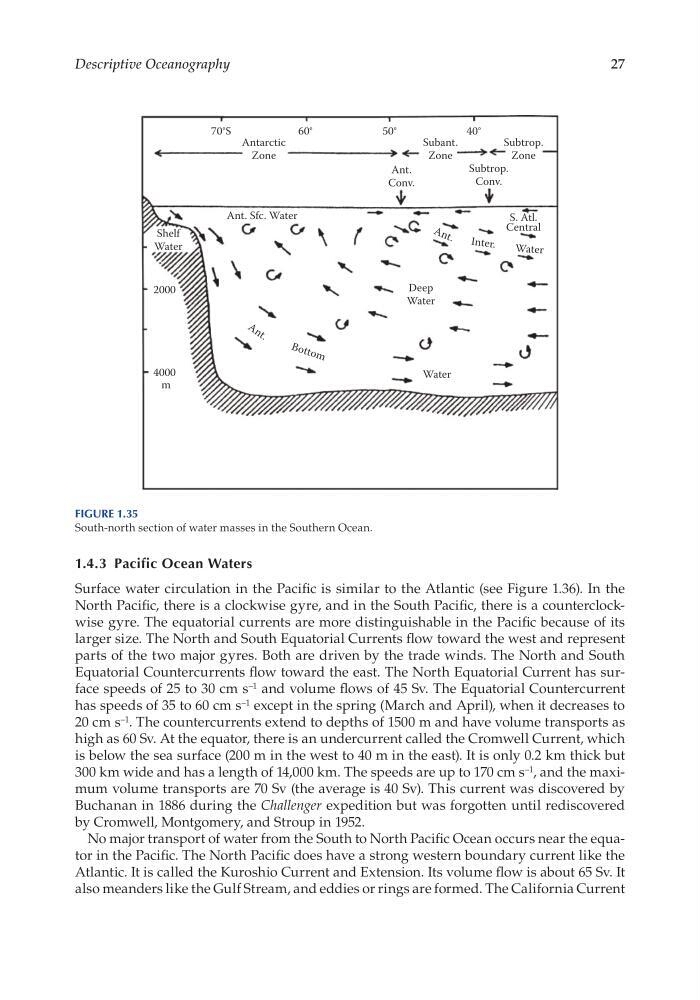
Figure 1.35
South- north section of water masses in the Southern Ocean.
Descriptive Oceanography
1.4.3 Pacific Ocean Waters
Surface water circulation in the Pacific is similar to the Atlantic (see Figure 1.36). In the
North Pacific, there is a clockwise gyre, and in the South Pacific, there is a counterclockwise gyre. The equatorial currents are more distinguishable in the Pacific because of its
larger size. The North and South Equatorial Currents flow toward the west and represent
parts of the two major gyres. Both are driven by the trade winds. The North and South
Equatorial Countercurrents flow toward the east. The North Equatorial Current has surface speeds of 25 to 30 cm s –1 and volume flows of 45 Sv. The Equatorial Countercurrent
has speeds of 35 to 60 cm s –1 except in the spring (March and April), when it decreases to
20 cm s –1 . The countercurrents extend to depths of 1500 m and have volume transports as
high as 60 Sv. At the equator, there is an undercurrent called the Cromwell Current, which
is below the sea surface (200 m in the west to 40 m in the east). It is only 0.2 km thick but
300 km wide and has a length of 14,000 km. The speeds are up to 170 cm s –1 , and the maximum volume transports are 70 Sv (the average is 40 Sv). This current was discovered by
Buchanan in 1886 during the Challenger expedition but was forgotten until rediscovered
by Cromwell, Montgomery, and Stroup in 1952.
No major transport of water from the South to North Pacific Ocean occurs near the equator in the Pacific. The North Pacific does have a strong western boundary current like the
Atlantic. It is called the Kuroshio Current and Extension. Its volume flow is about 65 Sv. It
also meanders like the Gulf Stream, and eddies or rings are formed. The California Current
Antarctic
Zone
70°S
60°
50°
40°
Subant.
Zone
Subtrop.
Zone
Subtrop.
Conv.
S. Atl.
Central
Ant.
Conv.
Ant. Sfc. Water
A n t .
A n t .
Int er.
Wate r
B o tt o m
Shelf
Water
2000
4000
m
Water
Deep
Water
Figure 1.35
South- north section of water masses in the Southern Ocean.