

26
Chemical Oceanography, 4th Edition
varies from 4 cm s –1 in the Antarctic zone to 15 cm s –1 north of the Antarctic convergence.
It has the largest volume flow of all the water masses (150 to 190 Sv). A sketch of the water
masses in the southern oceans is shown in Figure 1.35. The circumpolar water extends
from the surface to 400 m. At 400 m, it has a temperature of 2.5°C and a temperature of 0°C
at the bottom. The salinity is 34.7 for the circumpolar water. It is made up of North Atlantic
deep water with some mixing with surface and intermediate waters.
Antarctic bottom water is formed in the Weddell and Ross Seas. It is a mixture of circumpolar water and shelf water (t = –1.9°C, the freezing point of seawater; S = 34.6; σ T =
27.9, the highest value in the Southern Ocean). The bottom water is formed at a high density (σ T = 27.9) and flows down the continental slope northward in the Atlantic, Indian, and
Pacific Oceans. As it moves north, it mixes with deep water, and the temperature rises to
1.5°C and the salinity goes from 34.7 to 34.8.
As mentioned, Antarctic intermediate water forms at the Antarctic convergence. It
includes Antarctic surface water and circumpolar water. It moves north in the Atlantic,
Indian, and Pacific Oceans, mixing with deep waters and surface waters. The deep water
in the Southern Ocean comes from the North Atlantic deep water, which is circulated
as part of the circumpolar current. It moves toward the north in the Indian and Pacific
Oceans and lies between 1500 and 3000 m in the subantarctic region (t = 2 to 3°C and
S = 34.6 to 34.8). This “warm” deep water is sandwiched between the colder intermediate
and bottom waters. The North Atlantic origin of deep waters was suggested by earlier
oceanographers to be due to the similarities in their temperature and salinity (t ~ 2°C and
S = 34.9). These waters lose O 2 and gain nutrients as they make their tour from the North
Atlantic to the North Pacific.
40
60
80
60
40
Aust.
Subtropical
Convergence
S.
Amer.
80
60
60
Drake
Pass
Polar
Front
Weddell
Sea
Ross
Sea
40
40
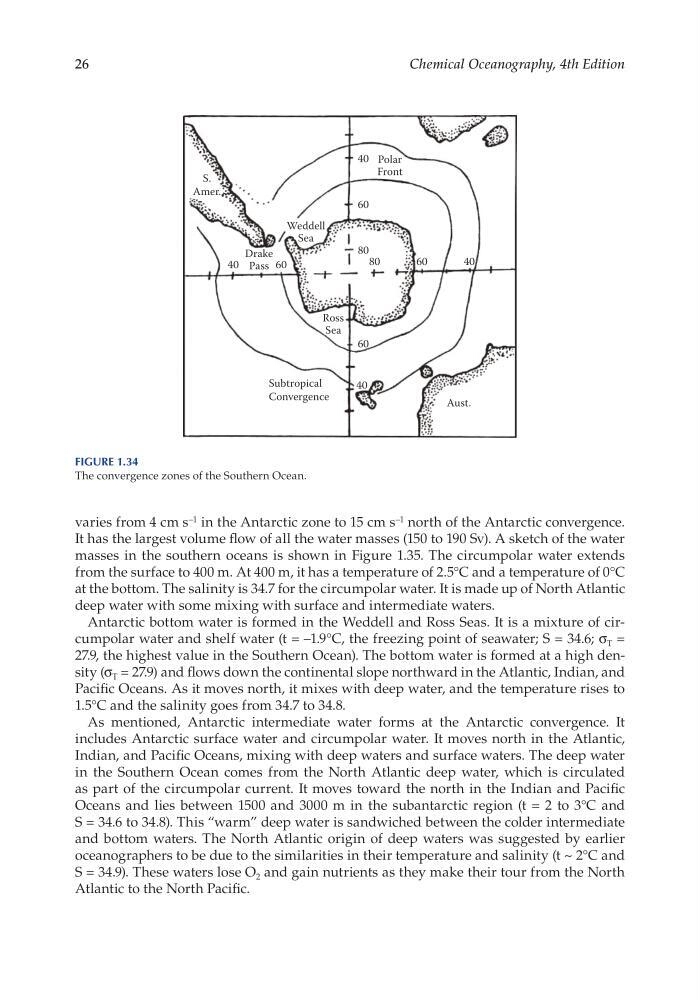
Figure 1.34
The convergence zones of the Southern Ocean.
Chemical Oceanography, 4th Edition
varies from 4 cm s –1 in the Antarctic zone to 15 cm s –1 north of the Antarctic convergence.
It has the largest volume flow of all the water masses (150 to 190 Sv). A sketch of the water
masses in the southern oceans is shown in Figure 1.35. The circumpolar water extends
from the surface to 400 m. At 400 m, it has a temperature of 2.5°C and a temperature of 0°C
at the bottom. The salinity is 34.7 for the circumpolar water. It is made up of North Atlantic
deep water with some mixing with surface and intermediate waters.
Antarctic bottom water is formed in the Weddell and Ross Seas. It is a mixture of circumpolar water and shelf water (t = –1.9°C, the freezing point of seawater; S = 34.6; σ T =
27.9, the highest value in the Southern Ocean). The bottom water is formed at a high density (σ T = 27.9) and flows down the continental slope northward in the Atlantic, Indian, and
Pacific Oceans. As it moves north, it mixes with deep water, and the temperature rises to
1.5°C and the salinity goes from 34.7 to 34.8.
As mentioned, Antarctic intermediate water forms at the Antarctic convergence. It
includes Antarctic surface water and circumpolar water. It moves north in the Atlantic,
Indian, and Pacific Oceans, mixing with deep waters and surface waters. The deep water
in the Southern Ocean comes from the North Atlantic deep water, which is circulated
as part of the circumpolar current. It moves toward the north in the Indian and Pacific
Oceans and lies between 1500 and 3000 m in the subantarctic region (t = 2 to 3°C and
S = 34.6 to 34.8). This “warm” deep water is sandwiched between the colder intermediate
and bottom waters. The North Atlantic origin of deep waters was suggested by earlier
oceanographers to be due to the similarities in their temperature and salinity (t ~ 2°C and
S = 34.9). These waters lose O 2 and gain nutrients as they make their tour from the North
Atlantic to the North Pacific.
40
60
80
60
40
Aust.
Subtropical
Convergence
S.
Amer.
80
60
60
Drake
Pass
Polar
Front
Weddell
Sea
Ross
Sea
40
40
Figure 1.34
The convergence zones of the Southern Ocean.