

25
Descriptive Oceanography
1.4.2 Southern Ocean Waters
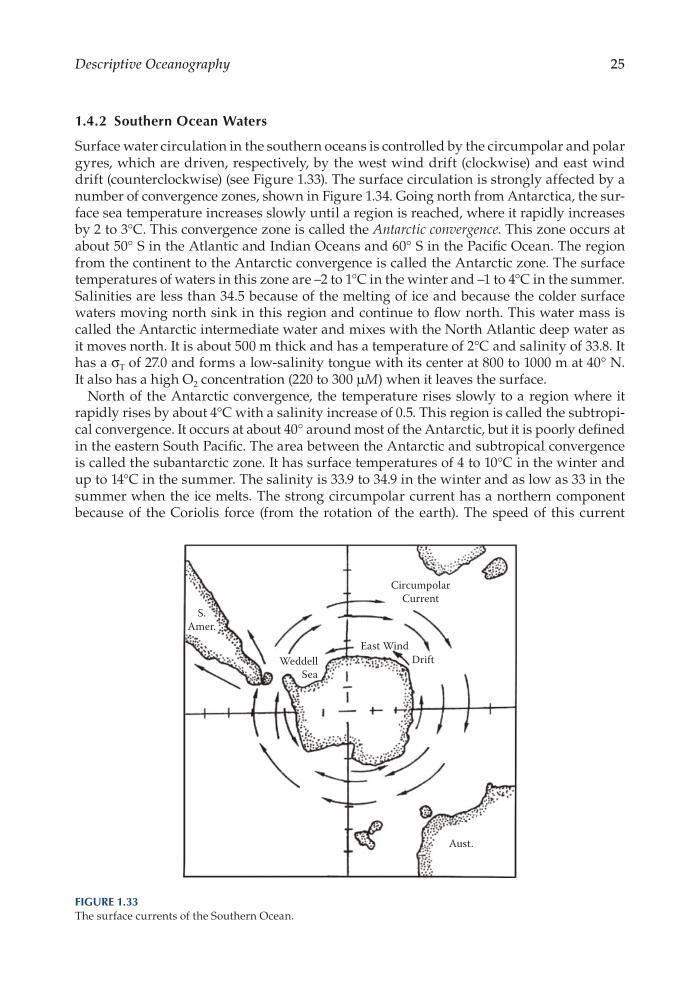
Surface water circulation in the southern oceans is controlled by the circumpolar and polar
gyres, which are driven, respectively, by the west wind drift (clockwise) and east wind
drift (counterclockwise) (see Figure 1.33). The surface circulation is strongly affected by a
number of convergence zones, shown in Figure 1.34. Going north from Antarctica, the surface sea temperature increases slowly until a region is reached, where it rapidly increases
by 2 to 3°C. This convergence zone is called the Antarctic convergence. This zone occurs at
about 50° S in the Atlantic and Indian Oceans and 60° S in the Pacific Ocean. The region
from the continent to the Antarctic convergence is called the Antarctic zone. The surface
temperatures of waters in this zone are –2 to 1°C in the winter and –1 to 4°C in the summer.
Salinities are less than 34.5 because of the melting of ice and because the colder surface
waters moving north sink in this region and continue to flow north. This water mass is
called the Antarctic intermediate water and mixes with the North Atlantic deep water as
it moves north. It is about 500 m thick and has a temperature of 2°C and salinity of 33.8. It
has a σ T of 27.0 and forms a low- salinity tongue with its center at 800 to 1000 m at 40° N.
It also has a high O 2 concentration (220 to 300 μM) when it leaves the surface.
North of the Antarctic convergence, the temperature rises slowly to a region where it
rapidly rises by about 4°C with a salinity increase of 0.5. This region is called the subtropical convergence. It occurs at about 40° around most of the Antarctic, but it is poorly defined
in the eastern South Pacific. The area between the Antarctic and subtropical convergence
is called the subantarctic zone. It has surface temperatures of 4 to 10°C in the winter and
up to 14°C in the summer. The salinity is 33.9 to 34.9 in the winter and as low as 33 in the
summer when the ice melts. The strong circumpolar current has a northern component
because of the Coriolis force (from the rotation of the earth). The speed of this current
Circumpolar
Current
Weddell
Sea
S.
Amer.
East Wind
Drift
Aust.
Figure 1.33
The surface currents of the Southern Ocean.
Descriptive Oceanography
1.4.2 Southern Ocean Waters
Surface water circulation in the southern oceans is controlled by the circumpolar and polar
gyres, which are driven, respectively, by the west wind drift (clockwise) and east wind
drift (counterclockwise) (see Figure 1.33). The surface circulation is strongly affected by a
number of convergence zones, shown in Figure 1.34. Going north from Antarctica, the surface sea temperature increases slowly until a region is reached, where it rapidly increases
by 2 to 3°C. This convergence zone is called the Antarctic convergence. This zone occurs at
about 50° S in the Atlantic and Indian Oceans and 60° S in the Pacific Ocean. The region
from the continent to the Antarctic convergence is called the Antarctic zone. The surface
temperatures of waters in this zone are –2 to 1°C in the winter and –1 to 4°C in the summer.
Salinities are less than 34.5 because of the melting of ice and because the colder surface
waters moving north sink in this region and continue to flow north. This water mass is
called the Antarctic intermediate water and mixes with the North Atlantic deep water as
it moves north. It is about 500 m thick and has a temperature of 2°C and salinity of 33.8. It
has a σ T of 27.0 and forms a low- salinity tongue with its center at 800 to 1000 m at 40° N.
It also has a high O 2 concentration (220 to 300 μM) when it leaves the surface.
North of the Antarctic convergence, the temperature rises slowly to a region where it
rapidly rises by about 4°C with a salinity increase of 0.5. This region is called the subtropical convergence. It occurs at about 40° around most of the Antarctic, but it is poorly defined
in the eastern South Pacific. The area between the Antarctic and subtropical convergence
is called the subantarctic zone. It has surface temperatures of 4 to 10°C in the winter and
up to 14°C in the summer. The salinity is 33.9 to 34.9 in the winter and as low as 33 in the
summer when the ice melts. The strong circumpolar current has a northern component
because of the Coriolis force (from the rotation of the earth). The speed of this current
Circumpolar
Current
Weddell
Sea
S.
Amer.
East Wind
Drift
Aust.
Figure 1.33
The surface currents of the Southern Ocean.