

445
Processes in the Oceans
H + causes the pH to decrease to values near 5.0. Slight increases of Fe 2+ , Mn 2+ , Ba 2+ , Al 3+ , and
Cu 2+ were also found. In the very- high- temperature measurements (water:rock ratio of 50:1
or 62:1), higher concentrations of trace metals were found.
The third source of evidence for hydrothermal fluxes comes from geochemical field measurements. This evidence includes finding altered basalts, sulfide deposits, and hydrothermal precipitates. The iron- and manganese- rich hydrothermal precipitates found by Bonatti
and Joensuu (1966) on active ridge systems were a strong indication that high- temperature
reactions were occurring. Earlier studies on Red Sea hot brines also demonstrated that
circulating seawater is heated by molten basalt.
The discovery of hot springs in the Galapagos and on the East Pacific rise demonstrated
that hydrothermal processes were occurring in the oceans. More recent studies of hydrothermal vents have been made in a number of sites (Figure 10.16). The Galapagos vent
CO 2
SiO 2
H 2 S
Black Smoke
Seawater
FeS, Mn 2+
Cations: Na
+ , Mg
2+
, Ca
2+
, K
+
Anions: Cl
– , SO 4
2– , HCO 3
–
Ca
2+
Traces : Fe
2+ , Mn
2+
H 2 S
H +
CaSO 4
SO 4
2–
FeS
FeOOH
CuS
MnO 2
Reactions on Route
Reactions on Route
Ca
2+ + SO 4
2–
SO 4
2–
SO 4
2– + 4H
+ + Fe 2 SiO 3
CaSO 4
Fe
2+ + H 2 S
FeS + H
+
Cu
2+ + H 2 S
CuS + H
+
At e Reaction Zone
H 2 S
HCO 3
–
CO 2
HCO 3
–
Mg
2+
Mg
2+ + Basalt + H 2 O
MgOHSiO 3 + H
+
H
+ + Basalt
Fe
2+ , Mn
2+ , Cu
2+ , Zn
2+
FeS 2 + 7Fe 2 O 3 + 2H 2 O
MgOHSiO 3
SiO 2 (quartz)
FeS 2 (pyrite)
Fe 2 O 3
SO 4
2–
SO 4
2–
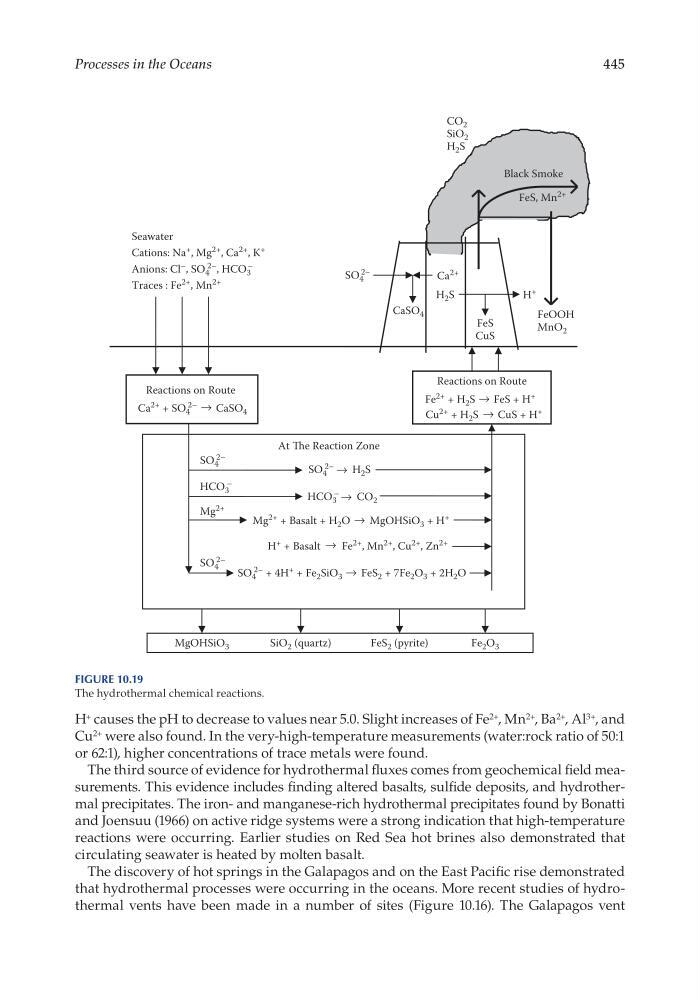
Figure 10.19
The hydrothermal chemical reactions.
Processes in the Oceans
H + causes the pH to decrease to values near 5.0. Slight increases of Fe 2+ , Mn 2+ , Ba 2+ , Al 3+ , and
Cu 2+ were also found. In the very- high- temperature measurements (water:rock ratio of 50:1
or 62:1), higher concentrations of trace metals were found.
The third source of evidence for hydrothermal fluxes comes from geochemical field measurements. This evidence includes finding altered basalts, sulfide deposits, and hydrothermal precipitates. The iron- and manganese- rich hydrothermal precipitates found by Bonatti
and Joensuu (1966) on active ridge systems were a strong indication that high- temperature
reactions were occurring. Earlier studies on Red Sea hot brines also demonstrated that
circulating seawater is heated by molten basalt.
The discovery of hot springs in the Galapagos and on the East Pacific rise demonstrated
that hydrothermal processes were occurring in the oceans. More recent studies of hydrothermal vents have been made in a number of sites (Figure 10.16). The Galapagos vent
CO 2
SiO 2
H 2 S
Black Smoke
Seawater
FeS, Mn 2+
Cations: Na
+ , Mg
2+
, Ca
2+
, K
+
Anions: Cl
– , SO 4
2– , HCO 3
–
Ca
2+
Traces : Fe
2+ , Mn
2+
H 2 S
H +
CaSO 4
SO 4
2–
FeS
FeOOH
CuS
MnO 2
Reactions on Route
Reactions on Route
Ca
2+ + SO 4
2–
SO 4
2–
SO 4
2– + 4H
+ + Fe 2 SiO 3
CaSO 4
Fe
2+ + H 2 S
FeS + H
+
Cu
2+ + H 2 S
CuS + H
+
At e Reaction Zone
H 2 S
HCO 3
–
CO 2
HCO 3
–
Mg
2+
Mg
2+ + Basalt + H 2 O
MgOHSiO 3 + H
+
H
+ + Basalt
Fe
2+ , Mn
2+ , Cu
2+ , Zn
2+
FeS 2 + 7Fe 2 O 3 + 2H 2 O
MgOHSiO 3
SiO 2 (quartz)
FeS 2 (pyrite)
Fe 2 O 3
SO 4
2–
SO 4
2–
Figure 10.19
The hydrothermal chemical reactions.