

444
Chemical Oceanography, 4th Edition
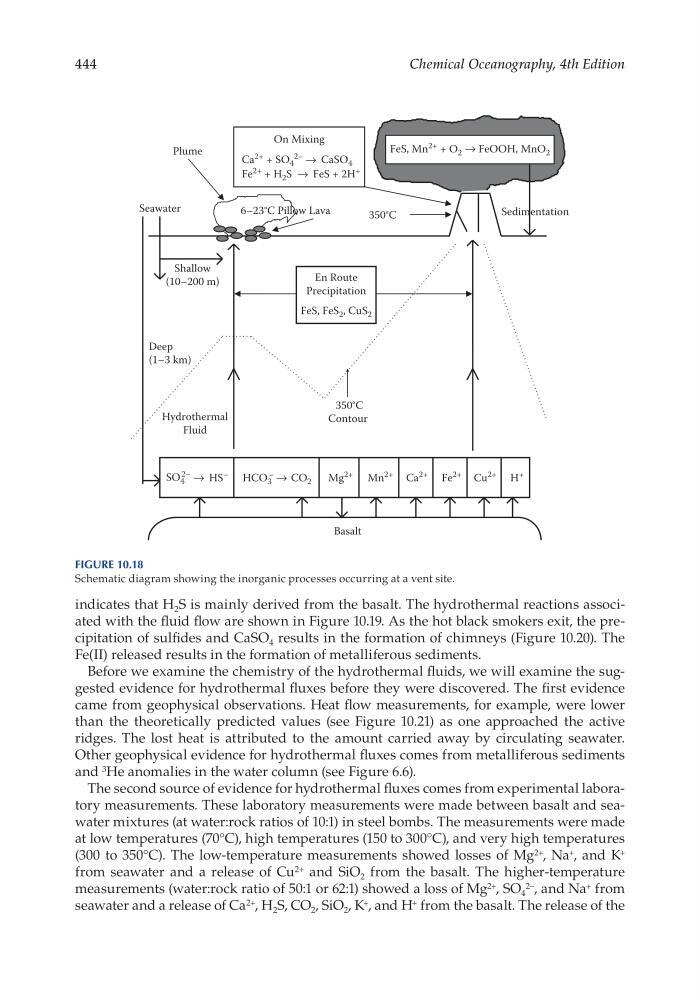
indicates that H 2 S is mainly derived from the basalt. The hydrothermal reactions associated with the fluid flow are shown in Figure 10.19. As the hot black smokers exit, the precipitation of sulfides and CaSO 4 results in the formation of chimneys (Figure 10.20). The
Fe(II) released results in the formation of metalliferous sediments.
Before we examine the chemistry of the hydrothermal fluids, we will examine the suggested evidence for hydrothermal fluxes before they were discovered. The first evidence
came from geophysical observations. Heat flow measurements, for example, were lower
than the theoretically predicted values (see Figure 10.21) as one approached the active
ridges. The lost heat is attributed to the amount carried away by circulating seawater.
Other geophysical evidence for hydrothermal fluxes comes from metalliferous sediments
and 3 He anomalies in the water column (see Figure 6.6).
The second source of evidence for hydrothermal fluxes comes from experimental laboratory measurements. These laboratory measurements were made between basalt and seawater mixtures (at water:rock ratios of 10:1) in steel bombs. The measurements were made
at low temperatures (70°C), high temperatures (150 to 300°C), and very high temperatures
(300 to 350°C). The low- temperature measurements showed losses of Mg 2+ , Na + , and K +
from seawater and a release of Cu 2+ and SiO 2 from the basalt. The higher- temperature
measurements (water:rock ratio of 50:1 or 62:1) showed a loss of Mg 2+ , SO 4
2– , and Na + from
seawater and a release of Ca 2+ , H 2 S, CO 2 , SiO 2 , K + , and H + from the basalt. The release of the
On Mixing
Plume
Ca 2+ + SO 4
2–
CaSO 4
Fe
2+ + H 2 S
FeS + 2H
+
FeS, Mn
2+ + O 2 FeOOH, MnO 2
Seawater
6–23°C Pillow Lava
350°C
Sedimentation
Shallow
(10–200 m)
En Route
Precipitation
FeS, FeS 2 , CuS 2
Deep
(1–3 km)
Hydrothermal
Fluid
350°C
Contour
SO 4
2–
HS
–
HCO 3
–
CO 2
Mg
2+
Mn
2+
Ca
2+
Fe
2+ Cu
2+
H
+
Basalt
Figure 10.18
Schematic diagram showing the inorganic processes occurring at a vent site.
Chemical Oceanography, 4th Edition
indicates that H 2 S is mainly derived from the basalt. The hydrothermal reactions associated with the fluid flow are shown in Figure 10.19. As the hot black smokers exit, the precipitation of sulfides and CaSO 4 results in the formation of chimneys (Figure 10.20). The
Fe(II) released results in the formation of metalliferous sediments.
Before we examine the chemistry of the hydrothermal fluids, we will examine the suggested evidence for hydrothermal fluxes before they were discovered. The first evidence
came from geophysical observations. Heat flow measurements, for example, were lower
than the theoretically predicted values (see Figure 10.21) as one approached the active
ridges. The lost heat is attributed to the amount carried away by circulating seawater.
Other geophysical evidence for hydrothermal fluxes comes from metalliferous sediments
and 3 He anomalies in the water column (see Figure 6.6).
The second source of evidence for hydrothermal fluxes comes from experimental laboratory measurements. These laboratory measurements were made between basalt and seawater mixtures (at water:rock ratios of 10:1) in steel bombs. The measurements were made
at low temperatures (70°C), high temperatures (150 to 300°C), and very high temperatures
(300 to 350°C). The low- temperature measurements showed losses of Mg 2+ , Na + , and K +
from seawater and a release of Cu 2+ and SiO 2 from the basalt. The higher- temperature
measurements (water:rock ratio of 50:1 or 62:1) showed a loss of Mg 2+ , SO 4
2– , and Na + from
seawater and a release of Ca 2+ , H 2 S, CO 2 , SiO 2 , K + , and H + from the basalt. The release of the
On Mixing
Plume
Ca 2+ + SO 4
2–
CaSO 4
Fe
2+ + H 2 S
FeS + 2H
+
FeS, Mn
2+ + O 2 FeOOH, MnO 2
Seawater
6–23°C Pillow Lava
350°C
Sedimentation
Shallow
(10–200 m)
En Route
Precipitation
FeS, FeS 2 , CuS 2
Deep
(1–3 km)
Hydrothermal
Fluid
350°C
Contour
SO 4
2–
HS
–
HCO 3
–
CO 2
Mg
2+
Mn
2+
Ca
2+
Fe
2+ Cu
2+
H
+
Basalt
Figure 10.18
Schematic diagram showing the inorganic processes occurring at a vent site.