

443
Processes in the Oceans
For oxygenic photoautolithotrophy, green plants:
hν
CO 2 + H 2 O → [CH 2 O] + O 2
(10.59)
For aerobic chemoautolithotrophy, bacteria:
CO 2 + H 2 S + O 2 + H 2 O → [CH 2 O] + H 2 SO 4
(10.60)
For anaerobic chemoautolithotrophy, bacteria:
2CO 2 + 6H 2 → [CH 2 O] + CH 4 + 3 H 2 O
(10.61)
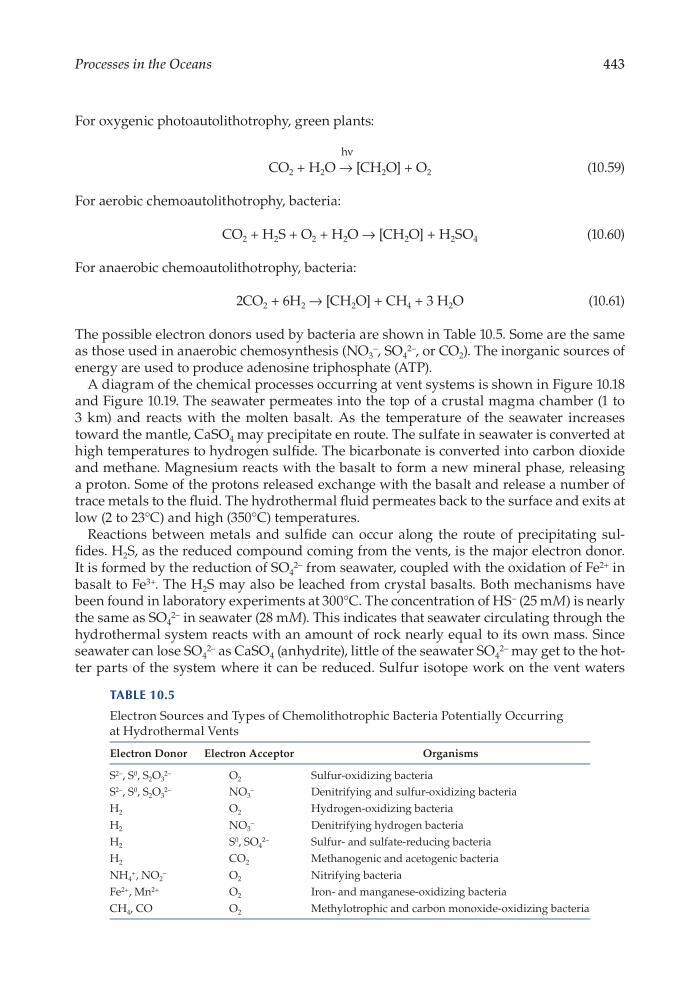
The possible electron donors used by bacteria are shown in Table 10.5. Some are the same
as those used in anaerobic chemosynthesis (NO 3
– , SO 4
2– , or CO 2 ). The inorganic sources of
energy are used to produce adenosine triphosphate (ATP).
A diagram of the chemical processes occurring at vent systems is shown in Figure 10.18
and Figure 10.19. The seawater permeates into the top of a crustal magma chamber (1 to
3 km) and reacts with the molten basalt. As the temperature of the seawater increases
toward the mantle, CaSO 4 may precipitate en route. The sulfate in seawater is converted at
high temperatures to hydrogen sulfide. The bicarbonate is converted into carbon dioxide
and methane. Magnesium reacts with the basalt to form a new mineral phase, releasing
a proton. Some of the protons released exchange with the basalt and release a number of
trace metals to the fluid. The hydrothermal fluid permeates back to the surface and exits at
low (2 to 23°C) and high (350°C) temperatures.
Reactions between metals and sulfide can occur along the route of precipitating sulfides. H 2 S, as the reduced compound coming from the vents, is the major electron donor.
It is formed by the reduction of SO 4
2– from seawater, coupled with the oxidation of Fe 2+ in
basalt to Fe 3+ . The H 2 S may also be leached from crystal basalts. Both mechanisms have
been found in laboratory experiments at 300°C. The concentration of HS – (25 mM) is nearly
the same as SO 4
2– in seawater (28 mM). This indicates that seawater circulating through the
hydrothermal system reacts with an amount of rock nearly equal to its own mass. Since
seawater can lose SO 4
2– as CaSO 4 (anhydrite), little of the seawater SO 4
2– may get to the hotter parts of the system where it can be reduced. Sulfur isotope work on the vent waters
Table 10.5
Electron Sources and Types of Chemolithotrophic Bacteria Potentially Occurring
at Hydrothermal Vents
Electron Donor
Electron Acceptor
Organisms
S 2– , S 0 , S 2 O 3
2–
O 2
Sulfur- oxidizing bacteria
S 2– , S 0 , S 2 O 3
2–
NO 3
–
Denitrifying and sulfur- oxidizing bacteria
H 2
O 2
Hydrogen- oxidizing bacteria
H 2
NO 3
–
Denitrifying hydrogen bacteria
H 2
S 0 , SO 4
2–
Sulfur- and sulfate- reducing bacteria
H 2
CO 2
Methanogenic and acetogenic bacteria
NH 4
+ , NO 2
–
O 2
Nitrifying bacteria
Fe 2+ , Mn 2+
O 2
Iron- and manganese- oxidizing bacteria
CH 4 , CO
O 2
Methylotrophic and carbon monoxide- oxidizing bacteria
Processes in the Oceans
For oxygenic photoautolithotrophy, green plants:
hν
CO 2 + H 2 O → [CH 2 O] + O 2
(10.59)
For aerobic chemoautolithotrophy, bacteria:
CO 2 + H 2 S + O 2 + H 2 O → [CH 2 O] + H 2 SO 4
(10.60)
For anaerobic chemoautolithotrophy, bacteria:
2CO 2 + 6H 2 → [CH 2 O] + CH 4 + 3 H 2 O
(10.61)
The possible electron donors used by bacteria are shown in Table 10.5. Some are the same
as those used in anaerobic chemosynthesis (NO 3
– , SO 4
2– , or CO 2 ). The inorganic sources of
energy are used to produce adenosine triphosphate (ATP).
A diagram of the chemical processes occurring at vent systems is shown in Figure 10.18
and Figure 10.19. The seawater permeates into the top of a crustal magma chamber (1 to
3 km) and reacts with the molten basalt. As the temperature of the seawater increases
toward the mantle, CaSO 4 may precipitate en route. The sulfate in seawater is converted at
high temperatures to hydrogen sulfide. The bicarbonate is converted into carbon dioxide
and methane. Magnesium reacts with the basalt to form a new mineral phase, releasing
a proton. Some of the protons released exchange with the basalt and release a number of
trace metals to the fluid. The hydrothermal fluid permeates back to the surface and exits at
low (2 to 23°C) and high (350°C) temperatures.
Reactions between metals and sulfide can occur along the route of precipitating sulfides. H 2 S, as the reduced compound coming from the vents, is the major electron donor.
It is formed by the reduction of SO 4
2– from seawater, coupled with the oxidation of Fe 2+ in
basalt to Fe 3+ . The H 2 S may also be leached from crystal basalts. Both mechanisms have
been found in laboratory experiments at 300°C. The concentration of HS – (25 mM) is nearly
the same as SO 4
2– in seawater (28 mM). This indicates that seawater circulating through the
hydrothermal system reacts with an amount of rock nearly equal to its own mass. Since
seawater can lose SO 4
2– as CaSO 4 (anhydrite), little of the seawater SO 4
2– may get to the hotter parts of the system where it can be reduced. Sulfur isotope work on the vent waters
Table 10.5
Electron Sources and Types of Chemolithotrophic Bacteria Potentially Occurring
at Hydrothermal Vents
Electron Donor
Electron Acceptor
Organisms
S 2– , S 0 , S 2 O 3
2–
O 2
Sulfur- oxidizing bacteria
S 2– , S 0 , S 2 O 3
2–
NO 3
–
Denitrifying and sulfur- oxidizing bacteria
H 2
O 2
Hydrogen- oxidizing bacteria
H 2
NO 3
–
Denitrifying hydrogen bacteria
H 2
S 0 , SO 4
2–
Sulfur- and sulfate- reducing bacteria
H 2
CO 2
Methanogenic and acetogenic bacteria
NH 4
+ , NO 2
–
O 2
Nitrifying bacteria
Fe 2+ , Mn 2+
O 2
Iron- and manganese- oxidizing bacteria
CH 4 , CO
O 2
Methylotrophic and carbon monoxide- oxidizing bacteria