

446
Chemical Oceanography, 4th Edition
studies showed a linear increase of SiO 2 with temperature (Figure 10.22). As the SiO 2
increases, the Mg 2+ decreases (Figure 10.23). The Mg 2+ concentration is inversely proportional to the temperature (Figure 10.24). This has led to the use of Mg 2+ as a measure of the
mixing of the hot hydrothermal fluids with seawater. The concentrations of Li + , K + , and Rb +
coming from the Galapagos vents are shown in Figure 10.25 to Figure 10.27, respectively.
FeS, ZnS, CuS
350°C
Hydrothermal
solution
SO 4
–2
SO 4
–2
Ca
Anhydrite
Seawater
Seawater
Black smoke (FeS)
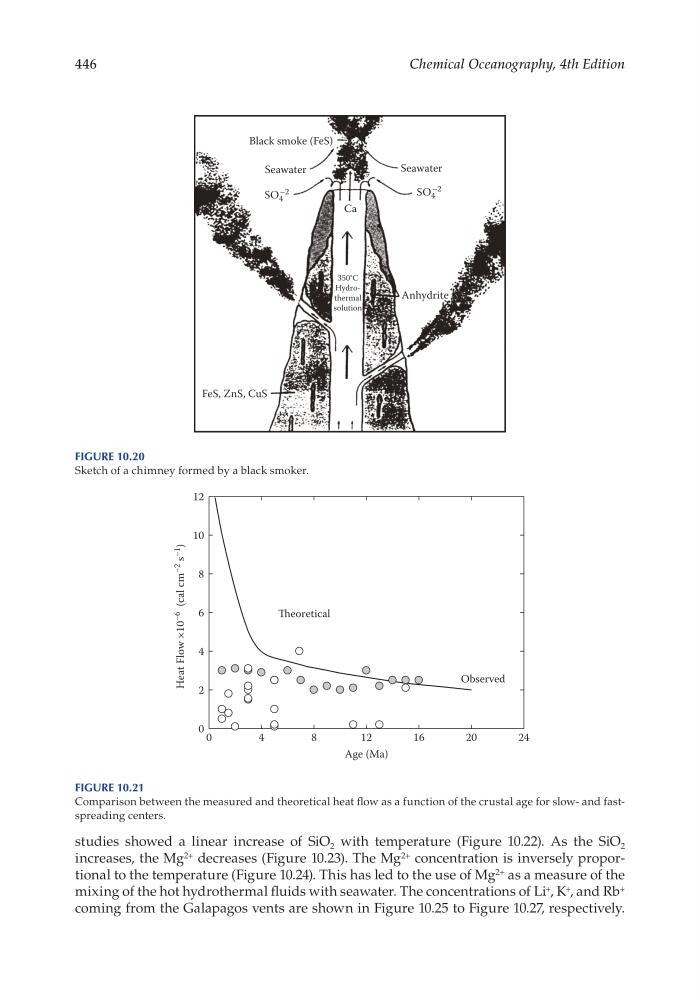
Figure 10.20
Sketch of a chimney formed by a black smoker.
Age (Ma)
0
4
8
12
16
20
24
Heat Flow ×10
–6
(cal cm
–2
s
–1
)
0
2
4
6
8
10
12
eoretical
Observed
Figure 10.21
Comparison between the measured and theoretical heat flow as a function of the crustal age for slow- and fastspreading centers.
Chemical Oceanography, 4th Edition
studies showed a linear increase of SiO 2 with temperature (Figure 10.22). As the SiO 2
increases, the Mg 2+ decreases (Figure 10.23). The Mg 2+ concentration is inversely proportional to the temperature (Figure 10.24). This has led to the use of Mg 2+ as a measure of the
mixing of the hot hydrothermal fluids with seawater. The concentrations of Li + , K + , and Rb +
coming from the Galapagos vents are shown in Figure 10.25 to Figure 10.27, respectively.
FeS, ZnS, CuS
350°C
Hydrothermal
solution
SO 4
–2
SO 4
–2
Ca
Anhydrite
Seawater
Seawater
Black smoke (FeS)
Figure 10.20
Sketch of a chimney formed by a black smoker.
Age (Ma)
0
4
8
12
16
20
24
Heat Flow ×10
–6
(cal cm
–2
s
–1
)
0
2
4
6
8
10
12
eoretical
Observed
Figure 10.21
Comparison between the measured and theoretical heat flow as a function of the crustal age for slow- and fastspreading centers.