

440
Chemical Oceanography, 4th Edition
Mopper and Zhou (1990) measured the production and steady- state concentrations of •OH
in sunlight- irradiated seawater. They determined the •OH radical by reaction with methanol:
CH 3 OH + •OH → CH 2 OH + H 2 O
(10.53)
CH 2 OH + O 2 → CH 2 O + HO 2
(10.54)
and the reaction with aromatic ring Ar of benzoic acid:
H- Ar + •OH → H- Ar- OH
(10.55)
H- Ar- OH + O 2 → HO- Ar + HO 2
(10.56)
The products (formaldehyde) from the reaction are determined using high- performance
liquid chromatography (HPLC) techniques.
The possible sources of the •OH radical in seawater are NO 3
– , NO 2
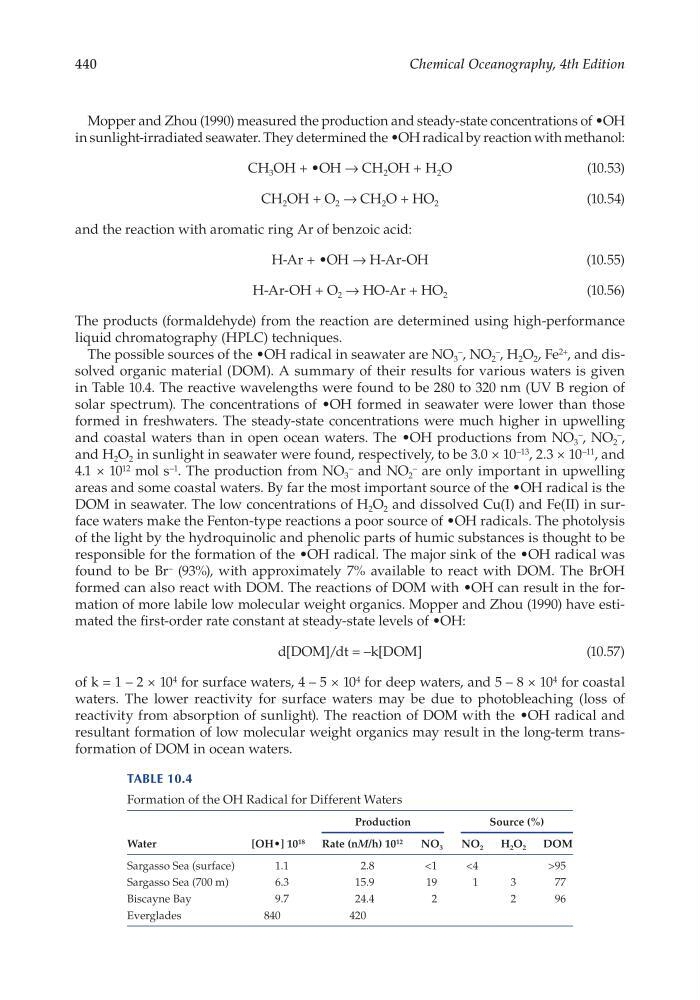
– , H 2 O 2 , Fe 2+ , and dissolved organic material (DOM). A summary of their results for various waters is given
in Table 10.4. The reactive wavelengths were found to be 280 to 320 nm (UV B region of
solar spectrum). The concentrations of •OH formed in seawater were lower than those
formed in freshwaters. The steady- state concentrations were much higher in upwelling
and coastal waters than in open ocean waters. The •OH productions from NO 3
– , NO 2
– ,
and H 2 O 2 in sunlight in seawater were found, respectively, to be 3.0 × 10 –13 , 2.3 × 10 –11 , and
4.1 × 10 12 mol s –1 . The production from NO 3
– and NO 2
– are only important in upwelling
areas and some coastal waters. By far the most important source of the •OH radical is the
DOM in seawater. The low concentrations of H 2 O 2 and dissolved Cu(I) and Fe(II) in surface waters make the Fenton- type reactions a poor source of •OH radicals. The photolysis
of the light by the hydroquinolic and phenolic parts of humic substances is thought to be
responsible for the formation of the •OH radical. The major sink of the •OH radical was
found to be Br – (93%), with approximately 7% available to react with DOM. The BrOH
formed can also react with DOM. The reactions of DOM with •OH can result in the formation of more labile low molecular weight organics. Mopper and Zhou (1990) have estimated the first- order rate constant at steady- state levels of •OH:
d[DOM]/dt = –k[DOM]
(10.57)
of k = 1 – 2 × 10 4 for surface waters, 4 – 5 × 10 4 for deep waters, and 5 – 8 × 10 4 for coastal
waters. The lower reactivity for surface waters may be due to photobleaching (loss of
reactivity from absorption of sunlight). The reaction of DOM with the •OH radical and
resultant formation of low molecular weight organics may result in the long- term transformation of DOM in ocean waters.
Table 10.4
Formation of the OH Radical for Different Waters
Water
[OH•] 10 18
Production
Source (%)
Rate (nM/ h) 10 12
NO 3
NO 2
H 2 O 2
DOM
Sargasso Sea (surface)
1.1
2.8
<1
<4
>95
Sargasso Sea (700 m)
6.3
15.9
19
1
3
77
Biscayne Bay
9.7
24.4
2
2
96
Everglades
840
420
Chemical Oceanography, 4th Edition
Mopper and Zhou (1990) measured the production and steady- state concentrations of •OH
in sunlight- irradiated seawater. They determined the •OH radical by reaction with methanol:
CH 3 OH + •OH → CH 2 OH + H 2 O
(10.53)
CH 2 OH + O 2 → CH 2 O + HO 2
(10.54)
and the reaction with aromatic ring Ar of benzoic acid:
H- Ar + •OH → H- Ar- OH
(10.55)
H- Ar- OH + O 2 → HO- Ar + HO 2
(10.56)
The products (formaldehyde) from the reaction are determined using high- performance
liquid chromatography (HPLC) techniques.
The possible sources of the •OH radical in seawater are NO 3
– , NO 2
– , H 2 O 2 , Fe 2+ , and dissolved organic material (DOM). A summary of their results for various waters is given
in Table 10.4. The reactive wavelengths were found to be 280 to 320 nm (UV B region of
solar spectrum). The concentrations of •OH formed in seawater were lower than those
formed in freshwaters. The steady- state concentrations were much higher in upwelling
and coastal waters than in open ocean waters. The •OH productions from NO 3
– , NO 2
– ,
and H 2 O 2 in sunlight in seawater were found, respectively, to be 3.0 × 10 –13 , 2.3 × 10 –11 , and
4.1 × 10 12 mol s –1 . The production from NO 3
– and NO 2
– are only important in upwelling
areas and some coastal waters. By far the most important source of the •OH radical is the
DOM in seawater. The low concentrations of H 2 O 2 and dissolved Cu(I) and Fe(II) in surface waters make the Fenton- type reactions a poor source of •OH radicals. The photolysis
of the light by the hydroquinolic and phenolic parts of humic substances is thought to be
responsible for the formation of the •OH radical. The major sink of the •OH radical was
found to be Br – (93%), with approximately 7% available to react with DOM. The BrOH
formed can also react with DOM. The reactions of DOM with •OH can result in the formation of more labile low molecular weight organics. Mopper and Zhou (1990) have estimated the first- order rate constant at steady- state levels of •OH:
d[DOM]/dt = –k[DOM]
(10.57)
of k = 1 – 2 × 10 4 for surface waters, 4 – 5 × 10 4 for deep waters, and 5 – 8 × 10 4 for coastal
waters. The lower reactivity for surface waters may be due to photobleaching (loss of
reactivity from absorption of sunlight). The reaction of DOM with the •OH radical and
resultant formation of low molecular weight organics may result in the long- term transformation of DOM in ocean waters.
Table 10.4
Formation of the OH Radical for Different Waters
Water
[OH•] 10 18
Production
Source (%)
Rate (nM/ h) 10 12
NO 3
NO 2
H 2 O 2
DOM
Sargasso Sea (surface)
1.1
2.8
<1
<4
>95
Sargasso Sea (700 m)
6.3
15.9
19
1
3
77
Biscayne Bay
9.7
24.4
2
2
96
Everglades
840
420