

441
Processes in the Oceans
10.2
Hydrothermal Vent Chemistry
In April 1979, scientists aboard the submersible Alvin discovered hot springs coming from
the seafloor in areas of active volcanism near the Galapagos Islands. The area around
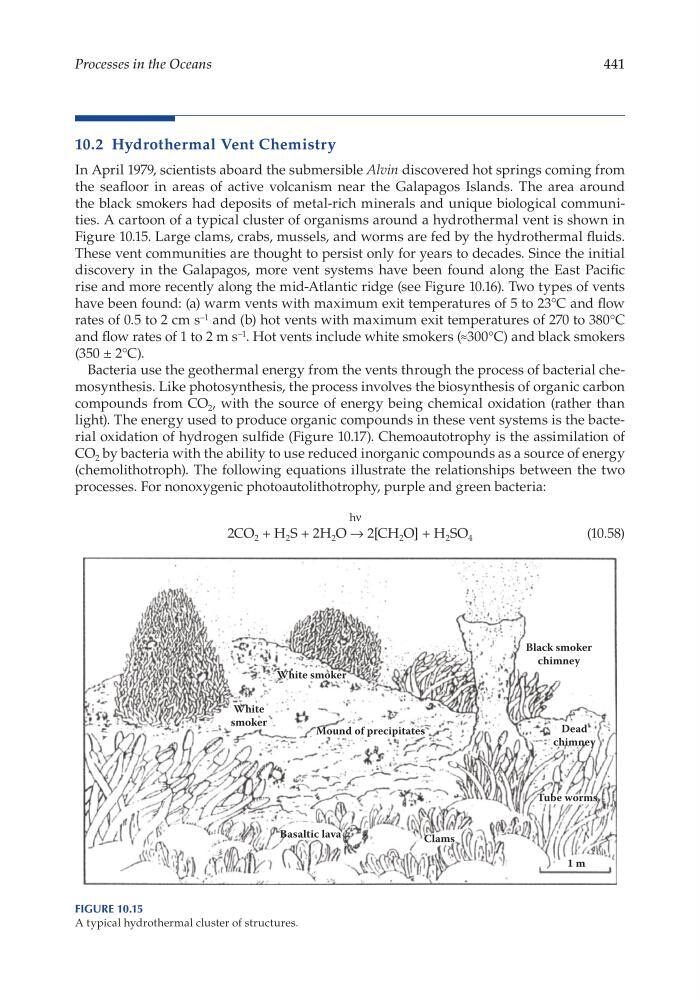
the black smokers had deposits of metal- rich minerals and unique biological communities. A cartoon of a typical cluster of organisms around a hydrothermal vent is shown in
Figure 10.15. Large clams, crabs, mussels, and worms are fed by the hydrothermal fluids.
These vent communities are thought to persist only for years to decades. Since the initial
discovery in the Galapagos, more vent systems have been found along the East Pacific
rise and more recently along the mid- Atlantic ridge (see Figure 10.16). Two types of vents
have been found: (a) warm vents with maximum exit temperatures of 5 to 23°C and flow
rates of 0.5 to 2 cm s –1 and (b) hot vents with maximum exit temperatures of 270 to 380°C
and flow rates of 1 to 2 m s –1 . Hot vents include white smokers (≈300°C) and black smokers
(350 ± 2°C).
Bacteria use the geothermal energy from the vents through the process of bacterial chemosynthesis. Like photosynthesis, the process involves the biosynthesis of organic carbon
compounds from CO 2 , with the source of energy being chemical oxidation (rather than
light). The energy used to produce organic compounds in these vent systems is the bacterial oxidation of hydrogen sulfide (Figure 10.17). Chemoautotrophy is the assimilation of
CO 2 by bacteria with the ability to use reduced inorganic compounds as a source of energy
(chemolithotroph). The following equations illustrate the relationships between the two
processes. For nonoxygenic photoautolithotrophy, purple and green bacteria:
hν
2CO 2 + H 2 S + 2H 2 O → 2[CH 2 O] + H 2 SO 4
(10.58)
1 m
Black smoker
chimney
Dead
chimney
White smoker
White
smoker
Mound of precipitates
Basaltic lava
Clams
Tube worms
Figure 10.15
A typical hydrothermal cluster of structures.
Processes in the Oceans
10.2
Hydrothermal Vent Chemistry
In April 1979, scientists aboard the submersible Alvin discovered hot springs coming from
the seafloor in areas of active volcanism near the Galapagos Islands. The area around
the black smokers had deposits of metal- rich minerals and unique biological communities. A cartoon of a typical cluster of organisms around a hydrothermal vent is shown in
Figure 10.15. Large clams, crabs, mussels, and worms are fed by the hydrothermal fluids.
These vent communities are thought to persist only for years to decades. Since the initial
discovery in the Galapagos, more vent systems have been found along the East Pacific
rise and more recently along the mid- Atlantic ridge (see Figure 10.16). Two types of vents
have been found: (a) warm vents with maximum exit temperatures of 5 to 23°C and flow
rates of 0.5 to 2 cm s –1 and (b) hot vents with maximum exit temperatures of 270 to 380°C
and flow rates of 1 to 2 m s –1 . Hot vents include white smokers (≈300°C) and black smokers
(350 ± 2°C).
Bacteria use the geothermal energy from the vents through the process of bacterial chemosynthesis. Like photosynthesis, the process involves the biosynthesis of organic carbon
compounds from CO 2 , with the source of energy being chemical oxidation (rather than
light). The energy used to produce organic compounds in these vent systems is the bacterial oxidation of hydrogen sulfide (Figure 10.17). Chemoautotrophy is the assimilation of
CO 2 by bacteria with the ability to use reduced inorganic compounds as a source of energy
(chemolithotroph). The following equations illustrate the relationships between the two
processes. For nonoxygenic photoautolithotrophy, purple and green bacteria:
hν
2CO 2 + H 2 S + 2H 2 O → 2[CH 2 O] + H 2 SO 4
(10.58)
1 m
Black smoker
chimney
Dead
chimney
White smoker
White
smoker
Mound of precipitates
Basaltic lava
Clams
Tube worms
Figure 10.15
A typical hydrothermal cluster of structures.