

439
Processes in the Oceans
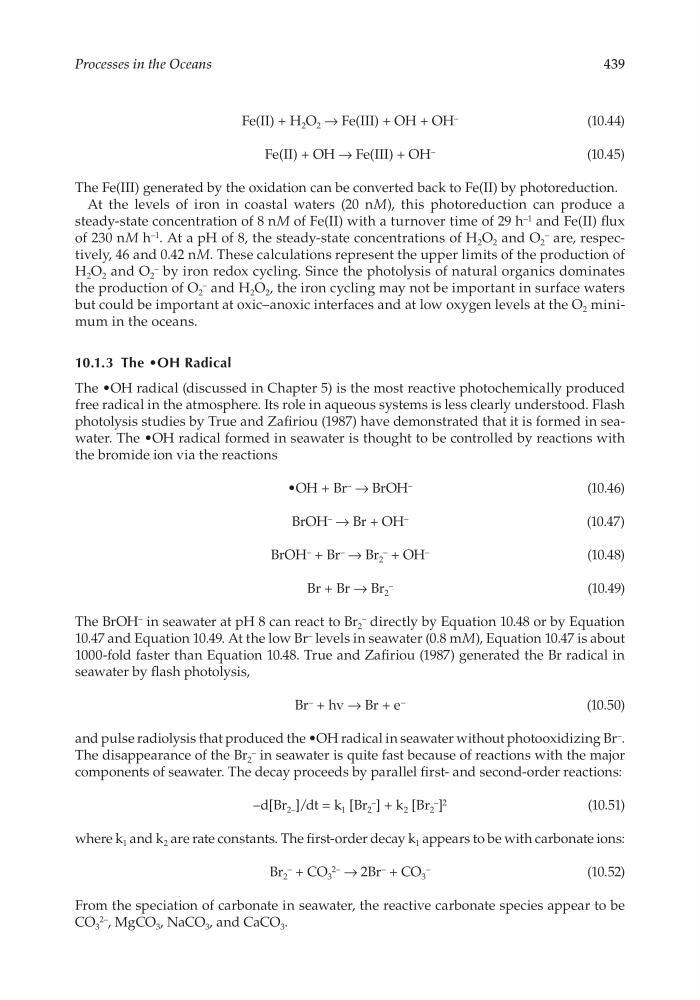
Fe(II) + H 2 O 2 → Fe(III) + OH + OH –
(10.44)
Fe(II) + OH → Fe(III) + OH –
(10.45)
The Fe(III) generated by the oxidation can be converted back to Fe(II) by photoreduction.
At the levels of iron in coastal waters (20 nM), this photoreduction can produce a
steady- state concentration of 8 nM of Fe(II) with a turnover time of 29 h –1 and Fe(II) flux
of 230 nM h –1 . At a pH of 8, the steady- state concentrations of H 2 O 2 and O 2
– are, respectively, 46 and 0.42 nM. These calculations represent the upper limits of the production of
H 2 O 2 and O 2
– by iron redox cycling. Since the photolysis of natural organics dominates
the production of O 2
– and H 2 O 2 , the iron cycling may not be important in surface waters
but could be important at oxic–anoxic interfaces and at low oxygen levels at the O 2 minimum in the oceans.
10.1.3 The •OH radical
The •OH radical (discussed in Chapter 5) is the most reactive photochemically produced
free radical in the atmosphere. Its role in aqueous systems is less clearly understood. Flash
photolysis studies by True and Zafiriou (1987) have demonstrated that it is formed in seawater. The •OH radical formed in seawater is thought to be controlled by reactions with
the bromide ion via the reactions
•OH + Br – → BrOH –
(10.46)
BrOH – → Br + OH –
(10.47)
BrOH – + Br – → Br 2
– + OH –
(10.48)
Br + Br → Br 2
–
(10.49)
The BrOH – in seawater at pH 8 can react to Br 2
– directly by Equation 10.48 or by Equation
10.47 and Equation 10.49. At the low Br – levels in seawater (0.8 mM), Equation 10.47 is about
1000-fold faster than Equation 10.48. True and Zafiriou (1987) generated the Br radical in
seawater by flash photolysis,
Br – + hv → Br + e –
(10.50)
and pulse radiolysis that produced the •OH radical in seawater without photooxidizing Br – .
The disappearance of the Br 2
– in seawater is quite fast because of reactions with the major
components of seawater. The decay proceeds by parallel first- and second- order reactions:
–d[Br 2– ]/dt = k 1 [Br 2
– ] + k 2 [Br 2
– ] 2
(10.51)
where k 1 and k 2 are rate constants. The first- order decay k 1 appears to be with carbonate ions:
Br 2
– + CO 3
2– → 2Br – + CO 3
–
(10.52)
From the speciation of carbonate in seawater, the reactive carbonate species appear to be
CO 3
2– , MgCO 3 , NaCO 3 , and CaCO 3 .
Processes in the Oceans
Fe(II) + H 2 O 2 → Fe(III) + OH + OH –
(10.44)
Fe(II) + OH → Fe(III) + OH –
(10.45)
The Fe(III) generated by the oxidation can be converted back to Fe(II) by photoreduction.
At the levels of iron in coastal waters (20 nM), this photoreduction can produce a
steady- state concentration of 8 nM of Fe(II) with a turnover time of 29 h –1 and Fe(II) flux
of 230 nM h –1 . At a pH of 8, the steady- state concentrations of H 2 O 2 and O 2
– are, respectively, 46 and 0.42 nM. These calculations represent the upper limits of the production of
H 2 O 2 and O 2
– by iron redox cycling. Since the photolysis of natural organics dominates
the production of O 2
– and H 2 O 2 , the iron cycling may not be important in surface waters
but could be important at oxic–anoxic interfaces and at low oxygen levels at the O 2 minimum in the oceans.
10.1.3 The •OH radical
The •OH radical (discussed in Chapter 5) is the most reactive photochemically produced
free radical in the atmosphere. Its role in aqueous systems is less clearly understood. Flash
photolysis studies by True and Zafiriou (1987) have demonstrated that it is formed in seawater. The •OH radical formed in seawater is thought to be controlled by reactions with
the bromide ion via the reactions
•OH + Br – → BrOH –
(10.46)
BrOH – → Br + OH –
(10.47)
BrOH – + Br – → Br 2
– + OH –
(10.48)
Br + Br → Br 2
–
(10.49)
The BrOH – in seawater at pH 8 can react to Br 2
– directly by Equation 10.48 or by Equation
10.47 and Equation 10.49. At the low Br – levels in seawater (0.8 mM), Equation 10.47 is about
1000-fold faster than Equation 10.48. True and Zafiriou (1987) generated the Br radical in
seawater by flash photolysis,
Br – + hv → Br + e –
(10.50)
and pulse radiolysis that produced the •OH radical in seawater without photooxidizing Br – .
The disappearance of the Br 2
– in seawater is quite fast because of reactions with the major
components of seawater. The decay proceeds by parallel first- and second- order reactions:
–d[Br 2– ]/dt = k 1 [Br 2
– ] + k 2 [Br 2
– ] 2
(10.51)
where k 1 and k 2 are rate constants. The first- order decay k 1 appears to be with carbonate ions:
Br 2
– + CO 3
2– → 2Br – + CO 3
–
(10.52)
From the speciation of carbonate in seawater, the reactive carbonate species appear to be
CO 3
2– , MgCO 3 , NaCO 3 , and CaCO 3 .