

438
Chemical Oceanography, 4th Edition
some waters the uncatalyzed dismutation may not be the major reactant of O 2
– . Reactions
of O 2
– with metals (Cu 2+ ) and organic compounds such as superoxide dismutases released
by biota may also be an important sink in surface waters. This anion is a strong reductant
and can result in the formation of reduced metals:
Fe 3+ + O 2
– → Fe 2+ + O 2
(10.37)
Cu 2+ + O 2
– → Cu + + O 2
(10.38)
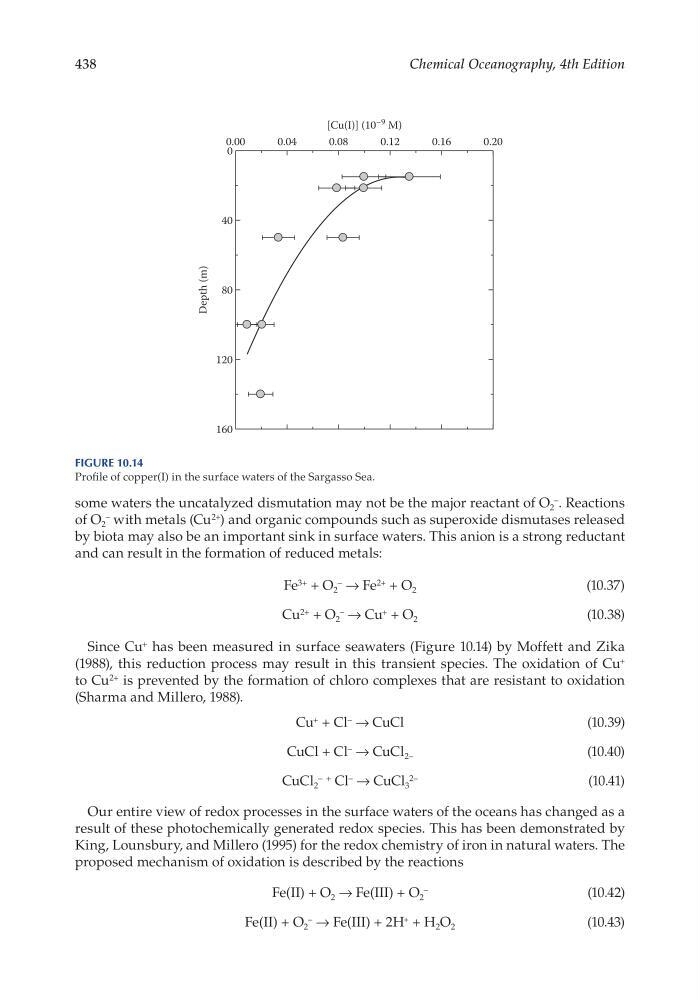
Since Cu + has been measured in surface seawaters (Figure 10.14) by Moffett and Zika
(1988), this reduction process may result in this transient species. The oxidation of Cu +
to Cu 2+ is prevented by the formation of chloro complexes that are resistant to oxidation
(Sharma and Millero, 1988).
Cu + + Cl – → CuCl
(10.39)
CuCl + Cl – → CuCl 2–
(10.40)
CuCl 2
– + Cl – → CuCl 3
2–
(10.41)
Our entire view of redox processes in the surface waters of the oceans has changed as a
result of these photochemically generated redox species. This has been demonstrated by
King, Lounsbury, and Millero (1995) for the redox chemistry of iron in natural waters. The
proposed mechanism of oxidation is described by the reactions
Fe(II) + O 2 → Fe(III) + O 2
–
(10.42)
Fe(II) + O 2
– → Fe(III) + 2H + + H 2 O 2
(10.43)
[Cu(I)] (10
–9 M)
0.00
0.04
0.08
0.12
0.16
0.20
Depth (m)
0
40
80
120
160
Figure 10.14
Profile of copper(I) in the surface waters of the Sargasso Sea.
Chemical Oceanography, 4th Edition
some waters the uncatalyzed dismutation may not be the major reactant of O 2
– . Reactions
of O 2
– with metals (Cu 2+ ) and organic compounds such as superoxide dismutases released
by biota may also be an important sink in surface waters. This anion is a strong reductant
and can result in the formation of reduced metals:
Fe 3+ + O 2
– → Fe 2+ + O 2
(10.37)
Cu 2+ + O 2
– → Cu + + O 2
(10.38)
Since Cu + has been measured in surface seawaters (Figure 10.14) by Moffett and Zika
(1988), this reduction process may result in this transient species. The oxidation of Cu +
to Cu 2+ is prevented by the formation of chloro complexes that are resistant to oxidation
(Sharma and Millero, 1988).
Cu + + Cl – → CuCl
(10.39)
CuCl + Cl – → CuCl 2–
(10.40)
CuCl 2
– + Cl – → CuCl 3
2–
(10.41)
Our entire view of redox processes in the surface waters of the oceans has changed as a
result of these photochemically generated redox species. This has been demonstrated by
King, Lounsbury, and Millero (1995) for the redox chemistry of iron in natural waters. The
proposed mechanism of oxidation is described by the reactions
Fe(II) + O 2 → Fe(III) + O 2
–
(10.42)
Fe(II) + O 2
– → Fe(III) + 2H + + H 2 O 2
(10.43)
[Cu(I)] (10
–9 M)
0.00
0.04
0.08
0.12
0.16
0.20
Depth (m)
0
40
80
120
160
Figure 10.14
Profile of copper(I) in the surface waters of the Sargasso Sea.