

437
Processes in the Oceans
is an acid and can dissociate to H + and O 2
– with a pK of 4.8 in pure water. The disproportionation reaction can take place by
HO 2 + HO 2 → H 2 O 2 + O 2
(10.33)
HO 2 + O 2
– + H 2 O → H 2 O 2+ O 2 + OH –
(10.34)
The second- order rate equation for these reactions is given by
–d[HO 2 ]/dt = k 2 [HO 2 ] T
(10.35)
where [HO 2 ] T is the total concentration of superoxide, and k 2 is the second- order rate constant. At a low pH, Reaction 10.33 is important, and above a pH of 6, Reaction 10.34 dominates (Millero, 1987). The second- order rate constant dominates over the pH range of most
natural waters (7 to 9); the values of k 2 in water can be estimated from log k 2 = 12.68 – 1.0
pH. The half- time for the disappearance of HO 2 is given by
t 1/2 = 1/2k 2 [HO 2 ] T
(10.36)
At a pH of 8 and a level of [HO 2 ] T = 100 nM (the levels of H 2 O 2 in surface waters), the
lifetime of O 2
– in water should be about 100 s—if it decays only to form H 2 O 2 . The lifetimes
of O 2
– in seawater based on measurements in sea salts (at high concentrations of O 2
– ) were
thought to be higher (three to five times longer) because of the formation of MgO 2
+ and
CaO 2
+ complexes. However, measurements made by Zafiriou (1990) indicated that the rate
and lifetimes in seawater are the same order as in pure water. These differences may be
related to the higher levels of O 2
– used in the earlier experiments analyzed by Millero.
These lifetimes are long enough to make O 2
– an important reductant and oxidant in surface waters of the oceans. Measured formation rates of O 2
– in natural seawater by Petasne
and Zika (1988) suggested that about 40% of the loss is from a second pathway. Thus, in
Time (h)
0
20
40
60
80
100
[H
2 O
2 ] (10
–6
M)
0.0
0.4
0.8
1.2
Straight
Autoclaved
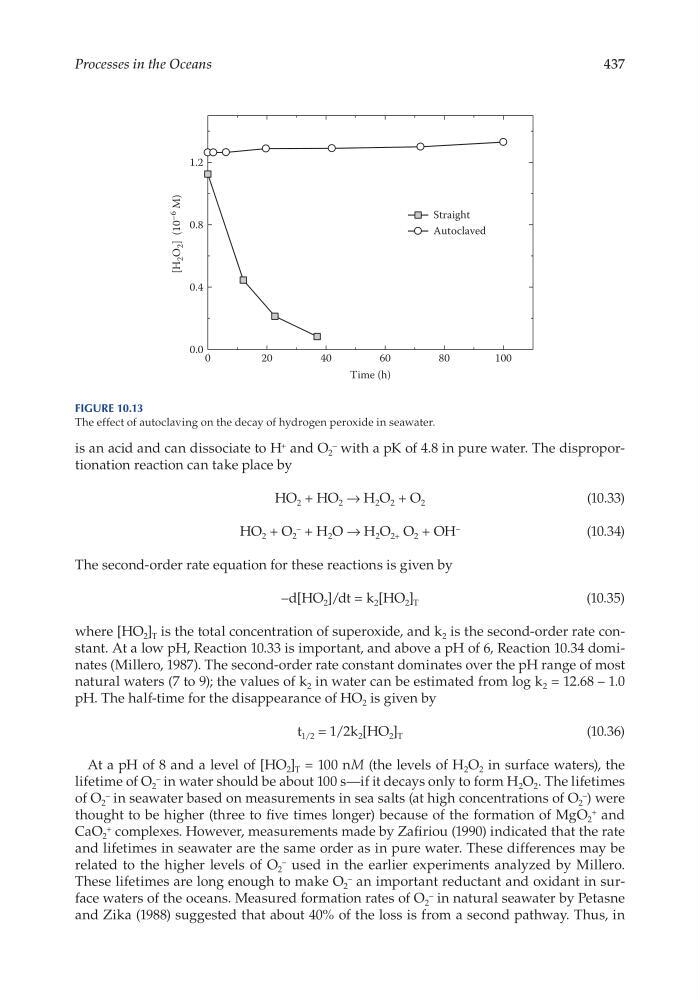
Figure 10.13
The effect of autoclaving on the decay of hydrogen peroxide in seawater.
Processes in the Oceans
is an acid and can dissociate to H + and O 2
– with a pK of 4.8 in pure water. The disproportionation reaction can take place by
HO 2 + HO 2 → H 2 O 2 + O 2
(10.33)
HO 2 + O 2
– + H 2 O → H 2 O 2+ O 2 + OH –
(10.34)
The second- order rate equation for these reactions is given by
–d[HO 2 ]/dt = k 2 [HO 2 ] T
(10.35)
where [HO 2 ] T is the total concentration of superoxide, and k 2 is the second- order rate constant. At a low pH, Reaction 10.33 is important, and above a pH of 6, Reaction 10.34 dominates (Millero, 1987). The second- order rate constant dominates over the pH range of most
natural waters (7 to 9); the values of k 2 in water can be estimated from log k 2 = 12.68 – 1.0
pH. The half- time for the disappearance of HO 2 is given by
t 1/2 = 1/2k 2 [HO 2 ] T
(10.36)
At a pH of 8 and a level of [HO 2 ] T = 100 nM (the levels of H 2 O 2 in surface waters), the
lifetime of O 2
– in water should be about 100 s—if it decays only to form H 2 O 2 . The lifetimes
of O 2
– in seawater based on measurements in sea salts (at high concentrations of O 2
– ) were
thought to be higher (three to five times longer) because of the formation of MgO 2
+ and
CaO 2
+ complexes. However, measurements made by Zafiriou (1990) indicated that the rate
and lifetimes in seawater are the same order as in pure water. These differences may be
related to the higher levels of O 2
– used in the earlier experiments analyzed by Millero.
These lifetimes are long enough to make O 2
– an important reductant and oxidant in surface waters of the oceans. Measured formation rates of O 2
– in natural seawater by Petasne
and Zika (1988) suggested that about 40% of the loss is from a second pathway. Thus, in
Time (h)
0
20
40
60
80
100
[H
2 O
2 ] (10
–6
M)
0.0
0.4
0.8
1.2
Straight
Autoclaved
Figure 10.13
The effect of autoclaving on the decay of hydrogen peroxide in seawater.