

433
Processes in the Oceans
about 120 h and about 12 h in coastal waters. Studies also indicate that the lifetimes are
much longer in deep waters (1900 h at 250 m). These results suggest that the rates of decay
of H 2 O 2 may be controlled by particles or biological processes. The effect of particles on
decay is shown in Figure 10.12. Filtration through a 0.2-μm filter slows the rate of decay
of H 2 O 2 .
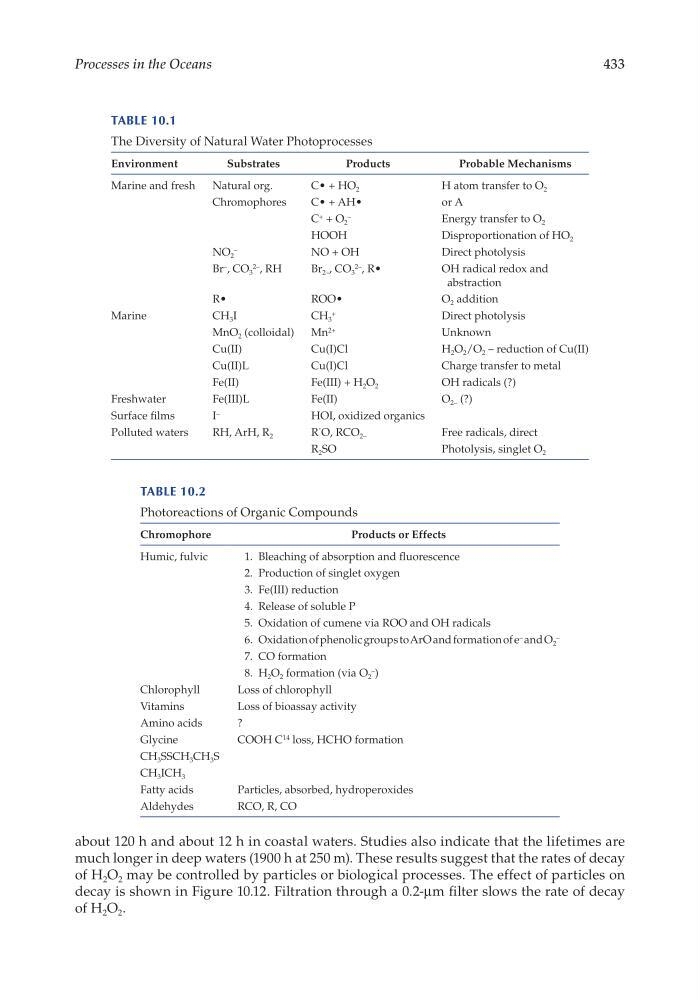
Table 10.1
The Diversity of Natural Water Photoprocesses
Environment
Substrates
Products
Probable Mechanisms
Marine and fresh
Natural org.
C• + HO 2
H atom transfer to O 2
Chromophores
C• + AH•
or A
C + + O 2
–
Energy transfer to O 2
HOOH
Disproportionation of HO 2
NO 2
–
NO + OH
Direct photolysis
Br – , CO 3
2– , RH
Br 2– , CO 3
2– , R•
OH radical redox and
abstraction
R•
ROO•
O 2 addition
Marine
CH 3 I
CH 3
+
Direct photolysis
MnO 2 (colloidal)
Mn 2+
Unknown
Cu(II)
Cu(I)Cl
H 2 O 2 /O 2 – reduction of Cu(II)
Cu(II)L
Cu(I)Cl
Charge transfer to metal
Fe(II)
Fe(III) + H 2 O 2
OH radicals (?)
Freshwater
Fe(III)L
Fe(II)
O 2– (?)
Surface films
I –
HOI, oxidized organics
Polluted waters
RH, ArH, R 2
R˙O, RCO 2–
Free radicals, direct
R 2 SO
Photolysis, singlet O 2
Table 10.2
Photoreactions of Organic Compounds
Chromophore
Products or Effects
Humic, fulvic
1. Bleaching of absorption and fluorescence
2. Production of singlet oxygen
3. Fe(III) reduction
4. Release of soluble P
5. Oxidation of cumene via ROO and OH radicals
6. Oxidation of phenolic groups to ArO and formation of e – and O 2
–
7. CO formation
8. H 2 O 2 formation (via O 2
– )
Chlorophyll
Loss of chlorophyll
Vitamins
Loss of bioassay activity
Amino acids
?
Glycine
COOH C 14 loss, HCHO formation
CH 3 SSCH 3 CH 3 S
CH 3 ICH 3
Fatty acids
Particles, absorbed, hydroperoxides
Aldehydes
RCO, R, CO
Processes in the Oceans
about 120 h and about 12 h in coastal waters. Studies also indicate that the lifetimes are
much longer in deep waters (1900 h at 250 m). These results suggest that the rates of decay
of H 2 O 2 may be controlled by particles or biological processes. The effect of particles on
decay is shown in Figure 10.12. Filtration through a 0.2-μm filter slows the rate of decay
of H 2 O 2 .
Table 10.1
The Diversity of Natural Water Photoprocesses
Environment
Substrates
Products
Probable Mechanisms
Marine and fresh
Natural org.
C• + HO 2
H atom transfer to O 2
Chromophores
C• + AH•
or A
C + + O 2
–
Energy transfer to O 2
HOOH
Disproportionation of HO 2
NO 2
–
NO + OH
Direct photolysis
Br – , CO 3
2– , RH
Br 2– , CO 3
2– , R•
OH radical redox and
abstraction
R•
ROO•
O 2 addition
Marine
CH 3 I
CH 3
+
Direct photolysis
MnO 2 (colloidal)
Mn 2+
Unknown
Cu(II)
Cu(I)Cl
H 2 O 2 /O 2 – reduction of Cu(II)
Cu(II)L
Cu(I)Cl
Charge transfer to metal
Fe(II)
Fe(III) + H 2 O 2
OH radicals (?)
Freshwater
Fe(III)L
Fe(II)
O 2– (?)
Surface films
I –
HOI, oxidized organics
Polluted waters
RH, ArH, R 2
R˙O, RCO 2–
Free radicals, direct
R 2 SO
Photolysis, singlet O 2
Table 10.2
Photoreactions of Organic Compounds
Chromophore
Products or Effects
Humic, fulvic
1. Bleaching of absorption and fluorescence
2. Production of singlet oxygen
3. Fe(III) reduction
4. Release of soluble P
5. Oxidation of cumene via ROO and OH radicals
6. Oxidation of phenolic groups to ArO and formation of e – and O 2
–
7. CO formation
8. H 2 O 2 formation (via O 2
– )
Chlorophyll
Loss of chlorophyll
Vitamins
Loss of bioassay activity
Amino acids
?
Glycine
COOH C 14 loss, HCHO formation
CH 3 SSCH 3 CH 3 S
CH 3 ICH 3
Fatty acids
Particles, absorbed, hydroperoxides
Aldehydes
RCO, R, CO