

434
Chemical Oceanography, 4th Edition
Since autoclaving the seawater has a similar affect (see Figure 10.13), the decay appears
to be partly related to biological particles (living and dead cells). Further work is needed
to elucidate the decay mechanism of H 2 O 2 and the effect cells have on the formation and
destruction of H 2 O 2 . The decomposition is not affected by light and occurs in a matter of
days. Enzymes as well as particles may be important in the destruction of H 2 O 2 in natural
waters. Although abiotic decomposition processes are small, they may be important in the
open oceans. Two major enzymes in organisms that control intracellular H 2 O 2 are catalases
and peroxidase. Moffett and Zafiriou (1990), using 18 O- labeled H 2 O 2 and O 2 , found that in
coastal waters 65 to 80% of the decomposition of H 2 O 2 was due to catalase.
The superoxide anion (O 2
– ) is a key intermediate in the formation of H 2 O 2 . Thus, all the
reactions that lead to O 2
– will increase the concentration of H 2 O 2 . The aqueous chemistry
of superoxide has been studied extensively by Bielski (1978). The superoxide radical (HO 2 )
[H 2 O 2 ] (10
–7 M)
0.0
0.4
0.8
1.2
1.6
Depth (m)
0
20
40
60
80
100
120
140
160
180
200
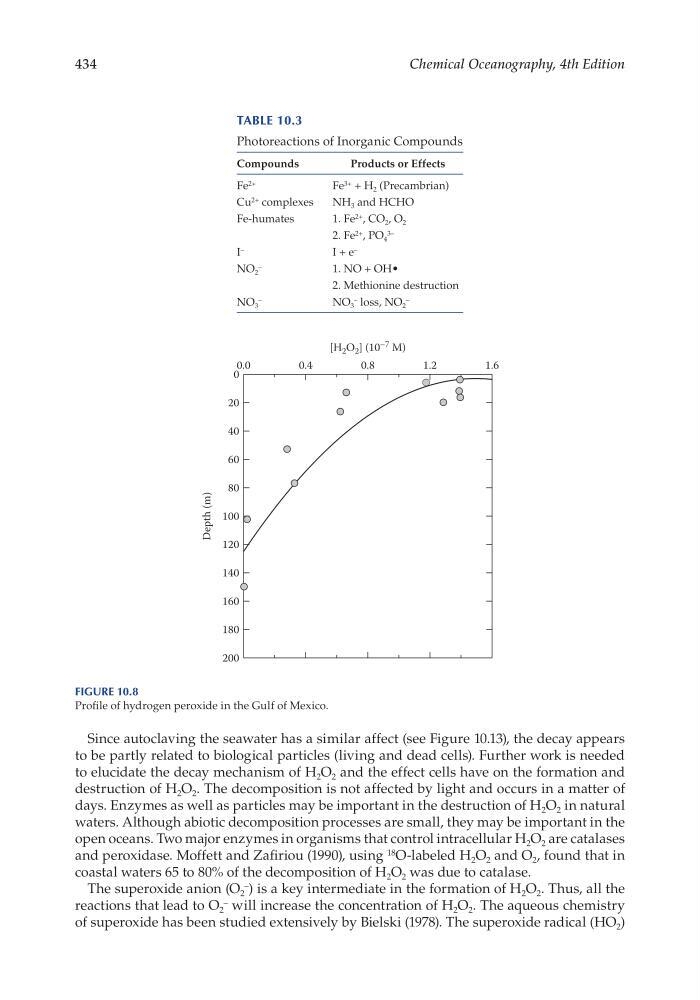
Figure 10.8
Profile of hydrogen peroxide in the Gulf of Mexico.
Table 10.3
Photoreactions of Inorganic Compounds
Compounds
Products or Effects
Fe 2+
Fe 3+ + H 2 (Precambrian)
Cu 2+ complexes
NH 3 and HCHO
Fe- humates
1. Fe 2+ , CO 2 , O 2
2. Fe 2+ , PO 4
3–
I –
I + e –
NO 2
–
1. NO + OH•
2. Methionine destruction
NO 3
–
NO 3
– loss, NO 2
–
Chemical Oceanography, 4th Edition
Since autoclaving the seawater has a similar affect (see Figure 10.13), the decay appears
to be partly related to biological particles (living and dead cells). Further work is needed
to elucidate the decay mechanism of H 2 O 2 and the effect cells have on the formation and
destruction of H 2 O 2 . The decomposition is not affected by light and occurs in a matter of
days. Enzymes as well as particles may be important in the destruction of H 2 O 2 in natural
waters. Although abiotic decomposition processes are small, they may be important in the
open oceans. Two major enzymes in organisms that control intracellular H 2 O 2 are catalases
and peroxidase. Moffett and Zafiriou (1990), using 18 O- labeled H 2 O 2 and O 2 , found that in
coastal waters 65 to 80% of the decomposition of H 2 O 2 was due to catalase.
The superoxide anion (O 2
– ) is a key intermediate in the formation of H 2 O 2 . Thus, all the
reactions that lead to O 2
– will increase the concentration of H 2 O 2 . The aqueous chemistry
of superoxide has been studied extensively by Bielski (1978). The superoxide radical (HO 2 )
[H 2 O 2 ] (10
–7 M)
0.0
0.4
0.8
1.2
1.6
Depth (m)
0
20
40
60
80
100
120
140
160
180
200
Figure 10.8
Profile of hydrogen peroxide in the Gulf of Mexico.
Table 10.3
Photoreactions of Inorganic Compounds
Compounds
Products or Effects
Fe 2+
Fe 3+ + H 2 (Precambrian)
Cu 2+ complexes
NH 3 and HCHO
Fe- humates
1. Fe 2+ , CO 2 , O 2
2. Fe 2+ , PO 4
3–
I –
I + e –
NO 2
–
1. NO + OH•
2. Methionine destruction
NO 3
–
NO 3
– loss, NO 2
–