

431
Processes in the Oceans
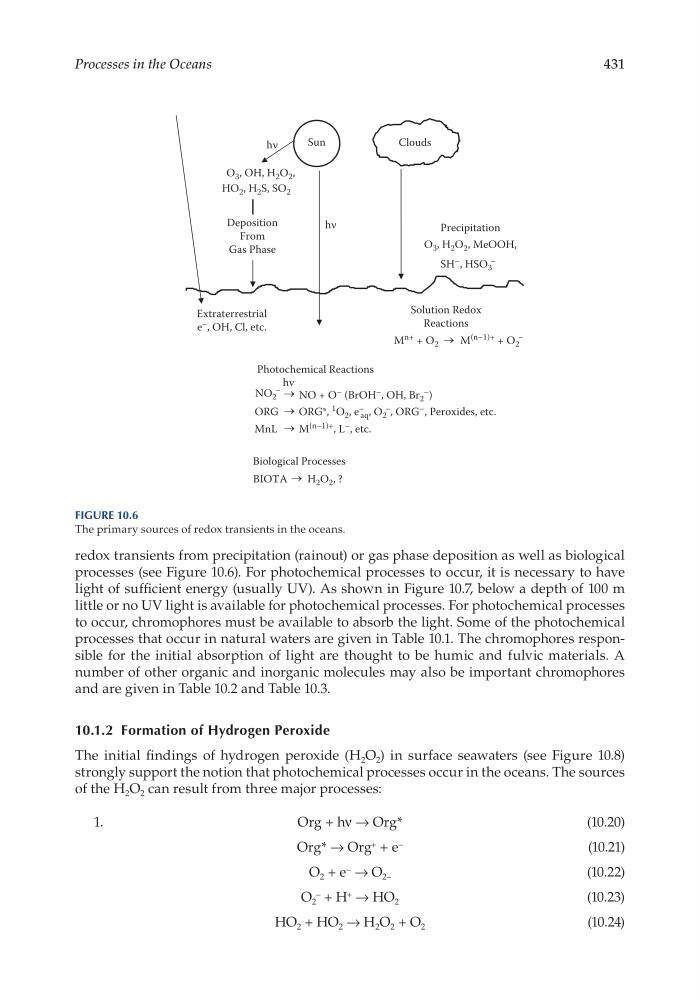
redox transients from precipitation (rainout) or gas phase deposition as well as biological
processes (see Figure 10.6). For photochemical processes to occur, it is necessary to have
light of sufficient energy (usually UV). As shown in Figure 10.7, below a depth of 100 m
little or no UV light is available for photochemical processes. For photochemical processes
to occur, chromophores must be available to absorb the light. Some of the photochemical
processes that occur in natural waters are given in Table 10.1. The chromophores responsible for the initial absorption of light are thought to be humic and fulvic materials. A
number of other organic and inorganic molecules may also be important chromophores
and are given in Table 10.2 and Table 10.3.
10.1.2 Formation of Hydrogen Peroxide
The initial findings of hydrogen peroxide (H 2 O 2 ) in surface seawaters (see Figure 10.8)
strongly support the notion that photochemical processes occur in the oceans. The sources
of the H 2 O 2 can result from three major processes:
1.
Org + hν → Org*
(10.20)
Org* → Org + + e –
(10.21)
O 2 + e – → O 2–
(10.22)
O 2
– + H + → HO 2
(10.23)
HO 2 + HO 2 → H 2 O 2 + O 2
(10.24)
Sun
Clouds
O 3 , OH, H 2 O 2 ,
HO 2 , H 2 S, SO 2
Deposition
From
Gas Phase
hν
hν
Precipitation
O 3 , H 2 O 2 , MeOOH,
SH – , HSO 3
–
Extraterrestrial
e
– , OH, Cl, etc.
Solution Redox
Reactions
M
n+ + O 2
M
(n–1)+ + O 2
–
NO 2
–
Photochemical Reactions
hν
NO + O
– (BrOH
– , OH, Br 2
– )
ORG
ORG*,
1 O 2 , e
–
aq , O 2
– , ORG
– , Peroxides, etc.
MnL
M (n–1)+ , L
– , etc.
Biological Processes
BIOTA
H 2 O 2 , ?
Figure 10.6
The primary sources of redox transients in the oceans.
Processes in the Oceans
redox transients from precipitation (rainout) or gas phase deposition as well as biological
processes (see Figure 10.6). For photochemical processes to occur, it is necessary to have
light of sufficient energy (usually UV). As shown in Figure 10.7, below a depth of 100 m
little or no UV light is available for photochemical processes. For photochemical processes
to occur, chromophores must be available to absorb the light. Some of the photochemical
processes that occur in natural waters are given in Table 10.1. The chromophores responsible for the initial absorption of light are thought to be humic and fulvic materials. A
number of other organic and inorganic molecules may also be important chromophores
and are given in Table 10.2 and Table 10.3.
10.1.2 Formation of Hydrogen Peroxide
The initial findings of hydrogen peroxide (H 2 O 2 ) in surface seawaters (see Figure 10.8)
strongly support the notion that photochemical processes occur in the oceans. The sources
of the H 2 O 2 can result from three major processes:
1.
Org + hν → Org*
(10.20)
Org* → Org + + e –
(10.21)
O 2 + e – → O 2–
(10.22)
O 2
– + H + → HO 2
(10.23)
HO 2 + HO 2 → H 2 O 2 + O 2
(10.24)
Sun
Clouds
O 3 , OH, H 2 O 2 ,
HO 2 , H 2 S, SO 2
Deposition
From
Gas Phase
hν
hν
Precipitation
O 3 , H 2 O 2 , MeOOH,
SH – , HSO 3
–
Extraterrestrial
e
– , OH, Cl, etc.
Solution Redox
Reactions
M
n+ + O 2
M
(n–1)+ + O 2
–
NO 2
–
Photochemical Reactions
hν
NO + O
– (BrOH
– , OH, Br 2
– )
ORG
ORG*,
1 O 2 , e
–
aq , O 2
– , ORG
– , Peroxides, etc.
MnL
M (n–1)+ , L
– , etc.
Biological Processes
BIOTA
H 2 O 2 , ?
Figure 10.6
The primary sources of redox transients in the oceans.