

430
Chemical Oceanography, 4th Edition
or by chemical reactions. Singlet excited states can also be formed by triplet–triplet annihilation. This can result in delayed fluorescence if the diffusion of the excited molecules is
rapid. An excited state that occurs by chemical effects can also have a delayed fluorescence
called chemiluminescence.
Photochemical processes in the surface waters of the oceans can be important because
they can generate various redox transients. One, however, cannot rule out the formation of
Vibration rotation
Increasing Electron Energy
T 1
Fluorescence
Absorption
S 1
S 2
S n
Inter
System
Crossing
Triplets
Singlets
T n
P h o s p h o r e s c e n c e
– h ν
Sublevels
S 0
Electronic energy levels
Radiative
Nonradiative
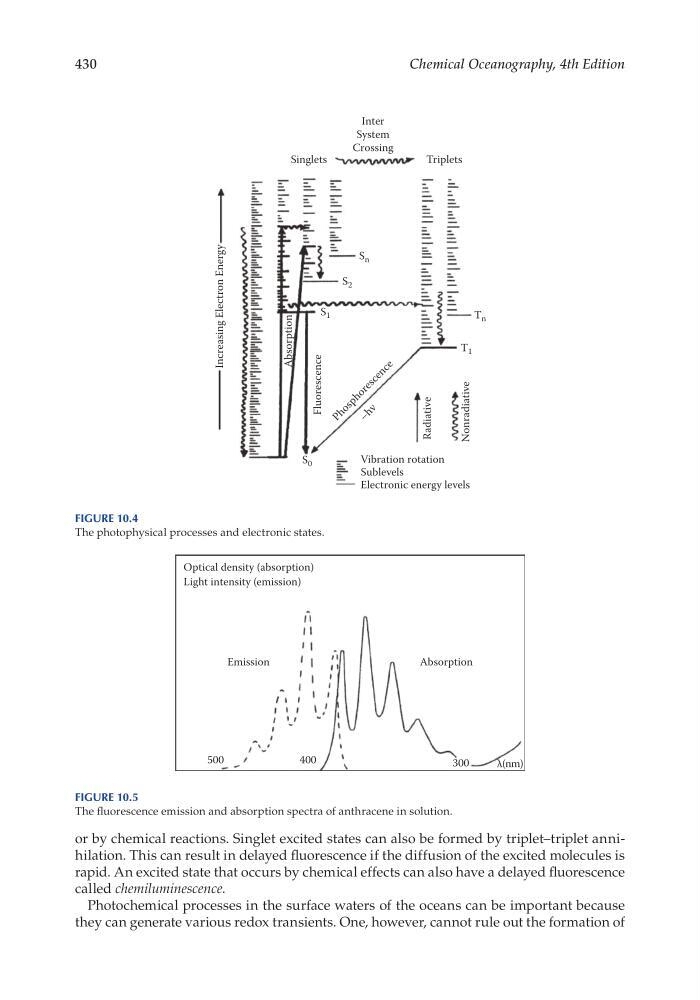
Figure 10.4
The photophysical processes and electronic states.
300
400
500
Emission
Optical density (absorption)
Light intensity (emission)
Absorption
λ(nm)
Figure 10.5
The fluorescence emission and absorption spectra of anthracene in solution.
Chemical Oceanography, 4th Edition
or by chemical reactions. Singlet excited states can also be formed by triplet–triplet annihilation. This can result in delayed fluorescence if the diffusion of the excited molecules is
rapid. An excited state that occurs by chemical effects can also have a delayed fluorescence
called chemiluminescence.
Photochemical processes in the surface waters of the oceans can be important because
they can generate various redox transients. One, however, cannot rule out the formation of
Vibration rotation
Increasing Electron Energy
T 1
Fluorescence
Absorption
S 1
S 2
S n
Inter
System
Crossing
Triplets
Singlets
T n
P h o s p h o r e s c e n c e
– h ν
Sublevels
S 0
Electronic energy levels
Radiative
Nonradiative
Figure 10.4
The photophysical processes and electronic states.
300
400
500
Emission
Optical density (absorption)
Light intensity (emission)
Absorption
λ(nm)
Figure 10.5
The fluorescence emission and absorption spectra of anthracene in solution.