

429
Processes in the Oceans
excited molecule from a singlet state to the ground state is called fluorescence. The emission of many molecules is shifted to longer wavelengths (lower energy). This is shown for
anthracene in Figure 10.5. Many molecules show a longer- lived emission at longer wavelengths. This emission can last for seconds. It comes from a special type of excited state
known as a triplet (unpaired).
Two electrons can share the same orbital only if they have different spin quantum numbers (↑↓). In an excited state, one electron is a singly occupied higher orbital, while it has
left a vacancy in the lower orbital, which is also singly occupied. These two electrons
in different orbitals are quite independent and can have their spins antiparallel, as in the
ground state, or parallel (↑↑ or ↑↓). When the spins are parallel, the excited state is called
the triplet state. The emission from a molecule in the triplet state is called phosphorescence.
Delayed fluorescence arises from the production of an excited singlet state from the triplet
Visible light
10 10 10 9 10 8 10 7 10 6 10 5 10 4 10 3 10 2 10 1 10 0 10 –1 10 –2 10 –3 10 –4
10 7 10 6 10 5 10 4 10 3 10 2 10 1 10 0 10 –1 10 –2 10 –3 10 –4 10 –5 10 –6 10 –7
λ (nm)
λ (µm)
Photochemistry
|
|
|
|
|
|
|
|
|
|
|
|
|
|
|
|
|
|
|
|
|
|
|
|
|
|
|
|
|
|
|
|
|
|
|
|
|
|
|
|
λ(nm)
1000
900
800
700
600
500
400
300
200
100
ν(cm –1 )
10 000
15 000
20 000
30 000 40 000 50 000 100 000
E(eV)
1
2
3
4
5 6 7
Red
Yellow
Infrared
Visible
Ultraviolet
Green Blue
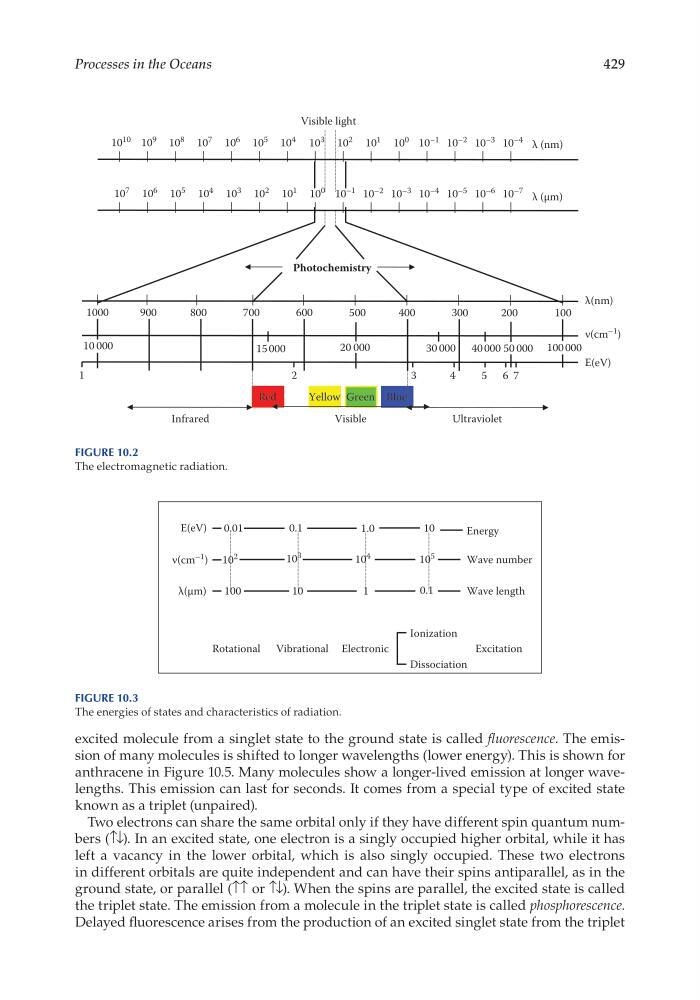
Figure 10.2
The electromagnetic radiation.
E(eV)
0.1
1.0
10
Energy
ν(cm
–1 ) 10
2
10
3
10
4
10
5
Wave number
λ(µm)
100
10
1
0.1
Wave length
Ionization
Rotational Vibrational Electronic
Excitation
Dissociation
0.01
Figure 10.3
The energies of states and characteristics of radiation.
Processes in the Oceans
excited molecule from a singlet state to the ground state is called fluorescence. The emission of many molecules is shifted to longer wavelengths (lower energy). This is shown for
anthracene in Figure 10.5. Many molecules show a longer- lived emission at longer wavelengths. This emission can last for seconds. It comes from a special type of excited state
known as a triplet (unpaired).
Two electrons can share the same orbital only if they have different spin quantum numbers (↑↓). In an excited state, one electron is a singly occupied higher orbital, while it has
left a vacancy in the lower orbital, which is also singly occupied. These two electrons
in different orbitals are quite independent and can have their spins antiparallel, as in the
ground state, or parallel (↑↑ or ↑↓). When the spins are parallel, the excited state is called
the triplet state. The emission from a molecule in the triplet state is called phosphorescence.
Delayed fluorescence arises from the production of an excited singlet state from the triplet
Visible light
10 10 10 9 10 8 10 7 10 6 10 5 10 4 10 3 10 2 10 1 10 0 10 –1 10 –2 10 –3 10 –4
10 7 10 6 10 5 10 4 10 3 10 2 10 1 10 0 10 –1 10 –2 10 –3 10 –4 10 –5 10 –6 10 –7
λ (nm)
λ (µm)
Photochemistry
|
|
|
|
|
|
|
|
|
|
|
|
|
|
|
|
|
|
|
|
|
|
|
|
|
|
|
|
|
|
|
|
|
|
|
|
|
|
|
|
λ(nm)
1000
900
800
700
600
500
400
300
200
100
ν(cm –1 )
10 000
15 000
20 000
30 000 40 000 50 000 100 000
E(eV)
1
2
3
4
5 6 7
Red
Yellow
Infrared
Visible
Ultraviolet
Green Blue
Figure 10.2
The electromagnetic radiation.
E(eV)
0.1
1.0
10
Energy
ν(cm
–1 ) 10
2
10
3
10
4
10
5
Wave number
λ(µm)
100
10
1
0.1
Wave length
Ionization
Rotational Vibrational Electronic
Excitation
Dissociation
0.01
Figure 10.3
The energies of states and characteristics of radiation.