

428
Chemical Oceanography, 4th Edition
The energy of an atom or molecule is given in units of electron volts, kilocalories, or kilojoules. One electron volt is equal to 9.65 × 10 4 J. The frequency ν of electromagnetic radiation is equivalent to a given energy (E = hν). Spectroscopists often use the wave numbers
rather than the frequency (wave number = ν/ c, where c = 3 × 10 8 m s –1 , the speed of light).
The wavelength is related to the frequency by
λ = c/ ν
(10.19)
The wavelength is given in units of angstroms (1 Å = 10 –8 cm) or the preferred unit of the
nanometer (1 nm = 10 –9 m = 10 Å).
The relationship between energy and the various types of excitation are shown in
Figure 10.2. These energies can be compared (see Figure 10.3) to the energy of thermal
agitation (RT = 144 J mol –1 ), which is the same order of magnitude of translational and
rotational energy. Although some of the low vibrational levels (ν = 0) can be occupied,
electronically excited states cannot normally be obtained from the application of heat.
The absorption of a photon of electromagnetic radiation is possible if the energy corresponds to the energy separation between orbitals. Emission of a quantum of energy by an
atom takes place when an electron jumps back from an outer orbital to an inner orbital. The
frequencies of the light emitted are the same as the frequencies of the light absorbed. In the
ground state, all the electrons fill the available orbitals in order of increasing energy. An
excited state has one or several electrons occupying higher- energy orbitals, leaving one or
several vacancies of lower orbitals. A ground state can only absorb light. An excited state
can emit light and go to a lower or ground state. It can also absorb light and go upward in
energy to a higher excited state.
A schematic diagram of the photophysical process and its relationship to the various
electronic states of an atom or molecule is shown in Figure 10.4. The absorption of light
excites the molecule from the ground state S 0 to an excited state Sν. The excited molecule
loses some of its energy and can be transferred to a lower singlet (spin- paired) state. For
an isolated atom, the emission wavelength is the same as the absorption wavelength. The
emission from molecules is almost exclusively observed from the lowest excited state.
The lifetime of this emission is usually very short (10 –8 s). The emission process of an
Energy
Adsorption continuum ionization
and dissociation
Second electronic excited state
ν 1
ν 2
First electronic excited state
ν 3
ν 2
ν 1
ν 0 Ground electronic state
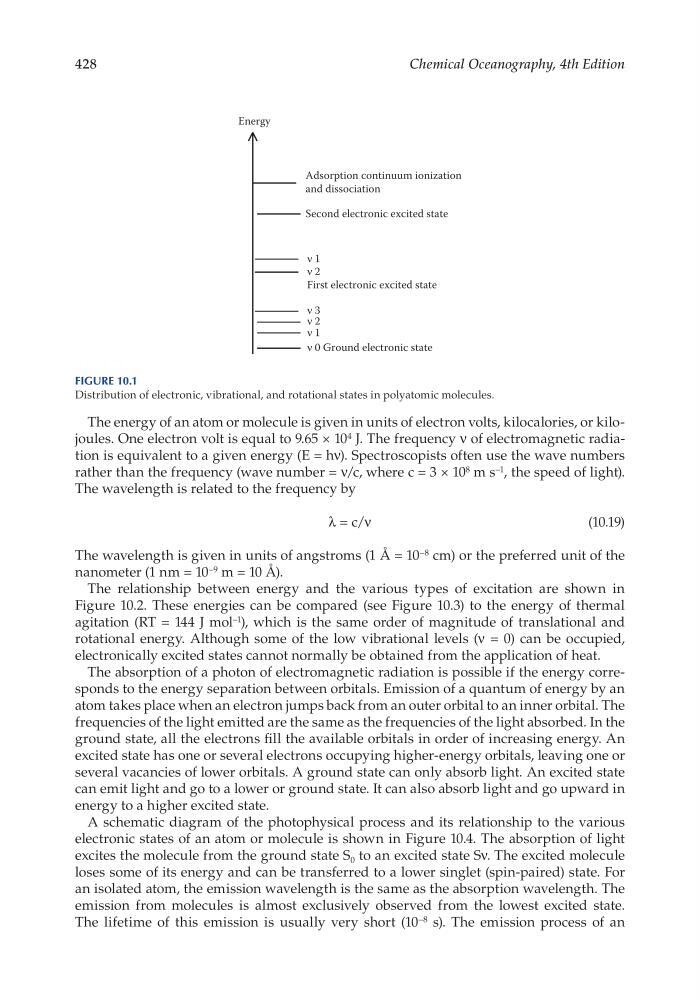
Figure 10.1
Distribution of electronic, vibrational, and rotational states in polyatomic molecules.
Chemical Oceanography, 4th Edition
The energy of an atom or molecule is given in units of electron volts, kilocalories, or kilojoules. One electron volt is equal to 9.65 × 10 4 J. The frequency ν of electromagnetic radiation is equivalent to a given energy (E = hν). Spectroscopists often use the wave numbers
rather than the frequency (wave number = ν/ c, where c = 3 × 10 8 m s –1 , the speed of light).
The wavelength is related to the frequency by
λ = c/ ν
(10.19)
The wavelength is given in units of angstroms (1 Å = 10 –8 cm) or the preferred unit of the
nanometer (1 nm = 10 –9 m = 10 Å).
The relationship between energy and the various types of excitation are shown in
Figure 10.2. These energies can be compared (see Figure 10.3) to the energy of thermal
agitation (RT = 144 J mol –1 ), which is the same order of magnitude of translational and
rotational energy. Although some of the low vibrational levels (ν = 0) can be occupied,
electronically excited states cannot normally be obtained from the application of heat.
The absorption of a photon of electromagnetic radiation is possible if the energy corresponds to the energy separation between orbitals. Emission of a quantum of energy by an
atom takes place when an electron jumps back from an outer orbital to an inner orbital. The
frequencies of the light emitted are the same as the frequencies of the light absorbed. In the
ground state, all the electrons fill the available orbitals in order of increasing energy. An
excited state has one or several electrons occupying higher- energy orbitals, leaving one or
several vacancies of lower orbitals. A ground state can only absorb light. An excited state
can emit light and go to a lower or ground state. It can also absorb light and go upward in
energy to a higher excited state.
A schematic diagram of the photophysical process and its relationship to the various
electronic states of an atom or molecule is shown in Figure 10.4. The absorption of light
excites the molecule from the ground state S 0 to an excited state Sν. The excited molecule
loses some of its energy and can be transferred to a lower singlet (spin- paired) state. For
an isolated atom, the emission wavelength is the same as the absorption wavelength. The
emission from molecules is almost exclusively observed from the lowest excited state.
The lifetime of this emission is usually very short (10 –8 s). The emission process of an
Energy
Adsorption continuum ionization
and dissociation
Second electronic excited state
ν 1
ν 2
First electronic excited state
ν 3
ν 2
ν 1
ν 0 Ground electronic state
Figure 10.1
Distribution of electronic, vibrational, and rotational states in polyatomic molecules.