

417
Primary Production in the Oceans
9.4.3.1 Carbohydrates
Carbohydrates are a major class of naturally occurring organic compounds. Plants are
composed of 50 to 90% carbohydrates. Carbohydrates are the central source of energy for
mechanical work and chemical reactions in all living cells. The derivatives of carbohydrates (ATP and nucleic acids) control energy transformations and the transfer of genetic
material. The general formula for carbohydrates is C n (H 2 O) m . They are classified by the
number of carbon chains per molecule:
Monosaccharide: a single continuous chain of carbon atoms
Disaccharides: two monosaccharide units per molecule
Polysaccharides: composed of many mono- or disaccharide units per molecule
The term sugar (or saccharide) refers to monosaccharides, disaccharides, or lower oligosaccharides (simple sugar is D- glucose). Monosaccharides are classified by the number of
carbon atoms per chain. For example, a monosaccharide with six carbons is called hexose (where -ose is used to denote that it is a carbohydrate). Cellulose, the main structural
component of the cell wall, is a linear sequence of glucose units linked by bonds formed
from the acetal carbonyls. It consists of a linear sequence of glucose units linked by acetal
mg POC/m
2 d
0.1
1
10
100
1000
Depth (m)
Peru upwelling
Vertex I
Paraflux P
Paraflux E
15
50
100
250
400
750
1000
1500
2700
3700
4200
5000
5200
5600
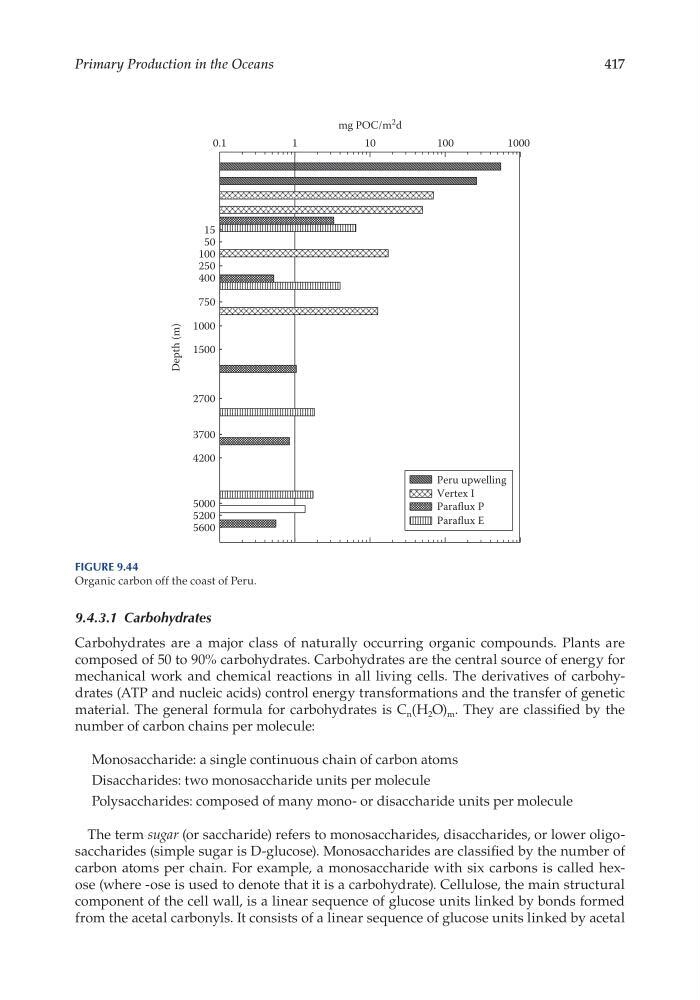
Figure 9.44
Organic carbon off the coast of Peru.
Primary Production in the Oceans
9.4.3.1 Carbohydrates
Carbohydrates are a major class of naturally occurring organic compounds. Plants are
composed of 50 to 90% carbohydrates. Carbohydrates are the central source of energy for
mechanical work and chemical reactions in all living cells. The derivatives of carbohydrates (ATP and nucleic acids) control energy transformations and the transfer of genetic
material. The general formula for carbohydrates is C n (H 2 O) m . They are classified by the
number of carbon chains per molecule:
Monosaccharide: a single continuous chain of carbon atoms
Disaccharides: two monosaccharide units per molecule
Polysaccharides: composed of many mono- or disaccharide units per molecule
The term sugar (or saccharide) refers to monosaccharides, disaccharides, or lower oligosaccharides (simple sugar is D- glucose). Monosaccharides are classified by the number of
carbon atoms per chain. For example, a monosaccharide with six carbons is called hexose (where -ose is used to denote that it is a carbohydrate). Cellulose, the main structural
component of the cell wall, is a linear sequence of glucose units linked by bonds formed
from the acetal carbonyls. It consists of a linear sequence of glucose units linked by acetal
mg POC/m
2 d
0.1
1
10
100
1000
Depth (m)
Peru upwelling
Vertex I
Paraflux P
Paraflux E
15
50
100
250
400
750
1000
1500
2700
3700
4200
5000
5200
5600
Figure 9.44
Organic carbon off the coast of Peru.