

416
Chemical Oceanography, 4th Edition
removal of some labile organic compounds from sinking POM and the selective incorporation of other labile organic matter into sinking POM as fecal material excretion products.
The fraction of POC is much less at other parts of the ocean (Figure 9.45) and depends on the
growth of calcareous and siliceous phytoplankton and the input of atmospheric aerosols.
Much of the work on the biogeochemistry related to sinking marine particles has focused
on lipids (fats, oils, and fat- soluble compounds). Lipids constitute a minor but important
fraction of the DOC and POC because of their involvement in energy storage and use,
reproduction, regulation of metabolic processes, membrane structure, and so on. The particulate lipids are much more complex than the dissolved lipids. Although the major components of dissolved and particulate lipids are similar (n- alkanes, pristane, phytane, and
fatty acid esters), particulate lipids include a substantial amount of unresolved compounds
as well as olefins, alkylated benzenes, quinones, and minor contributors not found in the
dissolved samples.
9.4.3 Kinds of Organic Compounds in Seawater
One can imagine that almost all the possible organic compounds could exist in seawater
because of the breakdown. It is difficult to determine the individual compounds in seawater because of their low levels and the problems with their concentration in a large amount
of seawater with changing composition. The simple organic compounds can be broken
down into a number of major groups (Table 9.10), briefly discussed next.
mg Particulate Matter/m
2 d
1
10
100
1000
10000
Depth (m)
15
50
100
250
400
750
1000
1500
2700
3700
4200
5000
5200
5600
Peru upwelling
Vertex I
Paraflux P
Paraflux E
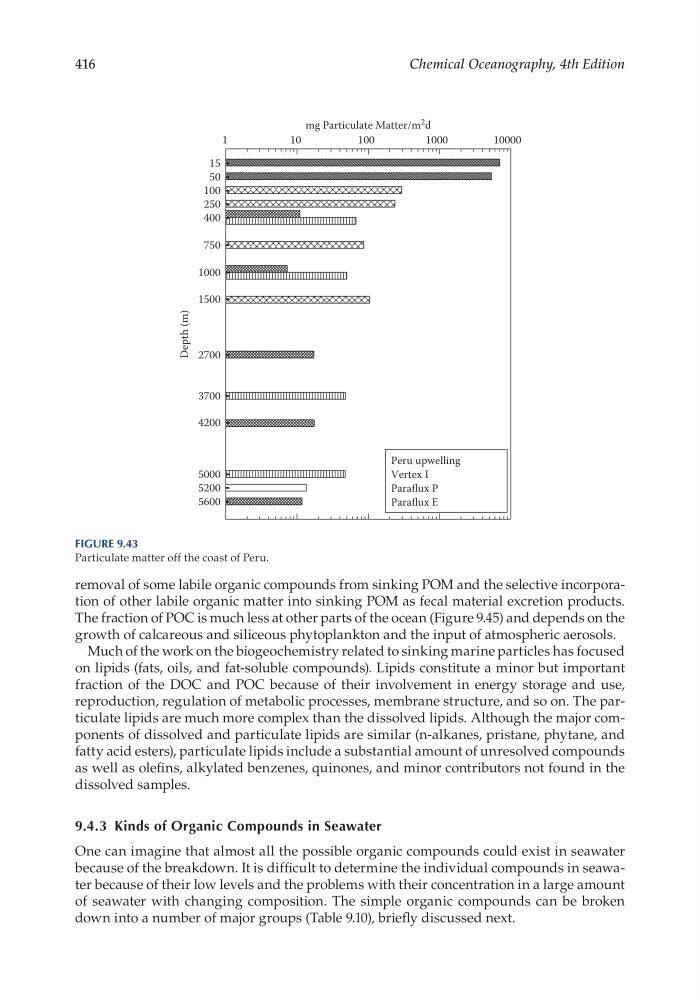
Figure 9.43
Particulate matter off the coast of Peru.
Chemical Oceanography, 4th Edition
removal of some labile organic compounds from sinking POM and the selective incorporation of other labile organic matter into sinking POM as fecal material excretion products.
The fraction of POC is much less at other parts of the ocean (Figure 9.45) and depends on the
growth of calcareous and siliceous phytoplankton and the input of atmospheric aerosols.
Much of the work on the biogeochemistry related to sinking marine particles has focused
on lipids (fats, oils, and fat- soluble compounds). Lipids constitute a minor but important
fraction of the DOC and POC because of their involvement in energy storage and use,
reproduction, regulation of metabolic processes, membrane structure, and so on. The particulate lipids are much more complex than the dissolved lipids. Although the major components of dissolved and particulate lipids are similar (n- alkanes, pristane, phytane, and
fatty acid esters), particulate lipids include a substantial amount of unresolved compounds
as well as olefins, alkylated benzenes, quinones, and minor contributors not found in the
dissolved samples.
9.4.3 Kinds of Organic Compounds in Seawater
One can imagine that almost all the possible organic compounds could exist in seawater
because of the breakdown. It is difficult to determine the individual compounds in seawater because of their low levels and the problems with their concentration in a large amount
of seawater with changing composition. The simple organic compounds can be broken
down into a number of major groups (Table 9.10), briefly discussed next.
mg Particulate Matter/m
2 d
1
10
100
1000
10000
Depth (m)
15
50
100
250
400
750
1000
1500
2700
3700
4200
5000
5200
5600
Peru upwelling
Vertex I
Paraflux P
Paraflux E
Figure 9.43
Particulate matter off the coast of Peru.