

404
Chemical Oceanography, 4th Edition
blue- green algae, and perhaps viruses. The latter groups, especially bacteria, are import
agents in the transformation of organic matter into a large range of organic breakdown
products and eventually CO 2 . They are frequently associated with microbial biomass and
are quite active at discontinuities in the marine environment. Their small size gives them
a high surface- to- volume ratio. They frequently live in microenvironments (marine snow,
the guts of animals, etc.) that have a different pH, p, O 2 , and composition than that of bulk
seawater. These microenvironments are created by particles, diffusion barriers, and the
metabolic activity of the microorganisms.
It is difficult to study these microorganisms because of the lack of methods that can be
used to accurately access their biomass, metabolic activity, and growth rates. For example,
cell numbers and biomass may be misleading in determining the potential for biochemical transformations. Nongrowing cells may have a greater chemical impact than efficient
and rapidly growing cells. Many of the earlier studies of microorganisms neglected to
sample at ocean discontinuities caused by physical (bubbles, thermoclines, pycnoclines,
and water mass boundaries); chemical (nutriclines, oxic–anoxic interfaces, digestive tracts);
and physio chemical (air–sea interface, sediment–sea interface, aerosols, particles, sea–ice
interface, and animal burrows) properties.
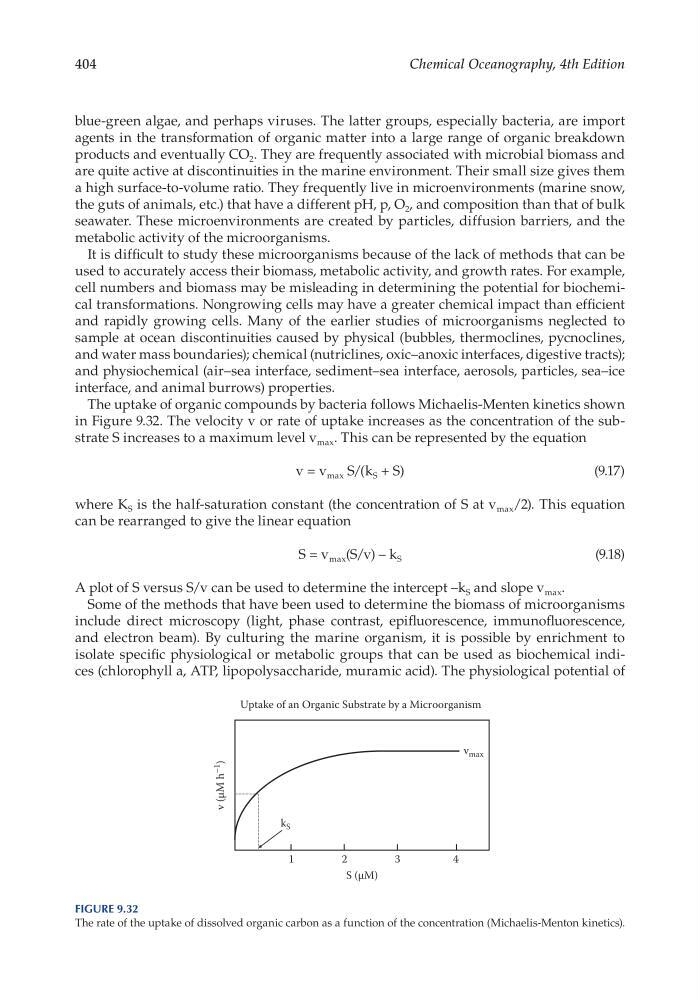
The uptake of organic compounds by bacteria follows Michaelis- Menten kinetics shown
in Figure 9.32. The velocity v or rate of uptake increases as the concentration of the substrate S increases to a maximum level v max . This can be represented by the equation
v = v max S/(k S + S)
(9.17)
where K S is the half- saturation constant (the concentration of S at v max /2). This equation
can be rearranged to give the linear equation
S = v max (S/ v) – k S
(9.18)
A plot of S versus S/ v can be used to determine the intercept –k S and slope v max .
Some of the methods that have been used to determine the biomass of microorganisms
include direct microscopy (light, phase contrast, epifluorescence, immunofluorescence,
and electron beam). By culturing the marine organism, it is possible by enrichment to
isolate specific physiological or metabolic groups that can be used as biochemical indices (chlorophyll a, ATP, lipopolysaccharide, muramic acid). The physiological potential of
Uptake of an Organic Substrate by a Microorganism
v max
v (µM h
–1
)
k S
3
4
S (µM)
1
2
Figure 9.32
The rate of the uptake of dissolved organic carbon as a function of the concentration (Michaelis- Menton kinetics).
Chemical Oceanography, 4th Edition
blue- green algae, and perhaps viruses. The latter groups, especially bacteria, are import
agents in the transformation of organic matter into a large range of organic breakdown
products and eventually CO 2 . They are frequently associated with microbial biomass and
are quite active at discontinuities in the marine environment. Their small size gives them
a high surface- to- volume ratio. They frequently live in microenvironments (marine snow,
the guts of animals, etc.) that have a different pH, p, O 2 , and composition than that of bulk
seawater. These microenvironments are created by particles, diffusion barriers, and the
metabolic activity of the microorganisms.
It is difficult to study these microorganisms because of the lack of methods that can be
used to accurately access their biomass, metabolic activity, and growth rates. For example,
cell numbers and biomass may be misleading in determining the potential for biochemical transformations. Nongrowing cells may have a greater chemical impact than efficient
and rapidly growing cells. Many of the earlier studies of microorganisms neglected to
sample at ocean discontinuities caused by physical (bubbles, thermoclines, pycnoclines,
and water mass boundaries); chemical (nutriclines, oxic–anoxic interfaces, digestive tracts);
and physio chemical (air–sea interface, sediment–sea interface, aerosols, particles, sea–ice
interface, and animal burrows) properties.
The uptake of organic compounds by bacteria follows Michaelis- Menten kinetics shown
in Figure 9.32. The velocity v or rate of uptake increases as the concentration of the substrate S increases to a maximum level v max . This can be represented by the equation
v = v max S/(k S + S)
(9.17)
where K S is the half- saturation constant (the concentration of S at v max /2). This equation
can be rearranged to give the linear equation
S = v max (S/ v) – k S
(9.18)
A plot of S versus S/ v can be used to determine the intercept –k S and slope v max .
Some of the methods that have been used to determine the biomass of microorganisms
include direct microscopy (light, phase contrast, epifluorescence, immunofluorescence,
and electron beam). By culturing the marine organism, it is possible by enrichment to
isolate specific physiological or metabolic groups that can be used as biochemical indices (chlorophyll a, ATP, lipopolysaccharide, muramic acid). The physiological potential of
Uptake of an Organic Substrate by a Microorganism
v max
v (µM h
–1
)
k S
3
4
S (µM)
1
2
Figure 9.32
The rate of the uptake of dissolved organic carbon as a function of the concentration (Michaelis- Menton kinetics).