

405
Primary Production in the Oceans
microorganisms can be accessed by measuring the adenylate energy charge or looking for
specific enzymes (dihydrogenase, alkaline phosphates, nitrogenase, and glutamine synthetase). The metabolic activity of microorganisms can be determined by measuring the
end products (O 2 , CO 2 , and CH 4 ) or measuring the uptake of 14 C- or 3 H- labeled substrates
(glucose, glutamate, amino acids). Oxygen respirometry and microautoradiography can
also be used to determine the metabolic activity of microorganisms. Microcalorimetry
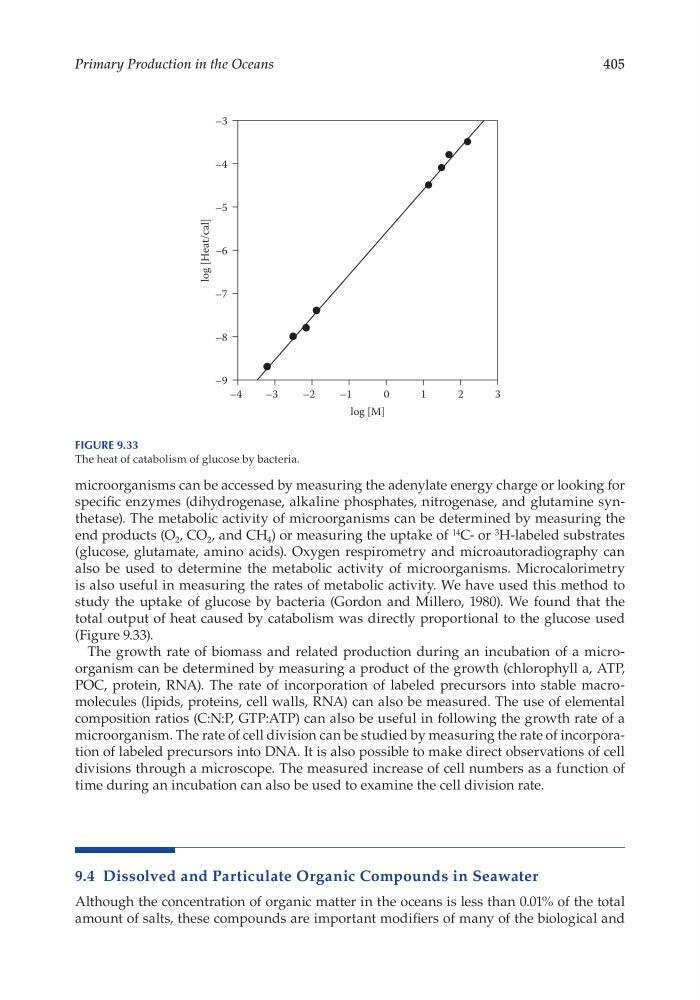
is also useful in measuring the rates of metabolic activity. We have used this method to
study the uptake of glucose by bacteria (Gordon and Millero, 1980). We found that the
total output of heat caused by catabolism was directly proportional to the glucose used
(Figure 9.33).
The growth rate of biomass and related production during an incubation of a microorganism can be determined by measuring a product of the growth (chlorophyll a, ATP,
POC, protein, RNA). The rate of incorporation of labeled precursors into stable macromolecules (lipids, proteins, cell walls, RNA) can also be measured. The use of elemental
composition ratios (C:N:P, GTP:ATP) can also be useful in following the growth rate of a
microorganism. The rate of cell division can be studied by measuring the rate of incorporation of labeled precursors into DNA. It is also possible to make direct observations of cell
divisions through a microscope. The measured increase of cell numbers as a function of
time during an incubation can also be used to examine the cell division rate.
9.4
Dissolved and Particulate Organic Compounds in Seawater
Although the concentration of organic matter in the oceans is less than 0.01% of the total
amount of salts, these compounds are important modifiers of many of the biological and
log [M]
–4
–3
–2
–1
0
1
2
3
log [Heat/cal]
–9
–8
–7
–6
–5
–4
–3
Figure 9.33
The heat of catabolism of glucose by bacteria.
Primary Production in the Oceans
microorganisms can be accessed by measuring the adenylate energy charge or looking for
specific enzymes (dihydrogenase, alkaline phosphates, nitrogenase, and glutamine synthetase). The metabolic activity of microorganisms can be determined by measuring the
end products (O 2 , CO 2 , and CH 4 ) or measuring the uptake of 14 C- or 3 H- labeled substrates
(glucose, glutamate, amino acids). Oxygen respirometry and microautoradiography can
also be used to determine the metabolic activity of microorganisms. Microcalorimetry
is also useful in measuring the rates of metabolic activity. We have used this method to
study the uptake of glucose by bacteria (Gordon and Millero, 1980). We found that the
total output of heat caused by catabolism was directly proportional to the glucose used
(Figure 9.33).
The growth rate of biomass and related production during an incubation of a microorganism can be determined by measuring a product of the growth (chlorophyll a, ATP,
POC, protein, RNA). The rate of incorporation of labeled precursors into stable macromolecules (lipids, proteins, cell walls, RNA) can also be measured. The use of elemental
composition ratios (C:N:P, GTP:ATP) can also be useful in following the growth rate of a
microorganism. The rate of cell division can be studied by measuring the rate of incorporation of labeled precursors into DNA. It is also possible to make direct observations of cell
divisions through a microscope. The measured increase of cell numbers as a function of
time during an incubation can also be used to examine the cell division rate.
9.4
Dissolved and Particulate Organic Compounds in Seawater
Although the concentration of organic matter in the oceans is less than 0.01% of the total
amount of salts, these compounds are important modifiers of many of the biological and
log [M]
–4
–3
–2
–1
0
1
2
3
log [Heat/cal]
–9
–8
–7
–6
–5
–4
–3
Figure 9.33
The heat of catabolism of glucose by bacteria.