

402
Chemical Oceanography, 4th Edition
enrichment. The SOIREE bloom was observed for only 13 days and the EisenEx bloom for
18 days.
In contrast to the intermediate silica environments examined in previous iron fertilization experiments, the Southern Ocean includes the low- silica region (<3 μmol kg –1 ) of the
subantarctic zone and the high silica concentrations (~63 μmol kg –1 ) of the subpolar region.
The detailed frontal structure of the Southern Ocean (Orsi, Whitworth, and Nowlin, 1995)
is directly related to the strong meridional gradients of hydrographic, carbonate, and nutrient parameters. Only a small fraction of the dissolved organic carbon is thought to make
it to deep waters and indirectly take CO 2 from the atmosphere to deep waters. A recent
study (Smetacek et al., 2012) suggests that as much as 50% is removed to waters at a depth
of 1000 m. In summary, most feel that adding Fe to ocean waters with high nutrients is not
going to sequester CO 2 from the atmosphere.
Recent observations of the effect of [Fe] on the elemental composition of phytoplankton
in HNLC regions of the Southern Ocean document stoichiometric utilization ratios in the
euphotic zone that differ from the classical Redfield values (Hiscock and Millero, 2005). A
comparison of the SOFeX results to other Fe addition experiments made by other studies
–172.5 –172.4 –172.3 –172.2 –172.1 –172 –171.9 –171.8 –171.7
–66.25
–66.2
–66.15
–66.1
–66.05
–66
–65.95
–65.9
–65.85
–65.8
–65.75
375
380
385
390
395
400
405
410
Uncorrected pCO 2 (µatm) 2/14/2002 02:46 – 2/15/2002 18:36 (UTC)
Southern Patch Map –7
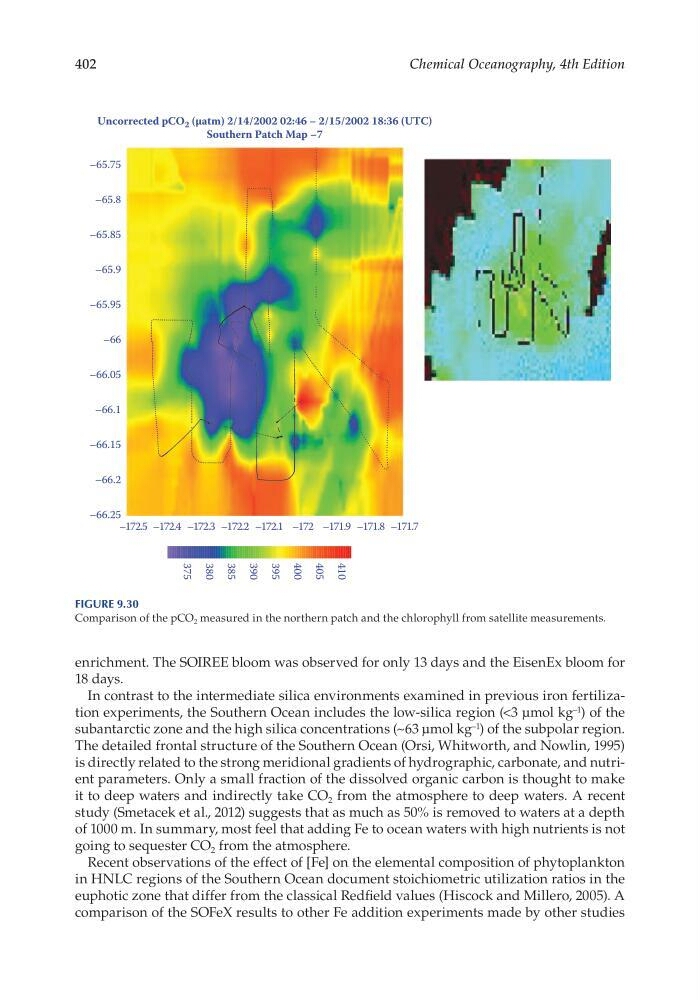
Figure 9.30
Comparison of the pCO 2 measured in the northern patch and the chlorophyll from satellite measurements.
Chemical Oceanography, 4th Edition
enrichment. The SOIREE bloom was observed for only 13 days and the EisenEx bloom for
18 days.
In contrast to the intermediate silica environments examined in previous iron fertilization experiments, the Southern Ocean includes the low- silica region (<3 μmol kg –1 ) of the
subantarctic zone and the high silica concentrations (~63 μmol kg –1 ) of the subpolar region.
The detailed frontal structure of the Southern Ocean (Orsi, Whitworth, and Nowlin, 1995)
is directly related to the strong meridional gradients of hydrographic, carbonate, and nutrient parameters. Only a small fraction of the dissolved organic carbon is thought to make
it to deep waters and indirectly take CO 2 from the atmosphere to deep waters. A recent
study (Smetacek et al., 2012) suggests that as much as 50% is removed to waters at a depth
of 1000 m. In summary, most feel that adding Fe to ocean waters with high nutrients is not
going to sequester CO 2 from the atmosphere.
Recent observations of the effect of [Fe] on the elemental composition of phytoplankton
in HNLC regions of the Southern Ocean document stoichiometric utilization ratios in the
euphotic zone that differ from the classical Redfield values (Hiscock and Millero, 2005). A
comparison of the SOFeX results to other Fe addition experiments made by other studies
–172.5 –172.4 –172.3 –172.2 –172.1 –172 –171.9 –171.8 –171.7
–66.25
–66.2
–66.15
–66.1
–66.05
–66
–65.95
–65.9
–65.85
–65.8
–65.75
375
380
385
390
395
400
405
410
Uncorrected pCO 2 (µatm) 2/14/2002 02:46 – 2/15/2002 18:36 (UTC)
Southern Patch Map –7
Figure 9.30
Comparison of the pCO 2 measured in the northern patch and the chlorophyll from satellite measurements.