

384
Chemical Oceanography, 4th Edition
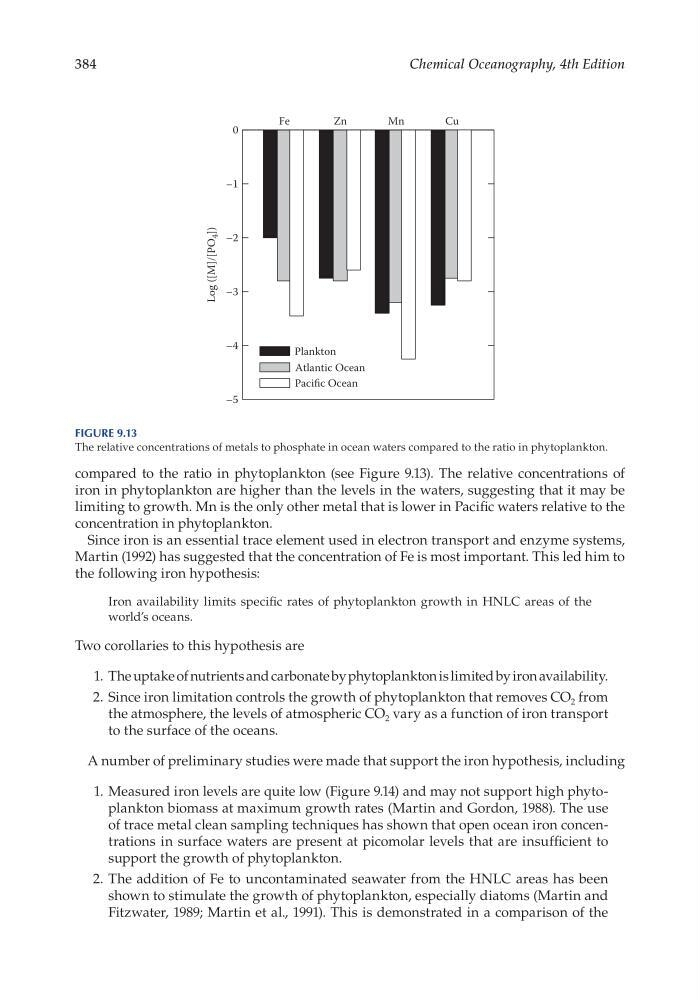
compared to the ratio in phytoplankton (see Figure 9.13). The relative concentrations of
iron in phytoplankton are higher than the levels in the waters, suggesting that it may be
limiting to growth. Mn is the only other metal that is lower in Pacific waters relative to the
concentration in phytoplankton.
Since iron is an essential trace element used in electron transport and enzyme systems,
Martin (1992) has suggested that the concentration of Fe is most important. This led him to
the following iron hypothesis:
Iron availability limits specific rates of phytoplankton growth in HNLC areas of the
world’s oceans.
Two corollaries to this hypothesis are
1. The uptake of nutrients and carbonate by phytoplankton is limited by iron availability.
2. Since iron limitation controls the growth of phytoplankton that removes CO 2 from
the atmosphere, the levels of atmospheric CO 2 vary as a function of iron transport
to the surface of the oceans.
A number of preliminary studies were made that support the iron hypothesis, including
1. Measured iron levels are quite low (Figure 9.14) and may not support high phytoplankton biomass at maximum growth rates (Martin and Gordon, 1988). The use
of trace metal clean sampling techniques has shown that open ocean iron concentrations in surface waters are present at picomolar levels that are insufficient to
support the growth of phytoplankton.
2. The addition of Fe to uncontaminated seawater from the HNLC areas has been
shown to stimulate the growth of phytoplankton, especially diatoms (Martin and
Fitzwater, 1989; Martin et al., 1991). This is demonstrated in a comparison of the
Log ([M]/[PO
4 ])
–5
–4
–3
–2
–1
0
Fe
Plankton
Atlantic Ocean
Pacific Ocean
Cu
Mn
Zn
Figure 9.13
The relative concentrations of metals to phosphate in ocean waters compared to the ratio in phytoplankton.
Chemical Oceanography, 4th Edition
compared to the ratio in phytoplankton (see Figure 9.13). The relative concentrations of
iron in phytoplankton are higher than the levels in the waters, suggesting that it may be
limiting to growth. Mn is the only other metal that is lower in Pacific waters relative to the
concentration in phytoplankton.
Since iron is an essential trace element used in electron transport and enzyme systems,
Martin (1992) has suggested that the concentration of Fe is most important. This led him to
the following iron hypothesis:
Iron availability limits specific rates of phytoplankton growth in HNLC areas of the
world’s oceans.
Two corollaries to this hypothesis are
1. The uptake of nutrients and carbonate by phytoplankton is limited by iron availability.
2. Since iron limitation controls the growth of phytoplankton that removes CO 2 from
the atmosphere, the levels of atmospheric CO 2 vary as a function of iron transport
to the surface of the oceans.
A number of preliminary studies were made that support the iron hypothesis, including
1. Measured iron levels are quite low (Figure 9.14) and may not support high phytoplankton biomass at maximum growth rates (Martin and Gordon, 1988). The use
of trace metal clean sampling techniques has shown that open ocean iron concentrations in surface waters are present at picomolar levels that are insufficient to
support the growth of phytoplankton.
2. The addition of Fe to uncontaminated seawater from the HNLC areas has been
shown to stimulate the growth of phytoplankton, especially diatoms (Martin and
Fitzwater, 1989; Martin et al., 1991). This is demonstrated in a comparison of the
Log ([M]/[PO
4 ])
–5
–4
–3
–2
–1
0
Fe
Plankton
Atlantic Ocean
Pacific Ocean
Cu
Mn
Zn
Figure 9.13
The relative concentrations of metals to phosphate in ocean waters compared to the ratio in phytoplankton.