

383
Primary Production in the Oceans
9.2 The Iron Hypothesis
Nitrate, phosphate, and silicate are needed for phytoplankton to grow in the surface waters
of the oceans. The limiting nutrient is thought to be nitrate in most ocean waters. Over 10%
of the world’s ocean surface waters, however, are replete with the major plant nutrients
(nitrate, phosphate, and silicate) and light, while standing stocks of phytoplankton remain
low. These areas include the North Pacific, the equatorial Pacific, and the Southern Ocean
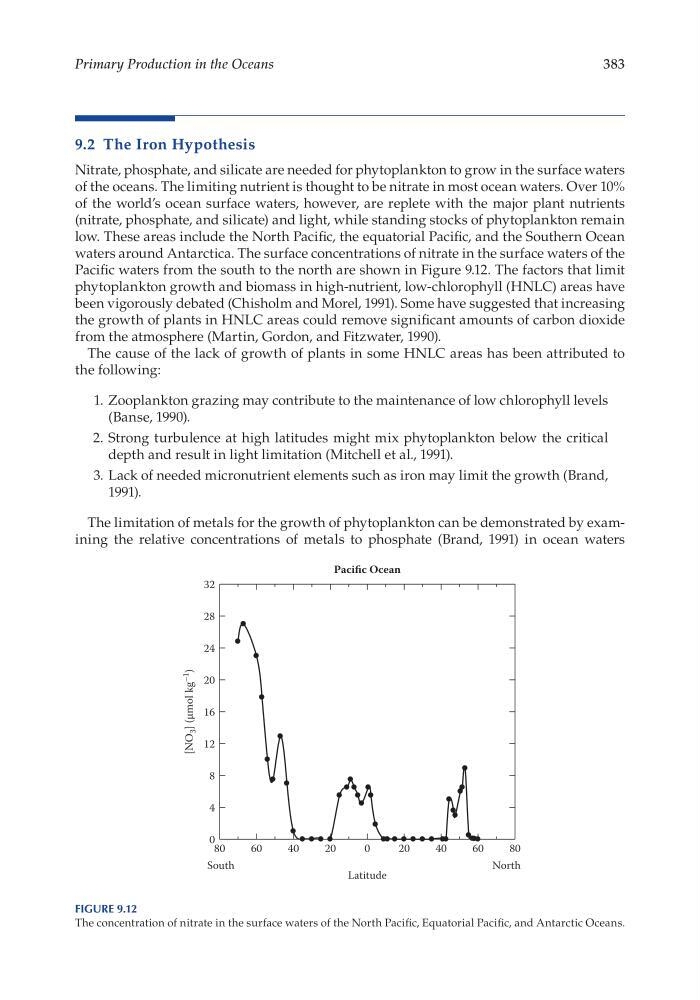
waters around Antarctica. The surface concentrations of nitrate in the surface waters of the
Pacific waters from the south to the north are shown in Figure 9.12. The factors that limit
phytoplankton growth and biomass in high- nutrient, low- chlorophyll (HNLC) areas have
been vigorously debated (Chisholm and Morel, 1991). Some have suggested that increasing
the growth of plants in HNLC areas could remove significant amounts of carbon dioxide
from the atmosphere (Martin, Gordon, and Fitzwater, 1990).
The cause of the lack of growth of plants in some HNLC areas has been attributed to
the following:
1. Zooplankton grazing may contribute to the maintenance of low chlorophyll levels
(Banse, 1990).
2. Strong turbulence at high latitudes might mix phytoplankton below the critical
depth and result in light limitation (Mitchell et al., 1991).
3. Lack of needed micronutrient elements such as iron may limit the growth (Brand,
1991).
The limitation of metals for the growth of phytoplankton can be demonstrated by examining the relative concentrations of metals to phosphate (Brand, 1991) in ocean waters
Latitude
[NO
3 ] (µmol kg
–1
)
0
4
8
12
16
20
24
28
32
North
South
80
60
40
20
0
20
40
60
80
Pacific Ocean
Figure 9.12
The concentration of nitrate in the surface waters of the North Pacific, Equatorial Pacific, and Antarctic Oceans.
Primary Production in the Oceans
9.2 The Iron Hypothesis
Nitrate, phosphate, and silicate are needed for phytoplankton to grow in the surface waters
of the oceans. The limiting nutrient is thought to be nitrate in most ocean waters. Over 10%
of the world’s ocean surface waters, however, are replete with the major plant nutrients
(nitrate, phosphate, and silicate) and light, while standing stocks of phytoplankton remain
low. These areas include the North Pacific, the equatorial Pacific, and the Southern Ocean
waters around Antarctica. The surface concentrations of nitrate in the surface waters of the
Pacific waters from the south to the north are shown in Figure 9.12. The factors that limit
phytoplankton growth and biomass in high- nutrient, low- chlorophyll (HNLC) areas have
been vigorously debated (Chisholm and Morel, 1991). Some have suggested that increasing
the growth of plants in HNLC areas could remove significant amounts of carbon dioxide
from the atmosphere (Martin, Gordon, and Fitzwater, 1990).
The cause of the lack of growth of plants in some HNLC areas has been attributed to
the following:
1. Zooplankton grazing may contribute to the maintenance of low chlorophyll levels
(Banse, 1990).
2. Strong turbulence at high latitudes might mix phytoplankton below the critical
depth and result in light limitation (Mitchell et al., 1991).
3. Lack of needed micronutrient elements such as iron may limit the growth (Brand,
1991).
The limitation of metals for the growth of phytoplankton can be demonstrated by examining the relative concentrations of metals to phosphate (Brand, 1991) in ocean waters
Latitude
[NO
3 ] (µmol kg
–1
)
0
4
8
12
16
20
24
28
32
North
South
80
60
40
20
0
20
40
60
80
Pacific Ocean
Figure 9.12
The concentration of nitrate in the surface waters of the North Pacific, Equatorial Pacific, and Antarctic Oceans.