

385
Primary Production in the Oceans
doubling times of phytoplankton in waters with and without the addition of iron
in waters collected near the North Pacific (Alaska), the South Pacific (Antarctica),
and the Equatorial Pacific (equator) in Figure 9.15.
3. Laboratory experiments have also shown that low levels of iron can limit the
growth of phytoplankton (Sunda et al., 1991; Hudson and Morel, 1990; Brand,
1991). Coastal phytoplankton have optimum ratios of Fe:P of 10 –2 to 10 –3.1 , while
most ocean species have ratios less than 10 –4 , an indication that the latter have
adapted to low levels of Fe in the open oceans. New production of cyanobacteria
is Fe limited, while algal biomass is not. By controlling the concentration of iron
by the addition of the complexing ligand EDTA, it can be shown that low levels of
Fe decrease the growth of coastal and oceanic cyanobacteria.
4. Fluorometry with a fast repetition rate has shown that the photochemical energy
conversion efficiency in phytoplankton is less than maximum in HNLC areas and
is significantly increased with the addition of nanomolar levels of iron (Greene,
Geider, and Falkowski, 1991).
These experiments suggested that iron availability and supply may regulate ocean production in HNLC areas. The historical record of atmospheric CO 2 , dust deposition, and
non- sea- salt aerosols (from the growth of phytoplankton) in the Vostok ice core suggests
that iron deposition may be related to ocean productivity (see Figure 9.16). The supply of
iron- rich dust to the oceans may cause an increase in ocean productivity and decrease the
atmospheric concentration of CO 2 (Martin, 1990).
0.0
0.3
0.6
0.9
1.2
1.5
Depth (m)
0
1000
2000
3000
4000 0
10
20
30
40
50
60
70
NO 3 (µmol kg
–1 )
Fe (nmol kg –1 )
Fe
NO 3
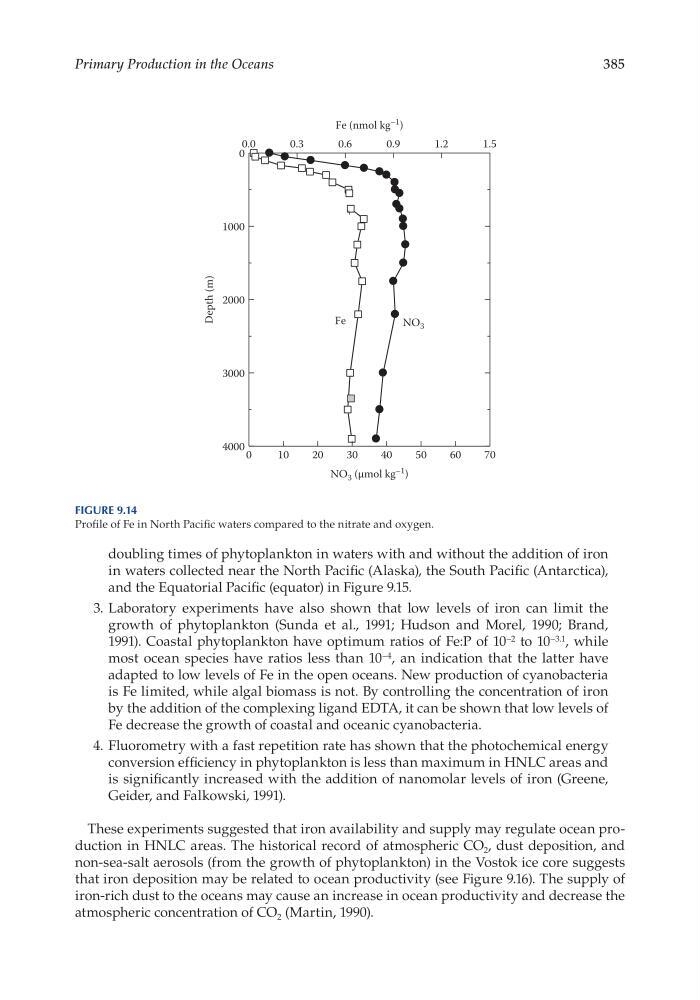
Figure 9.14
Profile of Fe in North Pacific waters compared to the nitrate and oxygen.
Primary Production in the Oceans
doubling times of phytoplankton in waters with and without the addition of iron
in waters collected near the North Pacific (Alaska), the South Pacific (Antarctica),
and the Equatorial Pacific (equator) in Figure 9.15.
3. Laboratory experiments have also shown that low levels of iron can limit the
growth of phytoplankton (Sunda et al., 1991; Hudson and Morel, 1990; Brand,
1991). Coastal phytoplankton have optimum ratios of Fe:P of 10 –2 to 10 –3.1 , while
most ocean species have ratios less than 10 –4 , an indication that the latter have
adapted to low levels of Fe in the open oceans. New production of cyanobacteria
is Fe limited, while algal biomass is not. By controlling the concentration of iron
by the addition of the complexing ligand EDTA, it can be shown that low levels of
Fe decrease the growth of coastal and oceanic cyanobacteria.
4. Fluorometry with a fast repetition rate has shown that the photochemical energy
conversion efficiency in phytoplankton is less than maximum in HNLC areas and
is significantly increased with the addition of nanomolar levels of iron (Greene,
Geider, and Falkowski, 1991).
These experiments suggested that iron availability and supply may regulate ocean production in HNLC areas. The historical record of atmospheric CO 2 , dust deposition, and
non- sea- salt aerosols (from the growth of phytoplankton) in the Vostok ice core suggests
that iron deposition may be related to ocean productivity (see Figure 9.16). The supply of
iron- rich dust to the oceans may cause an increase in ocean productivity and decrease the
atmospheric concentration of CO 2 (Martin, 1990).
0.0
0.3
0.6
0.9
1.2
1.5
Depth (m)
0
1000
2000
3000
4000 0
10
20
30
40
50
60
70
NO 3 (µmol kg
–1 )
Fe (nmol kg –1 )
Fe
NO 3
Figure 9.14
Profile of Fe in North Pacific waters compared to the nitrate and oxygen.