

381
Primary Production in the Oceans
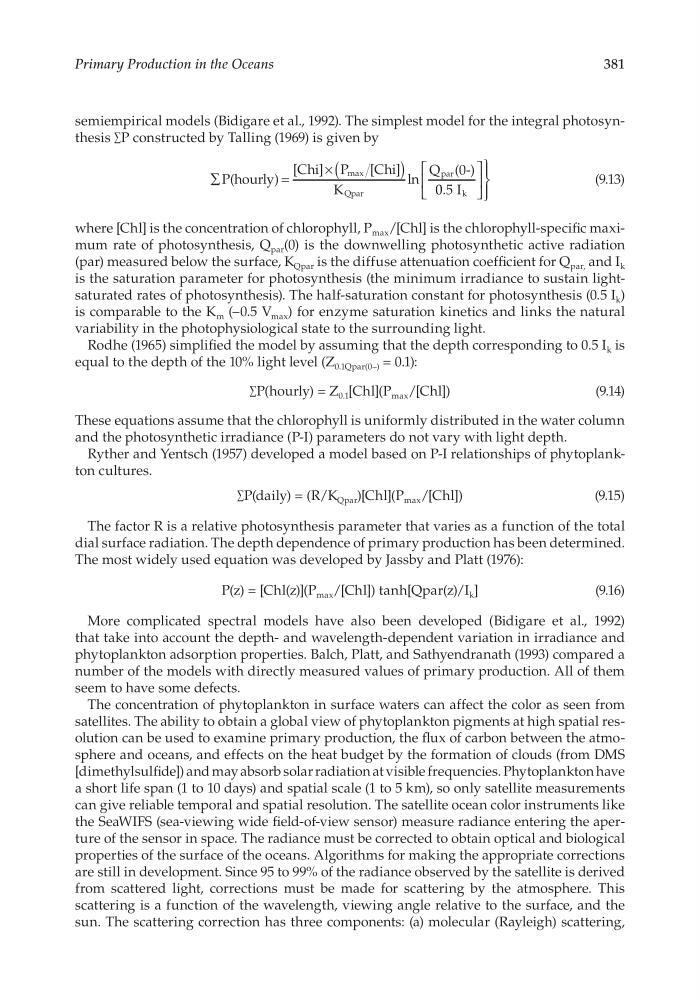
semiempirical models (Bidigare et al., 1992). The simplest model for the integral photosynthesis ∑P constructed by Talling (1969) is given by
∑
=
× (
)
P(hourly)
[Chi] P
[Chi]
K
ln
Q (0-)
max
Qpar
par
0 0.5 I k
(9.13)
where [Chl] is the concentration of chlorophyll, P max /[Chl] is the chlorophyll- specific maximum rate of photosynthesis, Q par (0) is the downwelling photosynthetic active radiation
(par) measured below the surface, K Qpar is the diffuse attenuation coefficient for Q par, and I k
is the saturation parameter for photosynthesis (the minimum irradiance to sustain lightsaturated rates of photosynthesis). The half- saturation constant for photosynthesis (0.5 I k )
is comparable to the K m (–0.5 V max ) for enzyme saturation kinetics and links the natural
variability in the photophysiological state to the surrounding light.
Rodhe (1965) simplified the model by assuming that the depth corresponding to 0.5 I k is
equal to the depth of the 10% light level (Z 0.1Qpar(0–) = 0.1):
∑P(hourly) = Z 0.1 [Chl](P max /[Chl])
(9.14)
These equations assume that the chlorophyll is uniformly distributed in the water column
and the photosynthetic irradiance (P- I) parameters do not vary with light depth.
Ryther and Yentsch (1957) developed a model based on P- I relationships of phytoplankton cultures.
∑P(daily) = (R/ K Qpar )[Chl](P max /[Chl])
(9.15)
The factor R is a relative photosynthesis parameter that varies as a function of the total
dial surface radiation. The depth dependence of primary production has been determined.
The most widely used equation was developed by Jassby and Platt (1976):
P(z) = [Chl(z)](P max /[Chl]) tanh[Qpar(z)/I k ]
(9.16)
More complicated spectral models have also been developed (Bidigare et al., 1992)
that take into account the depth- and wavelength- dependent variation in irradiance and
phyto plankton adsorption properties. Balch, Platt, and Sathyendranath (1993) compared a
number of the models with directly measured values of primary production. All of them
seem to have some defects.
The concentration of phytoplankton in surface waters can affect the color as seen from
satellites. The ability to obtain a global view of phytoplankton pigments at high spatial resolution can be used to examine primary production, the flux of carbon between the atmosphere and oceans, and effects on the heat budget by the formation of clouds (from DMS
[dimethylsulfide]) and may absorb solar radiation at visible frequencies. Phytoplankton have
a short life span (1 to 10 days) and spatial scale (1 to 5 km), so only satellite measurements
can give reliable temporal and spatial resolution. The satellite ocean color instruments like
the SeaWIFS (sea-viewing wide field-of-view sensor) measure radiance entering the aperture of the sensor in space. The radiance must be corrected to obtain optical and biological
properties of the surface of the oceans. Algorithms for making the appropriate corrections
are still in development. Since 95 to 99% of the radiance observed by the satellite is derived
from scattered light, corrections must be made for scattering by the atmosphere. This
scattering is a function of the wavelength, viewing angle relative to the surface, and the
sun. The scattering correction has three components: (a) molecular (Rayleigh) scattering,
Primary Production in the Oceans
semiempirical models (Bidigare et al., 1992). The simplest model for the integral photosynthesis ∑P constructed by Talling (1969) is given by
∑
=
× (
)
P(hourly)
[Chi] P
[Chi]
K
ln
Q (0-)
max
Qpar
par
0 0.5 I k
(9.13)
where [Chl] is the concentration of chlorophyll, P max /[Chl] is the chlorophyll- specific maximum rate of photosynthesis, Q par (0) is the downwelling photosynthetic active radiation
(par) measured below the surface, K Qpar is the diffuse attenuation coefficient for Q par, and I k
is the saturation parameter for photosynthesis (the minimum irradiance to sustain lightsaturated rates of photosynthesis). The half- saturation constant for photosynthesis (0.5 I k )
is comparable to the K m (–0.5 V max ) for enzyme saturation kinetics and links the natural
variability in the photophysiological state to the surrounding light.
Rodhe (1965) simplified the model by assuming that the depth corresponding to 0.5 I k is
equal to the depth of the 10% light level (Z 0.1Qpar(0–) = 0.1):
∑P(hourly) = Z 0.1 [Chl](P max /[Chl])
(9.14)
These equations assume that the chlorophyll is uniformly distributed in the water column
and the photosynthetic irradiance (P- I) parameters do not vary with light depth.
Ryther and Yentsch (1957) developed a model based on P- I relationships of phytoplankton cultures.
∑P(daily) = (R/ K Qpar )[Chl](P max /[Chl])
(9.15)
The factor R is a relative photosynthesis parameter that varies as a function of the total
dial surface radiation. The depth dependence of primary production has been determined.
The most widely used equation was developed by Jassby and Platt (1976):
P(z) = [Chl(z)](P max /[Chl]) tanh[Qpar(z)/I k ]
(9.16)
More complicated spectral models have also been developed (Bidigare et al., 1992)
that take into account the depth- and wavelength- dependent variation in irradiance and
phyto plankton adsorption properties. Balch, Platt, and Sathyendranath (1993) compared a
number of the models with directly measured values of primary production. All of them
seem to have some defects.
The concentration of phytoplankton in surface waters can affect the color as seen from
satellites. The ability to obtain a global view of phytoplankton pigments at high spatial resolution can be used to examine primary production, the flux of carbon between the atmosphere and oceans, and effects on the heat budget by the formation of clouds (from DMS
[dimethylsulfide]) and may absorb solar radiation at visible frequencies. Phytoplankton have
a short life span (1 to 10 days) and spatial scale (1 to 5 km), so only satellite measurements
can give reliable temporal and spatial resolution. The satellite ocean color instruments like
the SeaWIFS (sea-viewing wide field-of-view sensor) measure radiance entering the aperture of the sensor in space. The radiance must be corrected to obtain optical and biological
properties of the surface of the oceans. Algorithms for making the appropriate corrections
are still in development. Since 95 to 99% of the radiance observed by the satellite is derived
from scattered light, corrections must be made for scattering by the atmosphere. This
scattering is a function of the wavelength, viewing angle relative to the surface, and the
sun. The scattering correction has three components: (a) molecular (Rayleigh) scattering,