

374
Chemical Oceanography, 4th Edition
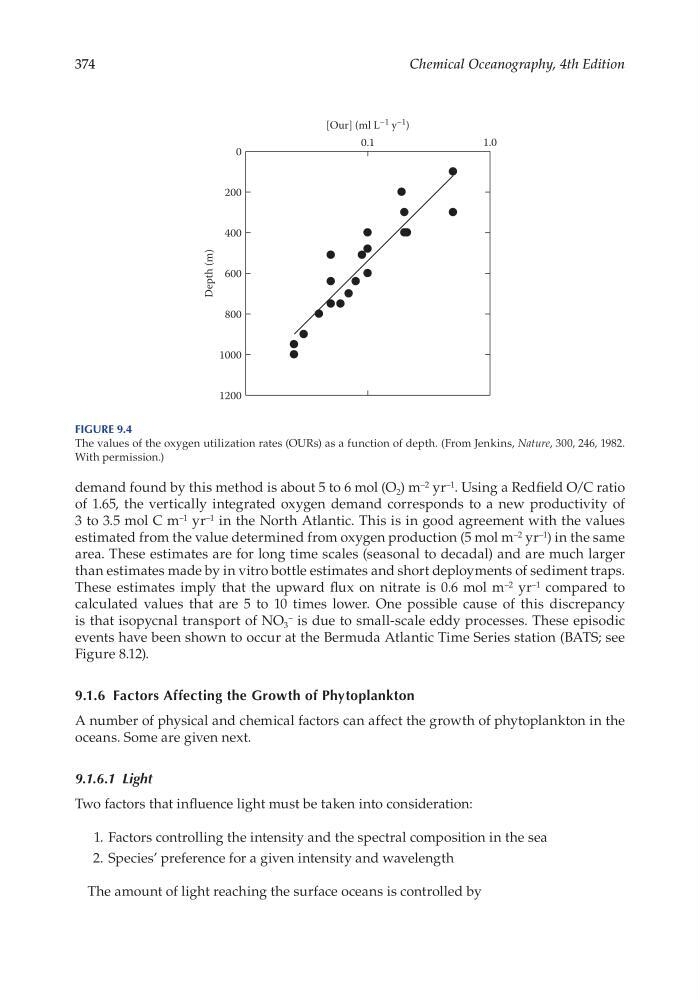
demand found by this method is about 5 to 6 mol (O 2 ) m –2 yr –1 . Using a Redfield O/ C ratio
of 1.65, the vertically integrated oxygen demand corresponds to a new productivity of
3 to 3.5 mol C m –1 yr –1 in the North Atlantic. This is in good agreement with the values
estimated from the value determined from oxygen production (5 mol m –2 yr –1 ) in the same
area. These estimates are for long time scales (seasonal to decadal) and are much larger
than estimates made by in vitro bottle estimates and short deployments of sediment traps.
These estimates imply that the upward flux on nitrate is 0.6 mol m –2 yr –1 compared to
calculated values that are 5 to 10 times lower. One possible cause of this discrepancy
is that isopycnal transport of NO 3
– is due to small- scale eddy processes. These episodic
events have been shown to occur at the Bermuda Atlantic Time Series station (BATS; see
Figure 8.12).
9.1.6 Factors affecting the growth of Phytoplankton
A number of physical and chemical factors can affect the growth of phytoplankton in the
oceans. Some are given next.
9.1.6.1 Light
Two factors that influence light must be taken into consideration:
1. Factors controlling the intensity and the spectral composition in the sea
2. Species’ preference for a given intensity and wavelength
The amount of light reaching the surface oceans is controlled by
[Our] (ml L
–1 y
–1 )
Depth (m)
0
200
400
600
800
1000
1200
0.1
1.0
Figure 9.4
The values of the oxygen utilization rates (OURs) as a function of depth. (From Jenkins, Nature, 300, 246, 1982.
With permission.)
Chemical Oceanography, 4th Edition
demand found by this method is about 5 to 6 mol (O 2 ) m –2 yr –1 . Using a Redfield O/ C ratio
of 1.65, the vertically integrated oxygen demand corresponds to a new productivity of
3 to 3.5 mol C m –1 yr –1 in the North Atlantic. This is in good agreement with the values
estimated from the value determined from oxygen production (5 mol m –2 yr –1 ) in the same
area. These estimates are for long time scales (seasonal to decadal) and are much larger
than estimates made by in vitro bottle estimates and short deployments of sediment traps.
These estimates imply that the upward flux on nitrate is 0.6 mol m –2 yr –1 compared to
calculated values that are 5 to 10 times lower. One possible cause of this discrepancy
is that isopycnal transport of NO 3
– is due to small- scale eddy processes. These episodic
events have been shown to occur at the Bermuda Atlantic Time Series station (BATS; see
Figure 8.12).
9.1.6 Factors affecting the growth of Phytoplankton
A number of physical and chemical factors can affect the growth of phytoplankton in the
oceans. Some are given next.
9.1.6.1 Light
Two factors that influence light must be taken into consideration:
1. Factors controlling the intensity and the spectral composition in the sea
2. Species’ preference for a given intensity and wavelength
The amount of light reaching the surface oceans is controlled by
[Our] (ml L
–1 y
–1 )
Depth (m)
0
200
400
600
800
1000
1200
0.1
1.0
Figure 9.4
The values of the oxygen utilization rates (OURs) as a function of depth. (From Jenkins, Nature, 300, 246, 1982.
With permission.)