

375
Primary Production in the Oceans
1. The sun’s altitude
2. Cloud cover
3. Wavelength (370 to 720 nm)
4. Reflection, absorption, and scattering
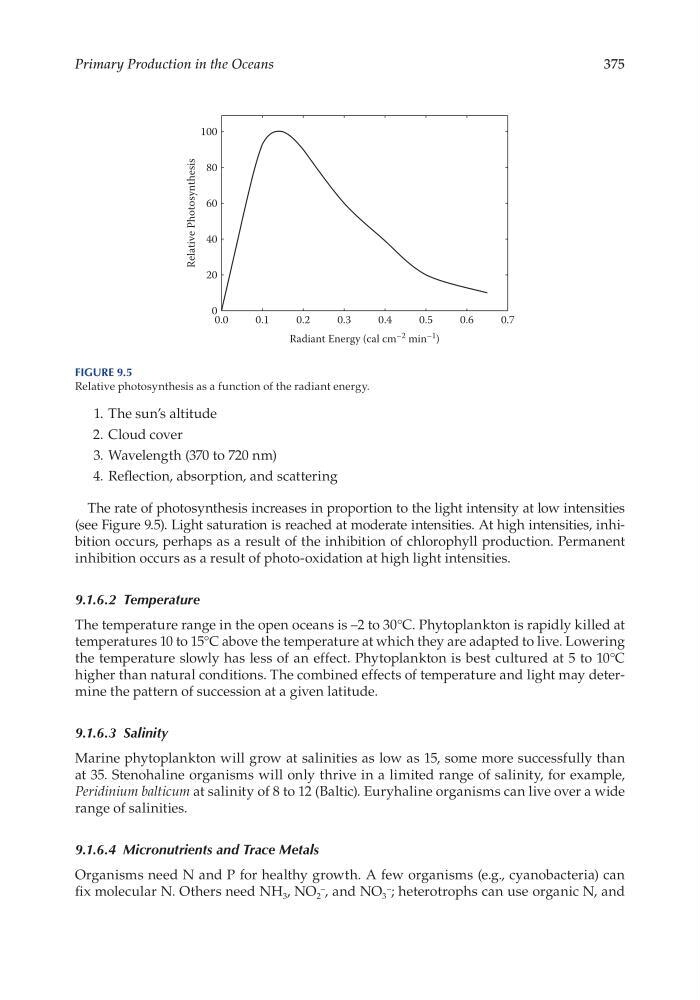
The rate of photosynthesis increases in proportion to the light intensity at low intensities
(see Figure 9.5). Light saturation is reached at moderate intensities. At high intensities, inhibition occurs, perhaps as a result of the inhibition of chlorophyll production. Permanent
inhibition occurs as a result of photo- oxidation at high light intensities.
9.1.6.2 Temperature
The temperature range in the open oceans is –2 to 30°C. Phytoplankton is rapidly killed at
temperatures 10 to 15°C above the temperature at which they are adapted to live. Lowering
the temperature slowly has less of an effect. Phytoplankton is best cultured at 5 to 10°C
higher than natural conditions. The combined effects of temperature and light may determine the pattern of succession at a given latitude.
9.1.6.3 Salinity
Marine phytoplankton will grow at salinities as low as 15, some more successfully than
at 35. Stenohaline organisms will only thrive in a limited range of salinity, for example,
Peridinium balticum at salinity of 8 to 12 (Baltic). Euryhaline organisms can live over a wide
range of salinities.
9.1.6.4 Micronutrients and Trace Metals
Organisms need N and P for healthy growth. A few organisms (e.g., cyanobacteria) can
fix molecular N. Others need NH 3 , NO 2
– , and NO 3
– ; heterotrophs can use organic N, and
Radiant Energy (cal cm
–2 min
–1 )
0.0
0.1
0.2
0.3
0.4
0.5
0.6
0.7
Relative Photosynthesis
0
20
40
60
80
100
Figure 9.5
Relative photosynthesis as a function of the radiant energy.
Primary Production in the Oceans
1. The sun’s altitude
2. Cloud cover
3. Wavelength (370 to 720 nm)
4. Reflection, absorption, and scattering
The rate of photosynthesis increases in proportion to the light intensity at low intensities
(see Figure 9.5). Light saturation is reached at moderate intensities. At high intensities, inhibition occurs, perhaps as a result of the inhibition of chlorophyll production. Permanent
inhibition occurs as a result of photo- oxidation at high light intensities.
9.1.6.2 Temperature
The temperature range in the open oceans is –2 to 30°C. Phytoplankton is rapidly killed at
temperatures 10 to 15°C above the temperature at which they are adapted to live. Lowering
the temperature slowly has less of an effect. Phytoplankton is best cultured at 5 to 10°C
higher than natural conditions. The combined effects of temperature and light may determine the pattern of succession at a given latitude.
9.1.6.3 Salinity
Marine phytoplankton will grow at salinities as low as 15, some more successfully than
at 35. Stenohaline organisms will only thrive in a limited range of salinity, for example,
Peridinium balticum at salinity of 8 to 12 (Baltic). Euryhaline organisms can live over a wide
range of salinities.
9.1.6.4 Micronutrients and Trace Metals
Organisms need N and P for healthy growth. A few organisms (e.g., cyanobacteria) can
fix molecular N. Others need NH 3 , NO 2
– , and NO 3
– ; heterotrophs can use organic N, and
Radiant Energy (cal cm
–2 min
–1 )
0.0
0.1
0.2
0.3
0.4
0.5
0.6
0.7
Relative Photosynthesis
0
20
40
60
80
100
Figure 9.5
Relative photosynthesis as a function of the radiant energy.