

373
Primary Production in the Oceans
NO 3
– to the photic zone and the accumulation of oxygen in the photic zone. Other methods
that have been used in recent years are based on the use of tracers. These include
1. The measurement of the consumption of O 2 that results from the production in
surface waters and export of organic carbon from the photic zone. The vertical
integration of the oxygen utilization rates (OURs) can be used to estimate new
production. This method gives long- term (seasonal- to- decadal) and large- scale
(1000-km) averages of new production.
2. The measurement of the production rates of O 2 in the photic zone.
3. The flux of nitrate into the euphotic zone, which can be estimated by examining the balance between the upward flux of 3 He from the thermocline and the loss
to the atmosphere.
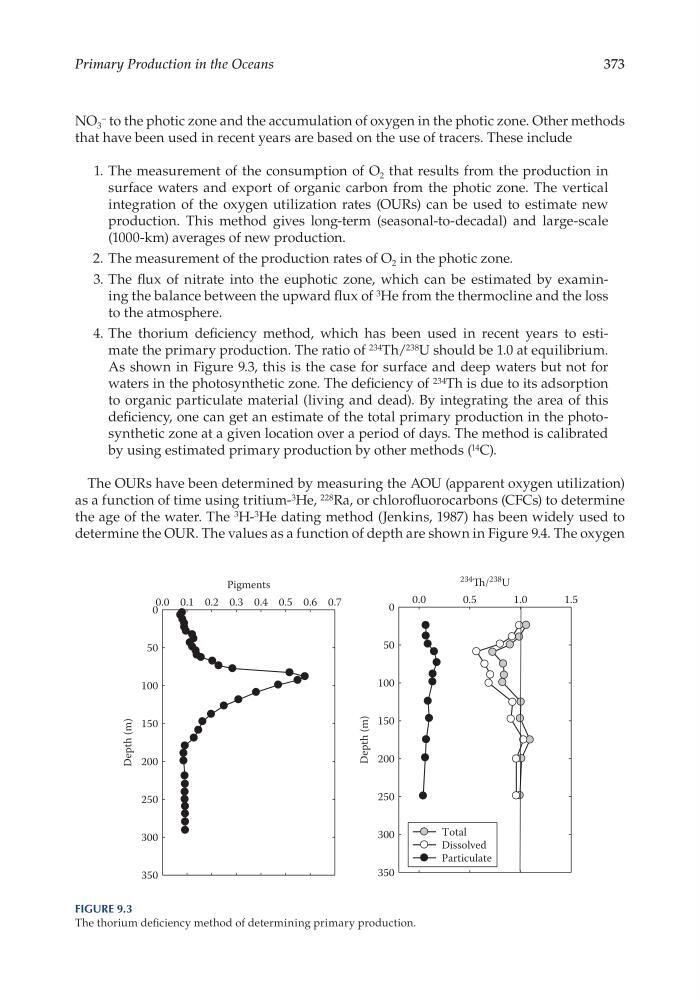
4. The thorium deficiency method, which has been used in recent years to estimate the primary production. The ratio of 234 Th/ 238 U should be 1.0 at equilibrium.
As shown in Figure 9.3, this is the case for surface and deep waters but not for
waters in the photosynthetic zone. The deficiency of 234 Th is due to its adsorption
to organic particulate material (living and dead). By integrating the area of this
deficiency, one can get an estimate of the total primary production in the photosynthetic zone at a given location over a period of days. The method is calibrated
by using estimated primary production by other methods ( 14 C).
The OURs have been determined by measuring the AOU (apparent oxygen utilization)
as a function of time using tritium- 3 He, 228 Ra, or chlorofluorocarbons (CFCs) to determine
the age of the water. The 3 H- 3 He dating method (Jenkins, 1987) has been widely used to
determine the OUR. The values as a function of depth are shown in Figure 9.4. The oxygen
Pigments
0.0 0.1 0.2 0.3 0.4 0.5 0.6 0.7
Depth (m)
0
50
100
150
200
250
300
350
234 /
238 U
0.0
0.5
1.0
1.5
Depth (m)
0
50
100
150
200
250
300
350
Total
Dissolved
Particulate
Figure 9.3
The thorium deficiency method of determining primary production.
Primary Production in the Oceans
NO 3
– to the photic zone and the accumulation of oxygen in the photic zone. Other methods
that have been used in recent years are based on the use of tracers. These include
1. The measurement of the consumption of O 2 that results from the production in
surface waters and export of organic carbon from the photic zone. The vertical
integration of the oxygen utilization rates (OURs) can be used to estimate new
production. This method gives long- term (seasonal- to- decadal) and large- scale
(1000-km) averages of new production.
2. The measurement of the production rates of O 2 in the photic zone.
3. The flux of nitrate into the euphotic zone, which can be estimated by examining the balance between the upward flux of 3 He from the thermocline and the loss
to the atmosphere.
4. The thorium deficiency method, which has been used in recent years to estimate the primary production. The ratio of 234 Th/ 238 U should be 1.0 at equilibrium.
As shown in Figure 9.3, this is the case for surface and deep waters but not for
waters in the photosynthetic zone. The deficiency of 234 Th is due to its adsorption
to organic particulate material (living and dead). By integrating the area of this
deficiency, one can get an estimate of the total primary production in the photosynthetic zone at a given location over a period of days. The method is calibrated
by using estimated primary production by other methods ( 14 C).
The OURs have been determined by measuring the AOU (apparent oxygen utilization)
as a function of time using tritium- 3 He, 228 Ra, or chlorofluorocarbons (CFCs) to determine
the age of the water. The 3 H- 3 He dating method (Jenkins, 1987) has been widely used to
determine the OUR. The values as a function of depth are shown in Figure 9.4. The oxygen
Pigments
0.0 0.1 0.2 0.3 0.4 0.5 0.6 0.7
Depth (m)
0
50
100
150
200
250
300
350
234 /
238 U
0.0
0.5
1.0
1.5
Depth (m)
0
50
100
150
200
250
300
350
Total
Dissolved
Particulate
Figure 9.3
The thorium deficiency method of determining primary production.