

361
Micronutrients in the Oceans
Petty (1983) have described a flow injection method that can be used to quickly and accurately determine silicate in seawater. As with the system described previously for phosphate and nitrate, it is automatic and can measure 30 samples per hour. The precision is 1%
and has a lower detection limit of 0.1 μM.
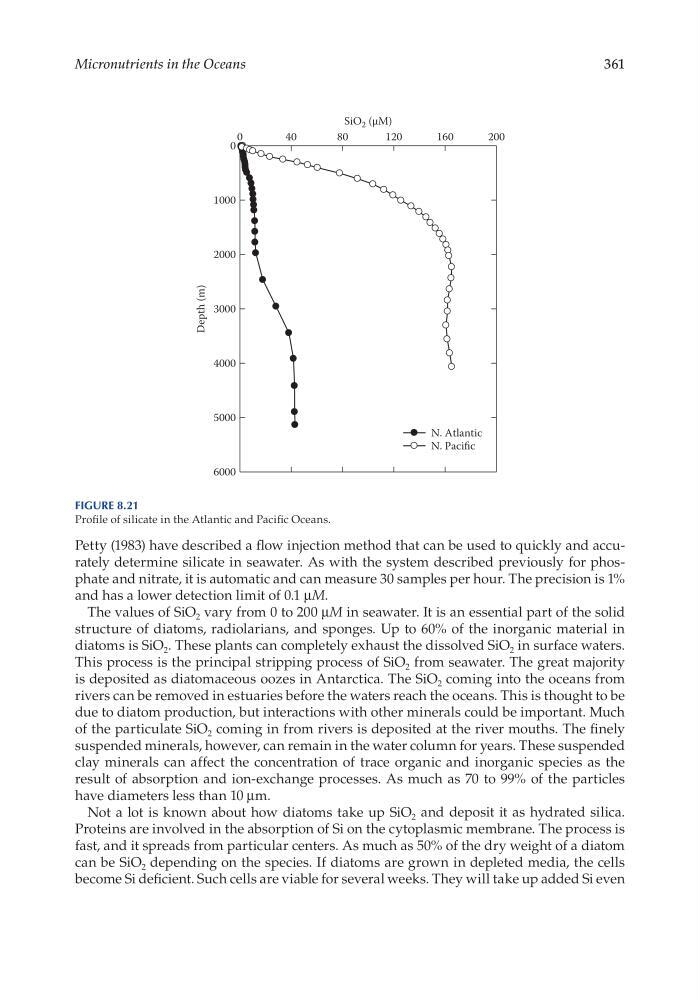
The values of SiO 2 vary from 0 to 200 μM in seawater. It is an essential part of the solid
structure of diatoms, radiolarians, and sponges. Up to 60% of the inorganic material in
diatoms is SiO 2 . These plants can completely exhaust the dissolved SiO 2 in surface waters.
This process is the principal stripping process of SiO 2 from seawater. The great majority
is deposited as diatomaceous oozes in Antarctica. The SiO 2 coming into the oceans from
rivers can be removed in estuaries before the waters reach the oceans. This is thought to be
due to diatom production, but interactions with other minerals could be important. Much
of the particulate SiO 2 coming in from rivers is deposited at the river mouths. The finely
suspended minerals, however, can remain in the water column for years. These suspended
clay minerals can affect the concentration of trace organic and inorganic species as the
result of absorption and ion- exchange processes. As much as 70 to 99% of the particles
have diameters less than 10 μm.
Not a lot is known about how diatoms take up SiO 2 and deposit it as hydrated silica.
Proteins are involved in the absorption of Si on the cytoplasmic membrane. The process is
fast, and it spreads from particular centers. As much as 50% of the dry weight of a diatom
can be SiO 2 depending on the species. If diatoms are grown in depleted media, the cells
become Si deficient. Such cells are viable for several weeks. They will take up added Si even
SiO 2 (µM)
0
40
80
120
160
200
Depth (m)
0
1000
2000
3000
4000
5000
6000
N. Atlantic
N. Pacific
Figure 8.21
Profile of silicate in the Atlantic and Pacific Oceans.
Micronutrients in the Oceans
Petty (1983) have described a flow injection method that can be used to quickly and accurately determine silicate in seawater. As with the system described previously for phosphate and nitrate, it is automatic and can measure 30 samples per hour. The precision is 1%
and has a lower detection limit of 0.1 μM.
The values of SiO 2 vary from 0 to 200 μM in seawater. It is an essential part of the solid
structure of diatoms, radiolarians, and sponges. Up to 60% of the inorganic material in
diatoms is SiO 2 . These plants can completely exhaust the dissolved SiO 2 in surface waters.
This process is the principal stripping process of SiO 2 from seawater. The great majority
is deposited as diatomaceous oozes in Antarctica. The SiO 2 coming into the oceans from
rivers can be removed in estuaries before the waters reach the oceans. This is thought to be
due to diatom production, but interactions with other minerals could be important. Much
of the particulate SiO 2 coming in from rivers is deposited at the river mouths. The finely
suspended minerals, however, can remain in the water column for years. These suspended
clay minerals can affect the concentration of trace organic and inorganic species as the
result of absorption and ion- exchange processes. As much as 70 to 99% of the particles
have diameters less than 10 μm.
Not a lot is known about how diatoms take up SiO 2 and deposit it as hydrated silica.
Proteins are involved in the absorption of Si on the cytoplasmic membrane. The process is
fast, and it spreads from particular centers. As much as 50% of the dry weight of a diatom
can be SiO 2 depending on the species. If diatoms are grown in depleted media, the cells
become Si deficient. Such cells are viable for several weeks. They will take up added Si even
SiO 2 (µM)
0
40
80
120
160
200
Depth (m)
0
1000
2000
3000
4000
5000
6000
N. Atlantic
N. Pacific
Figure 8.21
Profile of silicate in the Atlantic and Pacific Oceans.