

362
Chemical Oceanography, 4th Edition
in the dark. If deficient cells are illuminated, they photosynthesize for a limited period,
but they soon die. The silica in diatoms is insoluble when living but dissolves rapidly when
they die. An organic or inorganic (Al or Fe) skin may protect them when they are alive. The
treatment of dead cells with EDTA has been shown to accelerate the dissolution.
8.4.2 Distribution of Dissolved SiO 2
The distribution of SiO 2 in coastal waters is generally higher than in the open oceans
because of river runoff. In regions where diatom blooms occur, the seasonal variations are
similar to PO 4
3– . The concentrations decrease in the spring and increase in the summer
when growth slackens and then increase to a maximum in early winter. The concentrations in surface waters are low except in upwelling areas. A typical depth profile is shown
in Figure 8.21. A section of the distribution of SiO 2 in the Atlantic, Pacific, and Indian
Oceans is shown in Figure 8.22. The lateral distribution follows the general water mass
circulation. The high values in the Antarctic region are from the large diatom production
in the surface waters. The SiO 2 is also added to the deeper waters from the flux from the
sediments. The glacial weathering may also lead to higher concentrations of SiO 2 in these
regions. The high concentration of SiO 2 in the Antarctic bottom waters can be used to
trace this water mass. The vertical section in the Pacific (Figure 8.22) shows that the values
in the deep waters increase toward the north and reach concentrations of 220 μM in the
Bering Sea.
8.5 Use of Nutrients as Water Mass Tracers
Traditionally, temperature and salinity have been used as a tracer of water masses. More
recently, isotopes such as tritium have been used. From time to time, a number of workers have used nutrients to follow various water masses. To use nutrients, it is necessary to
make a correction to the amount of nutrients added because of the oxidation of plant material. The concentration of a nutrient present in the water when it was at the surface is called
the preformed value. This preformed value should be conservative if other processes are
not involved in the addition or subtraction from the water mass. Although both PO 4
3– and
NO 3
– have been used to trace water masses, only NO 3
– is discussed in this section. As
shown by Broecker (1974), the combination of O 2 and NO 2
– can lead to a conservative water
mass tracer. The oxidation that occurs is estimated from the AOU. The oxidation of plant
material is given by
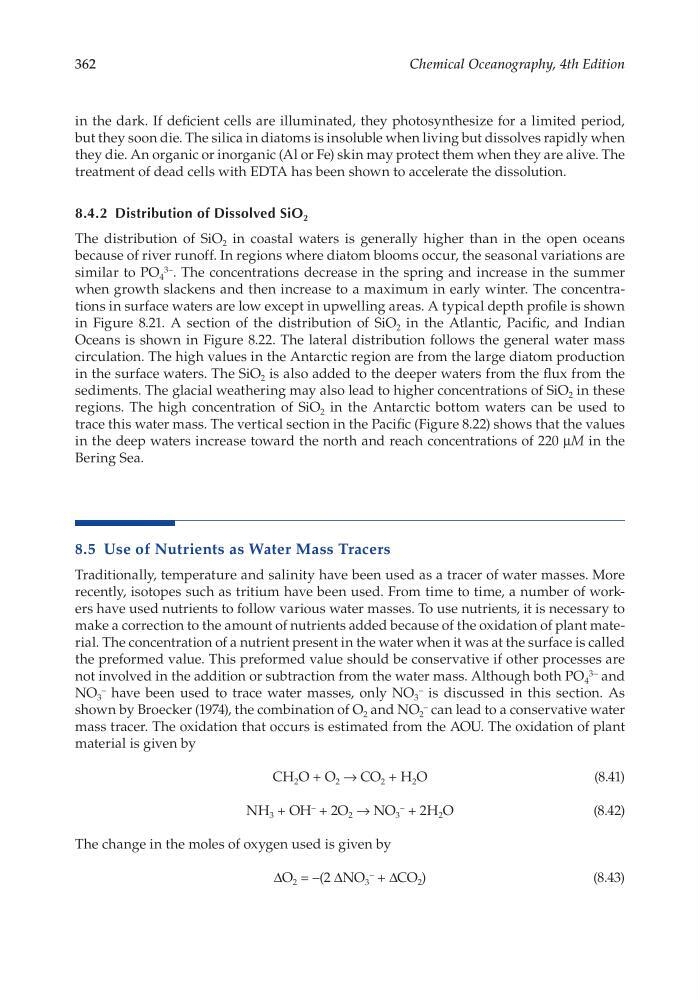
CH 2 O + O 2 → CO 2 + H 2 O
(8.41)
NH 3 + OH – + 2O 2 → NO 3
– + 2H 2 O
(8.42)
The change in the moles of oxygen used is given by
ΔO 2 = –(2 ΔNO 3
– + ΔCO 2 )
(8.43)
Chemical Oceanography, 4th Edition
in the dark. If deficient cells are illuminated, they photosynthesize for a limited period,
but they soon die. The silica in diatoms is insoluble when living but dissolves rapidly when
they die. An organic or inorganic (Al or Fe) skin may protect them when they are alive. The
treatment of dead cells with EDTA has been shown to accelerate the dissolution.
8.4.2 Distribution of Dissolved SiO 2
The distribution of SiO 2 in coastal waters is generally higher than in the open oceans
because of river runoff. In regions where diatom blooms occur, the seasonal variations are
similar to PO 4
3– . The concentrations decrease in the spring and increase in the summer
when growth slackens and then increase to a maximum in early winter. The concentrations in surface waters are low except in upwelling areas. A typical depth profile is shown
in Figure 8.21. A section of the distribution of SiO 2 in the Atlantic, Pacific, and Indian
Oceans is shown in Figure 8.22. The lateral distribution follows the general water mass
circulation. The high values in the Antarctic region are from the large diatom production
in the surface waters. The SiO 2 is also added to the deeper waters from the flux from the
sediments. The glacial weathering may also lead to higher concentrations of SiO 2 in these
regions. The high concentration of SiO 2 in the Antarctic bottom waters can be used to
trace this water mass. The vertical section in the Pacific (Figure 8.22) shows that the values
in the deep waters increase toward the north and reach concentrations of 220 μM in the
Bering Sea.
8.5 Use of Nutrients as Water Mass Tracers
Traditionally, temperature and salinity have been used as a tracer of water masses. More
recently, isotopes such as tritium have been used. From time to time, a number of workers have used nutrients to follow various water masses. To use nutrients, it is necessary to
make a correction to the amount of nutrients added because of the oxidation of plant material. The concentration of a nutrient present in the water when it was at the surface is called
the preformed value. This preformed value should be conservative if other processes are
not involved in the addition or subtraction from the water mass. Although both PO 4
3– and
NO 3
– have been used to trace water masses, only NO 3
– is discussed in this section. As
shown by Broecker (1974), the combination of O 2 and NO 2
– can lead to a conservative water
mass tracer. The oxidation that occurs is estimated from the AOU. The oxidation of plant
material is given by
CH 2 O + O 2 → CO 2 + H 2 O
(8.41)
NH 3 + OH – + 2O 2 → NO 3
– + 2H 2 O
(8.42)
The change in the moles of oxygen used is given by
ΔO 2 = –(2 ΔNO 3
– + ΔCO 2 )
(8.43)