

360
Chemical Oceanography, 4th Edition
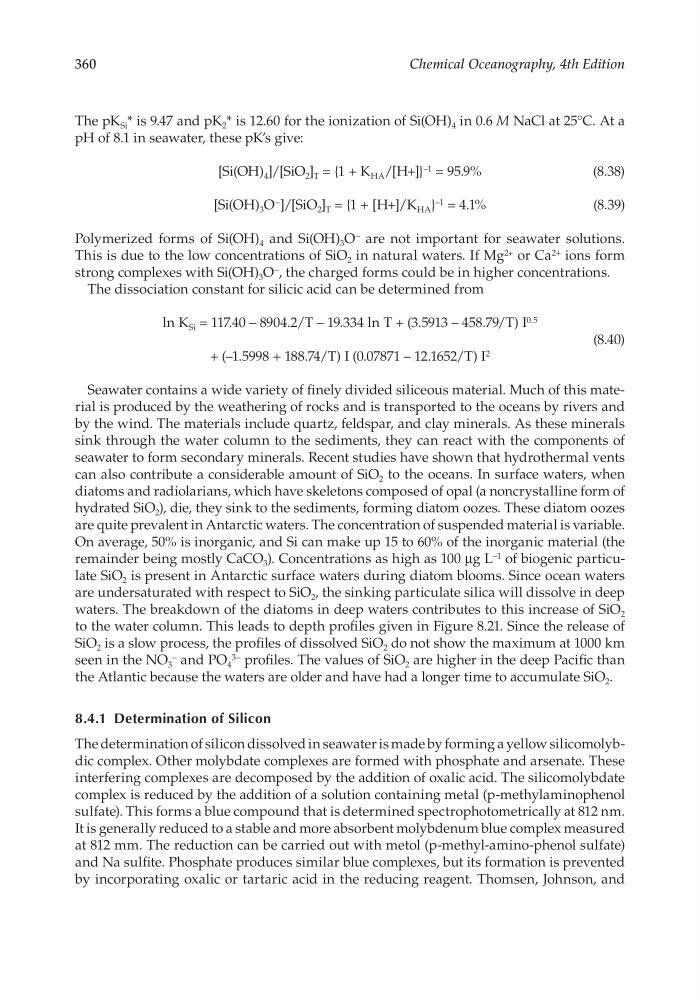
The pK Si * is 9.47 and pK 2 * is 12.60 for the ionization of Si(OH) 4 in 0.6 M NaCl at 25°C. At a
pH of 8.1 in seawater, these pK’s give:
[Si(OH) 4 ]/[SiO 2 ] T = {1 + K HA /[H+]} –1 = 95.9%
(8.38)
[Si(OH) 3 O − ]/[SiO 2 ] T = {1 + [H+]/K HA } –1 = 4.1%
(8.39)
Polymerized forms of Si(OH) 4 and Si(OH) 3 O – are not important for seawater solutions.
This is due to the low concentrations of SiO 2 in natural waters. If Mg 2+ or Ca 2+ ions form
strong complexes with Si(OH) 3 O – , the charged forms could be in higher concentrations.
The dissociation constant for silicic acid can be determined from
ln K Si = 117.40 – 8904.2/T – 19.334 ln T + (3.5913 – 458.79/T) I 0.5
+ (–1.5998 + 188.74/T) I (0.07871 – 12.1652/T) I 2
(8.40)
Seawater contains a wide variety of finely divided siliceous material. Much of this material is produced by the weathering of rocks and is transported to the oceans by rivers and
by the wind. The materials include quartz, feldspar, and clay minerals. As these minerals
sink through the water column to the sediments, they can react with the components of
seawater to form secondary minerals. Recent studies have shown that hydrothermal vents
can also contribute a considerable amount of SiO 2 to the oceans. In surface waters, when
diatoms and radiolarians, which have skeletons composed of opal (a noncrystalline form of
hydrated SiO 2 ), die, they sink to the sediments, forming diatom oozes. These diatom oozes
are quite prevalent in Antarctic waters. The concentration of suspended material is variable.
On average, 50% is inorganic, and Si can make up 15 to 60% of the inorganic material (the
remainder being mostly CaCO 3 ). Concentrations as high as 100 μg L –1 of biogenic particulate SiO 2 is present in Antarctic surface waters during diatom blooms. Since ocean waters
are undersaturated with respect to SiO 2 , the sinking particulate silica will dissolve in deep
waters. The breakdown of the diatoms in deep waters contributes to this increase of SiO 2
to the water column. This leads to depth profiles given in Figure 8.21. Since the release of
SiO 2 is a slow process, the profiles of dissolved SiO 2 do not show the maximum at 1000 km
seen in the NO 3
– and PO 4
3– profiles. The values of SiO 2 are higher in the deep Pacific than
the Atlantic because the waters are older and have had a longer time to accumulate SiO 2 .
8.4.1 Determination of Silicon
The determination of silicon dissolved in seawater is made by forming a yellow silicomolybdic complex. Other molybdate complexes are formed with phosphate and arsenate. These
interfering complexes are decomposed by the addition of oxalic acid. The silicomolybdate
complex is reduced by the addition of a solution containing metal (p- methylaminophenol
sulfate). This forms a blue compound that is determined spectrophotometrically at 812 nm.
It is generally reduced to a stable and more absorbent molybdenum blue complex measured
at 812 mm. The reduction can be carried out with metol (p- methyl- amino- phenol sulfate)
and Na sulfite. Phosphate produces similar blue complexes, but its formation is prevented
by incorporating oxalic or tartaric acid in the reducing reagent. Thomsen, Johnson, and
Chemical Oceanography, 4th Edition
The pK Si * is 9.47 and pK 2 * is 12.60 for the ionization of Si(OH) 4 in 0.6 M NaCl at 25°C. At a
pH of 8.1 in seawater, these pK’s give:
[Si(OH) 4 ]/[SiO 2 ] T = {1 + K HA /[H+]} –1 = 95.9%
(8.38)
[Si(OH) 3 O − ]/[SiO 2 ] T = {1 + [H+]/K HA } –1 = 4.1%
(8.39)
Polymerized forms of Si(OH) 4 and Si(OH) 3 O – are not important for seawater solutions.
This is due to the low concentrations of SiO 2 in natural waters. If Mg 2+ or Ca 2+ ions form
strong complexes with Si(OH) 3 O – , the charged forms could be in higher concentrations.
The dissociation constant for silicic acid can be determined from
ln K Si = 117.40 – 8904.2/T – 19.334 ln T + (3.5913 – 458.79/T) I 0.5
+ (–1.5998 + 188.74/T) I (0.07871 – 12.1652/T) I 2
(8.40)
Seawater contains a wide variety of finely divided siliceous material. Much of this material is produced by the weathering of rocks and is transported to the oceans by rivers and
by the wind. The materials include quartz, feldspar, and clay minerals. As these minerals
sink through the water column to the sediments, they can react with the components of
seawater to form secondary minerals. Recent studies have shown that hydrothermal vents
can also contribute a considerable amount of SiO 2 to the oceans. In surface waters, when
diatoms and radiolarians, which have skeletons composed of opal (a noncrystalline form of
hydrated SiO 2 ), die, they sink to the sediments, forming diatom oozes. These diatom oozes
are quite prevalent in Antarctic waters. The concentration of suspended material is variable.
On average, 50% is inorganic, and Si can make up 15 to 60% of the inorganic material (the
remainder being mostly CaCO 3 ). Concentrations as high as 100 μg L –1 of biogenic particulate SiO 2 is present in Antarctic surface waters during diatom blooms. Since ocean waters
are undersaturated with respect to SiO 2 , the sinking particulate silica will dissolve in deep
waters. The breakdown of the diatoms in deep waters contributes to this increase of SiO 2
to the water column. This leads to depth profiles given in Figure 8.21. Since the release of
SiO 2 is a slow process, the profiles of dissolved SiO 2 do not show the maximum at 1000 km
seen in the NO 3
– and PO 4
3– profiles. The values of SiO 2 are higher in the deep Pacific than
the Atlantic because the waters are older and have had a longer time to accumulate SiO 2 .
8.4.1 Determination of Silicon
The determination of silicon dissolved in seawater is made by forming a yellow silicomolybdic complex. Other molybdate complexes are formed with phosphate and arsenate. These
interfering complexes are decomposed by the addition of oxalic acid. The silicomolybdate
complex is reduced by the addition of a solution containing metal (p- methylaminophenol
sulfate). This forms a blue compound that is determined spectrophotometrically at 812 nm.
It is generally reduced to a stable and more absorbent molybdenum blue complex measured
at 812 mm. The reduction can be carried out with metol (p- methyl- amino- phenol sulfate)
and Na sulfite. Phosphate produces similar blue complexes, but its formation is prevented
by incorporating oxalic or tartaric acid in the reducing reagent. Thomsen, Johnson, and