

359
Micronutrients in the Oceans
demand for oxidation of organic molecules without N. The decomposition of fatty acids
would require more O 2 :
C 2 H 4 + 3O 2 → 2CO 2 + 2H 2 O
(8.32)
rather than what Redfield assumed:
C + O 2 → CO 2
(8.33)
These results lead to the following equation for the oxidation of phytoplankton- derived
organic carbon:
(CH 2 O) 103 (CH 2 ) 3 (NH 3 ) 16 (H 3 PO 4 ) + 135O 2
→ 103CO 2 + 119H 2 O+ 16HNO 3 + H 3 PO 4
(8.34)
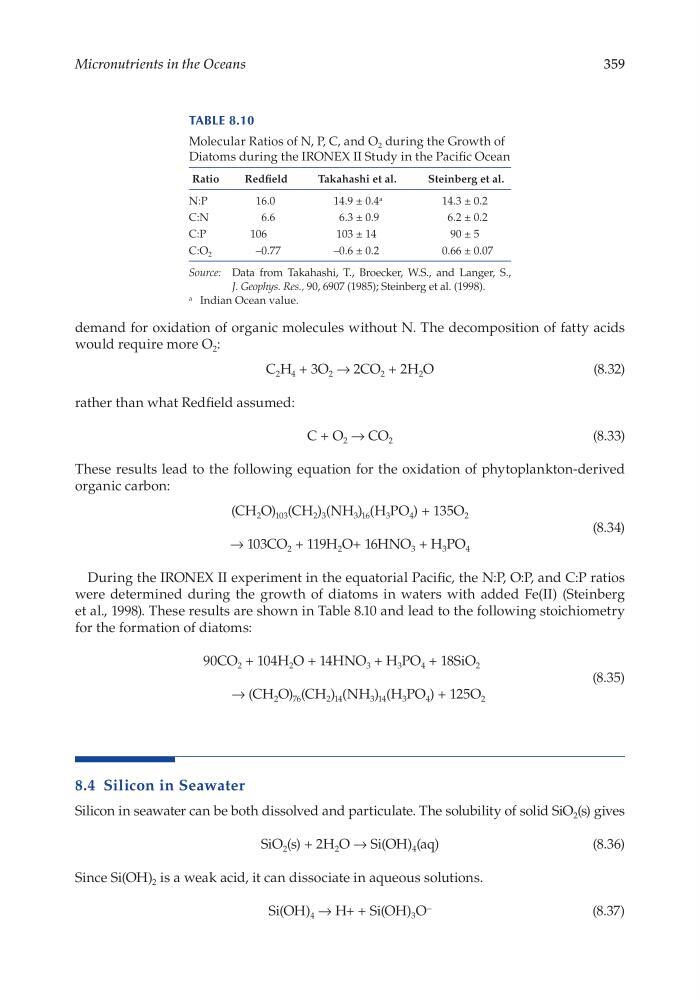
During the IRONEX II experiment in the equatorial Pacific, the N:P, O:P, and C:P ratios
were determined during the growth of diatoms in waters with added Fe(II) (Steinberg
et al., 1998). These results are shown in Table 8.10 and lead to the following stoichiometry
for the formation of diatoms:
90CO 2 + 104H 2 O + 14HNO 3 + H 3 PO 4 + 18SiO 2
→ (CH 2 O) 76 (CH 2 ) 14 (NH 3 ) 14 (H 3 PO 4 ) + 125O 2
(8.35)
8.4
Silicon in Seawater
Silicon in seawater can be both dissolved and particulate. The solubility of solid SiO 2 (s) gives
SiO 2 (s) + 2H 2 O → Si(OH) 4 (aq)
(8.36)
Since Si(OH) 2 is a weak acid, it can dissociate in aqueous solutions.
Si(OH) 4 → H+ + Si(OH) 3 O –
(8.37)
Table 8.10
Molecular Ratios of N, P, C, and O 2 during the Growth of
Diatoms during the IRONEX II Study in the Pacific Ocean
Ratio
Redfield
Takahashi et al.
Steinberg et al.
N:P
16.0
14.9 ± 0.4 a
14.3 ± 0.2
C:N
6.6
6.3 ± 0.9
6.2 ± 0.2
C:P
106
103 ± 14
90 ± 5
C:O 2
–0.77
–0.6 ± 0.2
0.66 ± 0.07
Source: Data from Takahashi, T., Broecker, W.S., and Langer, S.,
J. Geophys. Res., 90, 6907 (1985); Steinberg et al. (1998).
a Indian Ocean value.
Micronutrients in the Oceans
demand for oxidation of organic molecules without N. The decomposition of fatty acids
would require more O 2 :
C 2 H 4 + 3O 2 → 2CO 2 + 2H 2 O
(8.32)
rather than what Redfield assumed:
C + O 2 → CO 2
(8.33)
These results lead to the following equation for the oxidation of phytoplankton- derived
organic carbon:
(CH 2 O) 103 (CH 2 ) 3 (NH 3 ) 16 (H 3 PO 4 ) + 135O 2
→ 103CO 2 + 119H 2 O+ 16HNO 3 + H 3 PO 4
(8.34)
During the IRONEX II experiment in the equatorial Pacific, the N:P, O:P, and C:P ratios
were determined during the growth of diatoms in waters with added Fe(II) (Steinberg
et al., 1998). These results are shown in Table 8.10 and lead to the following stoichiometry
for the formation of diatoms:
90CO 2 + 104H 2 O + 14HNO 3 + H 3 PO 4 + 18SiO 2
→ (CH 2 O) 76 (CH 2 ) 14 (NH 3 ) 14 (H 3 PO 4 ) + 125O 2
(8.35)
8.4
Silicon in Seawater
Silicon in seawater can be both dissolved and particulate. The solubility of solid SiO 2 (s) gives
SiO 2 (s) + 2H 2 O → Si(OH) 4 (aq)
(8.36)
Since Si(OH) 2 is a weak acid, it can dissociate in aqueous solutions.
Si(OH) 4 → H+ + Si(OH) 3 O –
(8.37)
Table 8.10
Molecular Ratios of N, P, C, and O 2 during the Growth of
Diatoms during the IRONEX II Study in the Pacific Ocean
Ratio
Redfield
Takahashi et al.
Steinberg et al.
N:P
16.0
14.9 ± 0.4 a
14.3 ± 0.2
C:N
6.6
6.3 ± 0.9
6.2 ± 0.2
C:P
106
103 ± 14
90 ± 5
C:O 2
–0.77
–0.6 ± 0.2
0.66 ± 0.07
Source: Data from Takahashi, T., Broecker, W.S., and Langer, S.,
J. Geophys. Res., 90, 6907 (1985); Steinberg et al. (1998).
a Indian Ocean value.