

348
Chemical Oceanography, 4th Edition
can fix nitrogen. In the oceans, blue- green algae, or more correctly cyanobacteria, are the main nitrogen fixers (Howells and Geesey, 2010). The major species is
Trichodesmium (Capone, 1997). Since Fe is needed by the enzyme, it was thought
that the fixation was higher in the Atlantic (due to Fe from African dust), but it
appears to be higher in the Pacific (Howells and Geesey, 2010).
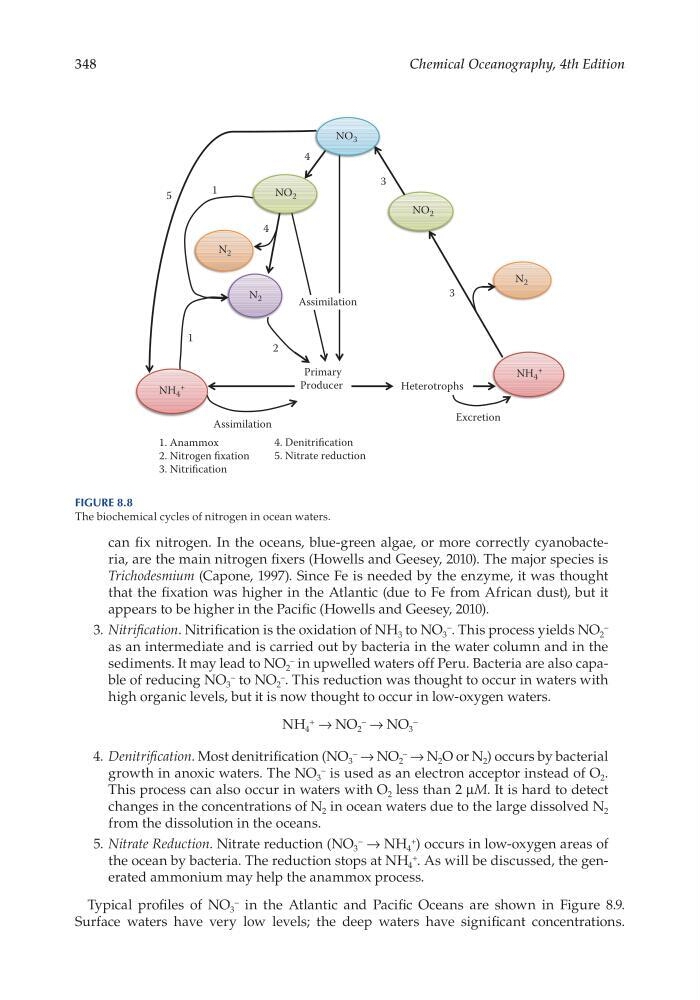
3. Nitrification. Nitrification is the oxidation of NH 3 to NO 3
– . This process yields NO 2
–
as an intermediate and is carried out by bacteria in the water column and in the
sediments. It may lead to NO 2
– in upwelled waters off Peru. Bacteria are also capable of reducing NO 3
– to NO 2
– . This reduction was thought to occur in waters with
high organic levels, but it is now thought to occur in low- oxygen waters.
NH 4
+ → NO 2
– → NO 3
–
4. Denitrification. Most denitrification (NO 3
– → NO 2
– → N 2 O or N 2 ) occurs by bacterial
growth in anoxic waters. The NO 3
– is used as an electron acceptor instead of O 2 .
This process can also occur in waters with O 2 less than 2 μM. It is hard to detect
changes in the concentrations of N 2 in ocean waters due to the large dissolved N 2
from the dissolution in the oceans.
5. Nitrate Reduction. Nitrate reduction (NO 3
– → NH 4
+ ) occurs in low- oxygen areas of
the ocean by bacteria. The reduction stops at NH 4
+ . As will be discussed, the generated ammonium may help the anammox process.
Typical profiles of NO 3
– in the Atlantic and Pacific Oceans are shown in Figure 8.9.
Surface waters have very low levels; the deep waters have significant concentrations.
Primary
Producer
1. Anammox
2. Nitrogen fixation
3. Nitrification
4. Denitrification
5. Nitrate reduction
NO 3
NO 2
NO 2
N 2
N 2
N 2
NH 4
+
NH 4
+
Assimilation
Heterotrophs
Assimilation
Excretion
1
1
2
3
3
4
4
5
Figure 8.8
The biochemical cycles of nitrogen in ocean waters.
Chemical Oceanography, 4th Edition
can fix nitrogen. In the oceans, blue- green algae, or more correctly cyanobacteria, are the main nitrogen fixers (Howells and Geesey, 2010). The major species is
Trichodesmium (Capone, 1997). Since Fe is needed by the enzyme, it was thought
that the fixation was higher in the Atlantic (due to Fe from African dust), but it
appears to be higher in the Pacific (Howells and Geesey, 2010).
3. Nitrification. Nitrification is the oxidation of NH 3 to NO 3
– . This process yields NO 2
–
as an intermediate and is carried out by bacteria in the water column and in the
sediments. It may lead to NO 2
– in upwelled waters off Peru. Bacteria are also capable of reducing NO 3
– to NO 2
– . This reduction was thought to occur in waters with
high organic levels, but it is now thought to occur in low- oxygen waters.
NH 4
+ → NO 2
– → NO 3
–
4. Denitrification. Most denitrification (NO 3
– → NO 2
– → N 2 O or N 2 ) occurs by bacterial
growth in anoxic waters. The NO 3
– is used as an electron acceptor instead of O 2 .
This process can also occur in waters with O 2 less than 2 μM. It is hard to detect
changes in the concentrations of N 2 in ocean waters due to the large dissolved N 2
from the dissolution in the oceans.
5. Nitrate Reduction. Nitrate reduction (NO 3
– → NH 4
+ ) occurs in low- oxygen areas of
the ocean by bacteria. The reduction stops at NH 4
+ . As will be discussed, the generated ammonium may help the anammox process.
Typical profiles of NO 3
– in the Atlantic and Pacific Oceans are shown in Figure 8.9.
Surface waters have very low levels; the deep waters have significant concentrations.
Primary
Producer
1. Anammox
2. Nitrogen fixation
3. Nitrification
4. Denitrification
5. Nitrate reduction
NO 3
NO 2
NO 2
N 2
N 2
N 2
NH 4
+
NH 4
+
Assimilation
Heterotrophs
Assimilation
Excretion
1
1
2
3
3
4
4
5
Figure 8.8
The biochemical cycles of nitrogen in ocean waters.