

347
Micronutrients in the Oceans
The acid reacting with NH 3 is called ketoglutaric acid. Twenty other amino acids are
formed from glutamic acid by transamination. The formation of alanine, for example,
is formed from pyruvic acid:
CH 3 COCOOH + HOOC – CH(NH 2 )CH 2 CH 2 COOH
→ CH 3 CH(NH 2 )COOH + HOOC – CO(CH 2 ) 2 COOH
(8.30)
Proteins are formed by the linking of the various amino acids by reactions involving RNA
and DNA and using energy from ATP.
NO 3
– is regenerated mainly by bacterial oxidation of organic nitrogen. When cells
die, they undergo rapid autolysis, releasing NH 3 and PO 4
3− . The decomposition of
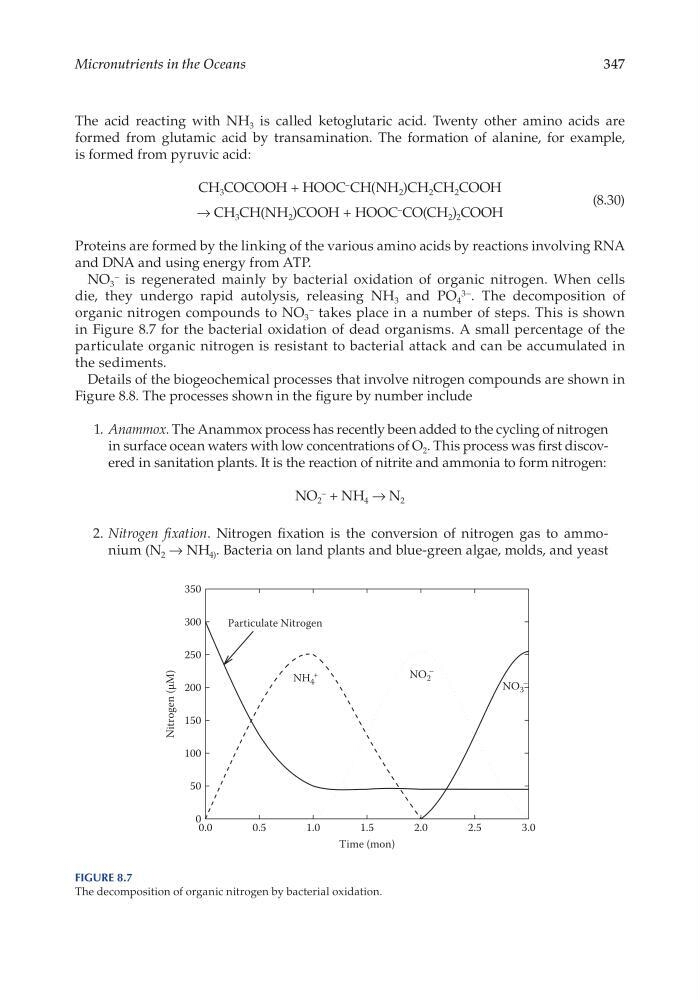
organic nitrogen compounds to NO 3
– takes place in a number of steps. This is shown
in Figure 8.7 for the bacterial oxidation of dead organisms. A small percentage of the
particulate organic nitrogen is resistant to bacterial attack and can be accumulated in
the sediments.
Details of the biogeochemical processes that involve nitrogen compounds are shown in
Figure 8.8. The processes shown in the figure by number include
1. Anammox. The Anammox process has recently been added to the cycling of nitrogen
in surface ocean waters with low concentrations of O 2 . This process was first discovered in sanitation plants. It is the reaction of nitrite and ammonia to form nitrogen:
NO 2
– + NH 4 → N 2
2. Nitrogen fixation. Nitrogen fixation is the conversion of nitrogen gas to ammonium (N 2 → NH 4) . Bacteria on land plants and blue- green algae, molds, and yeast
Time (mon)
0.0
0.5
1.0
1.5
2.0
2.5
3.0
Nitrogen (µM)
0
50
100
150
200
250
300
350
Particulate Nitrogen
NH 4
+
NO 2
–
NO 3
–
Figure 8.7
The decomposition of organic nitrogen by bacterial oxidation.
Micronutrients in the Oceans
The acid reacting with NH 3 is called ketoglutaric acid. Twenty other amino acids are
formed from glutamic acid by transamination. The formation of alanine, for example,
is formed from pyruvic acid:
CH 3 COCOOH + HOOC – CH(NH 2 )CH 2 CH 2 COOH
→ CH 3 CH(NH 2 )COOH + HOOC – CO(CH 2 ) 2 COOH
(8.30)
Proteins are formed by the linking of the various amino acids by reactions involving RNA
and DNA and using energy from ATP.
NO 3
– is regenerated mainly by bacterial oxidation of organic nitrogen. When cells
die, they undergo rapid autolysis, releasing NH 3 and PO 4
3− . The decomposition of
organic nitrogen compounds to NO 3
– takes place in a number of steps. This is shown
in Figure 8.7 for the bacterial oxidation of dead organisms. A small percentage of the
particulate organic nitrogen is resistant to bacterial attack and can be accumulated in
the sediments.
Details of the biogeochemical processes that involve nitrogen compounds are shown in
Figure 8.8. The processes shown in the figure by number include
1. Anammox. The Anammox process has recently been added to the cycling of nitrogen
in surface ocean waters with low concentrations of O 2 . This process was first discovered in sanitation plants. It is the reaction of nitrite and ammonia to form nitrogen:
NO 2
– + NH 4 → N 2
2. Nitrogen fixation. Nitrogen fixation is the conversion of nitrogen gas to ammonium (N 2 → NH 4) . Bacteria on land plants and blue- green algae, molds, and yeast
Time (mon)
0.0
0.5
1.0
1.5
2.0
2.5
3.0
Nitrogen (µM)
0
50
100
150
200
250
300
350
Particulate Nitrogen
NH 4
+
NO 2
–
NO 3
–
Figure 8.7
The decomposition of organic nitrogen by bacterial oxidation.