

340
Chemical Oceanography, 4th Edition
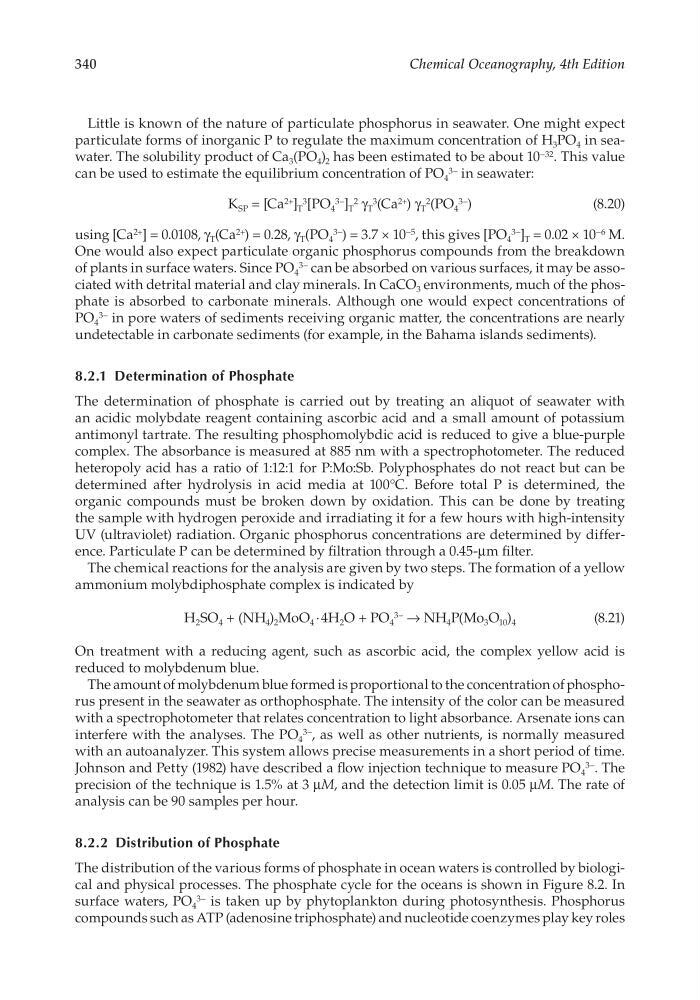
Little is known of the nature of particulate phosphorus in seawater. One might expect
particulate forms of inorganic P to regulate the maximum concentration of H 3 PO 4 in seawater. The solubility product of Ca 3 (PO 4 ) 2 has been estimated to be about 10 –32 . This value
can be used to estimate the equilibrium concentration of PO 4
3– in seawater:
K SP = [Ca 2+ ] T
3 [PO 4
3– ] T
2 γ T
3 (Ca 2+ ) γ T
2 (PO 4
3– )
(8.20)
using [Ca 2+ ] = 0.0108, γ T (Ca 2+ ) = 0.28, γ T (PO 4
3– ) = 3.7 × 10 –5 , this gives [PO 4
3– ] T = 0.02 × 10 –6 M.
One would also expect particulate organic phosphorus compounds from the breakdown
of plants in surface waters. Since PO 4
3– can be absorbed on various surfaces, it may be associated with detrital material and clay minerals. In CaCO 3 environments, much of the phosphate is absorbed to carbonate minerals. Although one would expect concentrations of
PO 4
3– in pore waters of sediments receiving organic matter, the concentrations are nearly
undetectable in carbonate sediments (for example, in the Bahama islands sediments).
8.2.1 Determination of Phosphate
The determination of phosphate is carried out by treating an aliquot of seawater with
an acidic molybdate reagent containing ascorbic acid and a small amount of potassium
antimonyl tartrate. The resulting phosphomolybdic acid is reduced to give a blue- purple
complex. The absorbance is measured at 885 nm with a spectrophotometer. The reduced
heteropoly acid has a ratio of 1:12:1 for P:Mo:Sb. Polyphosphates do not react but can be
determined after hydrolysis in acid media at 100°C. Before total P is determined, the
organic compounds must be broken down by oxidation. This can be done by treating
the sample with hydrogen peroxide and irradiating it for a few hours with high- intensity
UV (ultraviolet) radiation. Organic phosphorus concentrations are determined by difference. Particulate P can be determined by filtration through a 0.45-μm filter.
The chemical reactions for the analysis are given by two steps. The formation of a yellow
ammonium molybdiphosphate complex is indicated by
H 2 SO 4 + (NH 4 ) 2 MoO 4 · 4H 2 O + PO 4
3– → NH 4 P(Mo 3 O 10 ) 4
(8.21)
On treatment with a reducing agent, such as ascorbic acid, the complex yellow acid is
reduced to molybdenum blue.
The amount of molybdenum blue formed is proportional to the concentration of phosphorus present in the seawater as orthophosphate. The intensity of the color can be measured
with a spectrophotometer that relates concentration to light absorbance. Arsenate ions can
interfere with the analyses. The PO 4
3– , as well as other nutrients, is normally measured
with an autoanalyzer. This system allows precise measurements in a short period of time.
Johnson and Petty (1982) have described a flow injection technique to measure PO 4
3– . The
precision of the technique is 1.5% at 3 μM, and the detection limit is 0.05 μM. The rate of
analysis can be 90 samples per hour.
8.2.2 Distribution of Phosphate
The distribution of the various forms of phosphate in ocean waters is controlled by biological and physical processes. The phosphate cycle for the oceans is shown in Figure 8.2. In
surface waters, PO 4
3– is taken up by phytoplankton during photosynthesis. Phosphorus
compounds such as ATP (adenosine triphosphate) and nucleotide coenzymes play key roles
Chemical Oceanography, 4th Edition
Little is known of the nature of particulate phosphorus in seawater. One might expect
particulate forms of inorganic P to regulate the maximum concentration of H 3 PO 4 in seawater. The solubility product of Ca 3 (PO 4 ) 2 has been estimated to be about 10 –32 . This value
can be used to estimate the equilibrium concentration of PO 4
3– in seawater:
K SP = [Ca 2+ ] T
3 [PO 4
3– ] T
2 γ T
3 (Ca 2+ ) γ T
2 (PO 4
3– )
(8.20)
using [Ca 2+ ] = 0.0108, γ T (Ca 2+ ) = 0.28, γ T (PO 4
3– ) = 3.7 × 10 –5 , this gives [PO 4
3– ] T = 0.02 × 10 –6 M.
One would also expect particulate organic phosphorus compounds from the breakdown
of plants in surface waters. Since PO 4
3– can be absorbed on various surfaces, it may be associated with detrital material and clay minerals. In CaCO 3 environments, much of the phosphate is absorbed to carbonate minerals. Although one would expect concentrations of
PO 4
3– in pore waters of sediments receiving organic matter, the concentrations are nearly
undetectable in carbonate sediments (for example, in the Bahama islands sediments).
8.2.1 Determination of Phosphate
The determination of phosphate is carried out by treating an aliquot of seawater with
an acidic molybdate reagent containing ascorbic acid and a small amount of potassium
antimonyl tartrate. The resulting phosphomolybdic acid is reduced to give a blue- purple
complex. The absorbance is measured at 885 nm with a spectrophotometer. The reduced
heteropoly acid has a ratio of 1:12:1 for P:Mo:Sb. Polyphosphates do not react but can be
determined after hydrolysis in acid media at 100°C. Before total P is determined, the
organic compounds must be broken down by oxidation. This can be done by treating
the sample with hydrogen peroxide and irradiating it for a few hours with high- intensity
UV (ultraviolet) radiation. Organic phosphorus concentrations are determined by difference. Particulate P can be determined by filtration through a 0.45-μm filter.
The chemical reactions for the analysis are given by two steps. The formation of a yellow
ammonium molybdiphosphate complex is indicated by
H 2 SO 4 + (NH 4 ) 2 MoO 4 · 4H 2 O + PO 4
3– → NH 4 P(Mo 3 O 10 ) 4
(8.21)
On treatment with a reducing agent, such as ascorbic acid, the complex yellow acid is
reduced to molybdenum blue.
The amount of molybdenum blue formed is proportional to the concentration of phosphorus present in the seawater as orthophosphate. The intensity of the color can be measured
with a spectrophotometer that relates concentration to light absorbance. Arsenate ions can
interfere with the analyses. The PO 4
3– , as well as other nutrients, is normally measured
with an autoanalyzer. This system allows precise measurements in a short period of time.
Johnson and Petty (1982) have described a flow injection technique to measure PO 4
3– . The
precision of the technique is 1.5% at 3 μM, and the detection limit is 0.05 μM. The rate of
analysis can be 90 samples per hour.
8.2.2 Distribution of Phosphate
The distribution of the various forms of phosphate in ocean waters is controlled by biological and physical processes. The phosphate cycle for the oceans is shown in Figure 8.2. In
surface waters, PO 4
3– is taken up by phytoplankton during photosynthesis. Phosphorus
compounds such as ATP (adenosine triphosphate) and nucleotide coenzymes play key roles