

339
Micronutrients in the Oceans
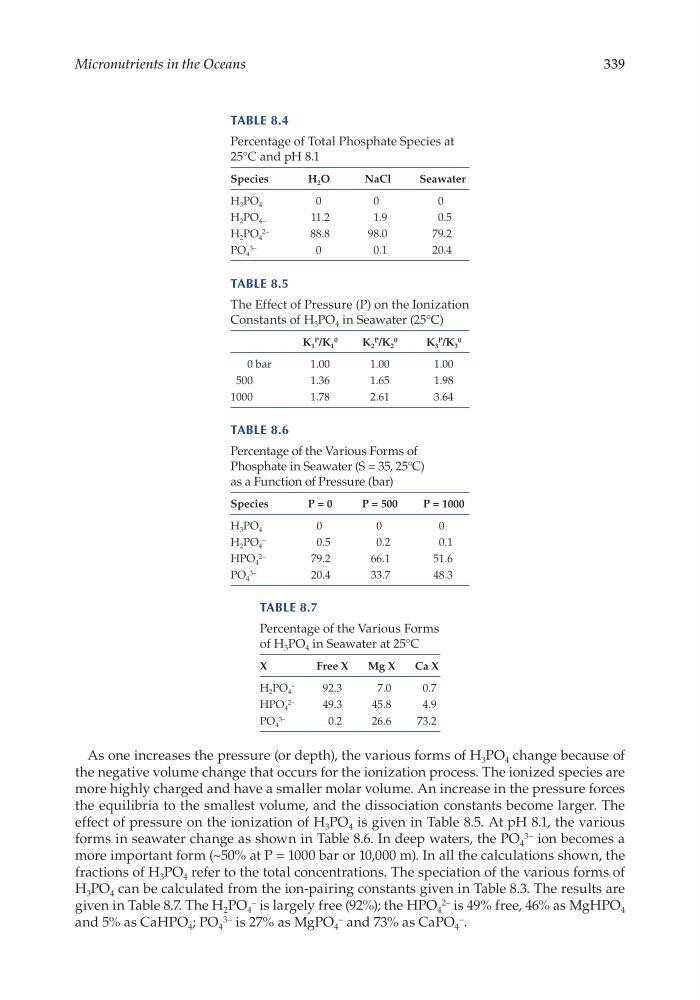
As one increases the pressure (or depth), the various forms of H 3 PO 4 change because of
the negative volume change that occurs for the ionization process. The ionized species are
more highly charged and have a smaller molar volume. An increase in the pressure forces
the equilibria to the smallest volume, and the dissociation constants become larger. The
effect of pressure on the ionization of H 3 PO 4 is given in Table 8.5. At pH 8.1, the various
forms in seawater change as shown in Table 8.6. In deep waters, the PO 4
3– ion becomes a
more important form (~50% at P = 1000 bar or 10,000 m). In all the calculations shown, the
fractions of H 3 PO 4 refer to the total concentrations. The speciation of the various forms of
H 3 PO 4 can be calculated from the ion- pairing constants given in Table 8.3. The results are
given in Table 8.7. The H 2 PO 4
– is largely free (92%); the HPO 4
2– is 49% free, 46% as MgHPO 4
and 5% as CaHPO 4 ; PO 4
3– is 27% as MgPO 4
– and 73% as CaPO 4
– .
Table 8.4
Percentage of Total Phosphate Species at
25°C and pH 8.1
Species
H 2 O
NaCl
Seawater
H 3 PO 4
0
0
0
H 2 PO 4–
11.2
1.9
0.5
H 2 PO 4
2–
88.8
98.0
79.2
PO 4
3–
0
0.1
20.4
Table 8.6
Percentage of the Various Forms of
Phosphate in Seawater (S = 35, 25°C)
as a Function of Pressure (bar)
Species
P = 0
P = 500
P = 1000
H 3 PO 4
0
0
0
H 2 PO 4
–
0.5
0.2
0.1
HPO 4
2–
79.2
66.1
51.6
PO 4
3–
20.4
33.7
48.3
Table 8.5
The Effect of Pressure (P) on the Ionization
Constants of H 3 PO 4 in Seawater (25°C)
K 1
P / K 1
0
K 2
P / K 2
0
K 3
P / K 3
0
0 bar
1.00
1.00
1.00
500
1.36
1.65
1.98
1000
1.78
2.61
3.64
Table 8.7
Percentage of the Various Forms
of H 3 PO 4 in Seawater at 25°C
X
Free X
Mg X
Ca X
H 2 PO 4
–
92.3
7.0
0.7
HPO 4
2–
49.3
45.8
4.9
PO 4
3–
0.2
26.6
73.2
Micronutrients in the Oceans
As one increases the pressure (or depth), the various forms of H 3 PO 4 change because of
the negative volume change that occurs for the ionization process. The ionized species are
more highly charged and have a smaller molar volume. An increase in the pressure forces
the equilibria to the smallest volume, and the dissociation constants become larger. The
effect of pressure on the ionization of H 3 PO 4 is given in Table 8.5. At pH 8.1, the various
forms in seawater change as shown in Table 8.6. In deep waters, the PO 4
3– ion becomes a
more important form (~50% at P = 1000 bar or 10,000 m). In all the calculations shown, the
fractions of H 3 PO 4 refer to the total concentrations. The speciation of the various forms of
H 3 PO 4 can be calculated from the ion- pairing constants given in Table 8.3. The results are
given in Table 8.7. The H 2 PO 4
– is largely free (92%); the HPO 4
2– is 49% free, 46% as MgHPO 4
and 5% as CaHPO 4 ; PO 4
3– is 27% as MgPO 4
– and 73% as CaPO 4
– .
Table 8.4
Percentage of Total Phosphate Species at
25°C and pH 8.1
Species
H 2 O
NaCl
Seawater
H 3 PO 4
0
0
0
H 2 PO 4–
11.2
1.9
0.5
H 2 PO 4
2–
88.8
98.0
79.2
PO 4
3–
0
0.1
20.4
Table 8.6
Percentage of the Various Forms of
Phosphate in Seawater (S = 35, 25°C)
as a Function of Pressure (bar)
Species
P = 0
P = 500
P = 1000
H 3 PO 4
0
0
0
H 2 PO 4
–
0.5
0.2
0.1
HPO 4
2–
79.2
66.1
51.6
PO 4
3–
20.4
33.7
48.3
Table 8.5
The Effect of Pressure (P) on the Ionization
Constants of H 3 PO 4 in Seawater (25°C)
K 1
P / K 1
0
K 2
P / K 2
0
K 3
P / K 3
0
0 bar
1.00
1.00
1.00
500
1.36
1.65
1.98
1000
1.78
2.61
3.64
Table 8.7
Percentage of the Various Forms
of H 3 PO 4 in Seawater at 25°C
X
Free X
Mg X
Ca X
H 2 PO 4
–
92.3
7.0
0.7
HPO 4
2–
49.3
45.8
4.9
PO 4
3–
0.2
26.6
73.2