

317
The Carbonate System
in calcification (Riebesell et al., 2000; Delille et al., 2005) at low pH, and some show an
increase or are not affected (Igeslas- Rodriguez et al., 2008; Shi et al., 2009) at low pH. Smith
et al. (2012) have shown that coccolithophores (Emiliania huxleyi) show seasonality and are
heavier under low- pH conditions. This is important since they contribute about 10% of primary production and dominate the carbonate flux in the oceans. The increase in nitrogen
fixation and photosynthesis may be related to increased concentration of Fe at low pH.
Future shocks to the system that may occur over the next 90 yr are based on results shown
in Figure 7.69. One would expect that more will be said about these, and other types of
experiments at low pH will be made in the future.
Feely et al. (2012) have shown that upwelling waters off the West Coast of America have
low pH values (Figure 7.70). This low pH has already caused some problems in the rearing
of oysters along the coast of Oregon (Service, 2012). Gruber et al. (2012) have used models
to show that this problem will become more severe over the next 50 yr.
7.7.2 effect of Ocean acidification on the Speciation of Metals in Seawater
The decrease in the pH will also affect the speciation of metal in ocean waters (Millero
et al., 2009). Most of the inorganic (OH – , CO 3
2– ) and organic (organic charged ligands,
amino acids) ligands are a function of pH. The expected changes in concentrations of OH –
and CO 3
2– ions over the next 1000 yr are shown in Figure 7.71. The decrease in these ions
60°N
40°N
20°N
0°
20°S
Latitude
40°S
60°S
80°S
120°E
140°E
160°E
180°
160°W
Longitude
140°W 120°W
P06:
P02: 1994 /2004
Line P
2004
P18:
1994/2007-08
P16:
1991–92/2005–06
1992/2003
100°W 80°W
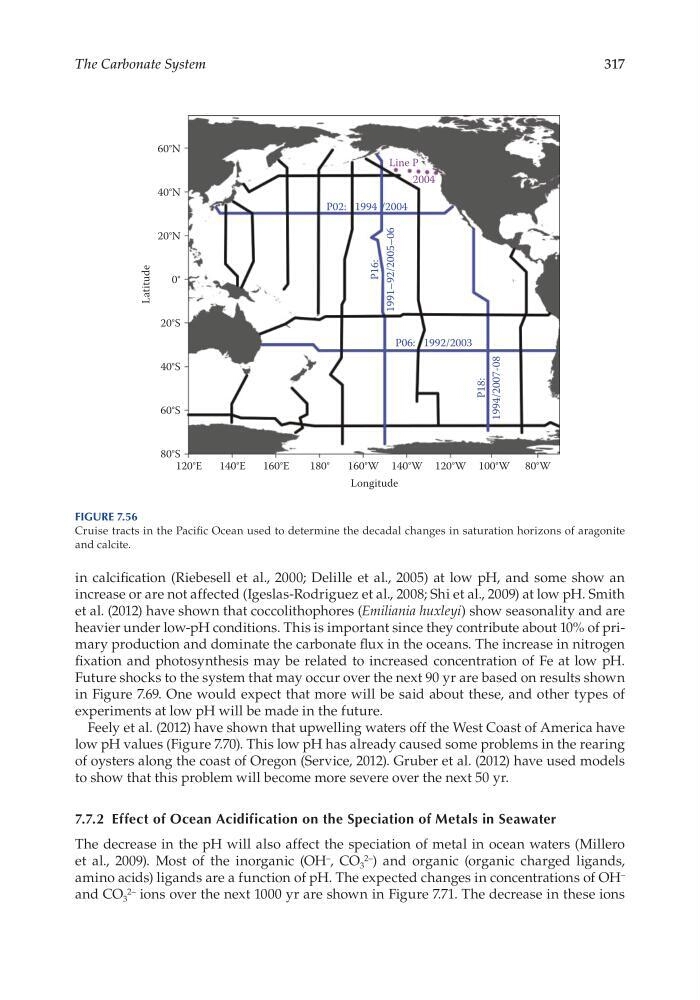
Figure 7.56
Cruise tracts in the Pacific Ocean used to determine the decadal changes in saturation horizons of aragonite
and calcite.
The Carbonate System
in calcification (Riebesell et al., 2000; Delille et al., 2005) at low pH, and some show an
increase or are not affected (Igeslas- Rodriguez et al., 2008; Shi et al., 2009) at low pH. Smith
et al. (2012) have shown that coccolithophores (Emiliania huxleyi) show seasonality and are
heavier under low- pH conditions. This is important since they contribute about 10% of primary production and dominate the carbonate flux in the oceans. The increase in nitrogen
fixation and photosynthesis may be related to increased concentration of Fe at low pH.
Future shocks to the system that may occur over the next 90 yr are based on results shown
in Figure 7.69. One would expect that more will be said about these, and other types of
experiments at low pH will be made in the future.
Feely et al. (2012) have shown that upwelling waters off the West Coast of America have
low pH values (Figure 7.70). This low pH has already caused some problems in the rearing
of oysters along the coast of Oregon (Service, 2012). Gruber et al. (2012) have used models
to show that this problem will become more severe over the next 50 yr.
7.7.2 effect of Ocean acidification on the Speciation of Metals in Seawater
The decrease in the pH will also affect the speciation of metal in ocean waters (Millero
et al., 2009). Most of the inorganic (OH – , CO 3
2– ) and organic (organic charged ligands,
amino acids) ligands are a function of pH. The expected changes in concentrations of OH –
and CO 3
2– ions over the next 1000 yr are shown in Figure 7.71. The decrease in these ions
60°N
40°N
20°N
0°
20°S
Latitude
40°S
60°S
80°S
120°E
140°E
160°E
180°
160°W
Longitude
140°W 120°W
P06:
P02: 1994 /2004
Line P
2004
P18:
1994/2007-08
P16:
1991–92/2005–06
1992/2003
100°W 80°W
Figure 7.56
Cruise tracts in the Pacific Ocean used to determine the decadal changes in saturation horizons of aragonite
and calcite.