

315
The Carbonate System
Figure 7.60 (Morel et al., 2010). The pH over the last 400,000 yr has oscillated between 8.2 and
8.3. Over the last 200 yr, the pH of the surface waters of the oceans has decreased from 8.2 to
8.1. The Intergovernmental Panel on Climate Change (IPCC, 2007) has estimated the possible increases in pCO 2 due to the burning of fossil fuels over the next 100 yr (Figure 7.61).
The estimates are based on various estimates of the increase of CO 2 due to the burning of
fossil fuels and lead to values of pH between 7.7 and 7.8 by the end of the century.
The pCO 2 over longer periods of time have been estimated by Caldeira and Wickett
(2003). They have estimated the production of CO 2 (GtC/ yr) due to the burning of all
the fossil fuels and the resultant increase of pCO 2 in the atmosphere as a function of time
(Figure 7.62). The pCO 2 is expected to reach levels of 2000 μatm. Since the uptake of the CO 2
is slow, the pCO 2 in the atmosphere will be high for hundreds of years. Table 7.13 summarizes all the expected changes in the CO 2 system over the next 1000 yr. The estimates of pH
over the future have been made by assuming that TA was constant (2300 μmol kg –1 ) and
the surface waters are in equilibrium with the atmosphere. The resulting values of pH are
shown in Figure 7.63 as a function of pCO 2 and time. At the maximum pCO 2 of 2000 ppm,
the pH will be as low as 7.4.
The increases in pCO 2 in the atmosphere and the oceans are being measured at the
HOT and BATS stations. The measurements at HOT are shown in Figure 7.64. The increase
in the surface water follows the atmospheric values with a delay due to the slow uptake
of CO 2 by the oceans. The changes in pH have also been measured in the waters. The
0
500
1000
1500
Depth (m)
0
500
1000
1500
Depth (m)
150°E
140°E
160°E
–10
–5
0
5
∆C AOU (µmol kg –1 )
10
15
20
170°E
180°
170°W
Longitude
CO 2 from AOU
(a)
(b)
160°W 150°W 140°W 130°W
60°S
70°S
50°S
40°S
30°S
20°S
10°S
10°N 20°N 30°N 40°N
0°
Latitude
50°N
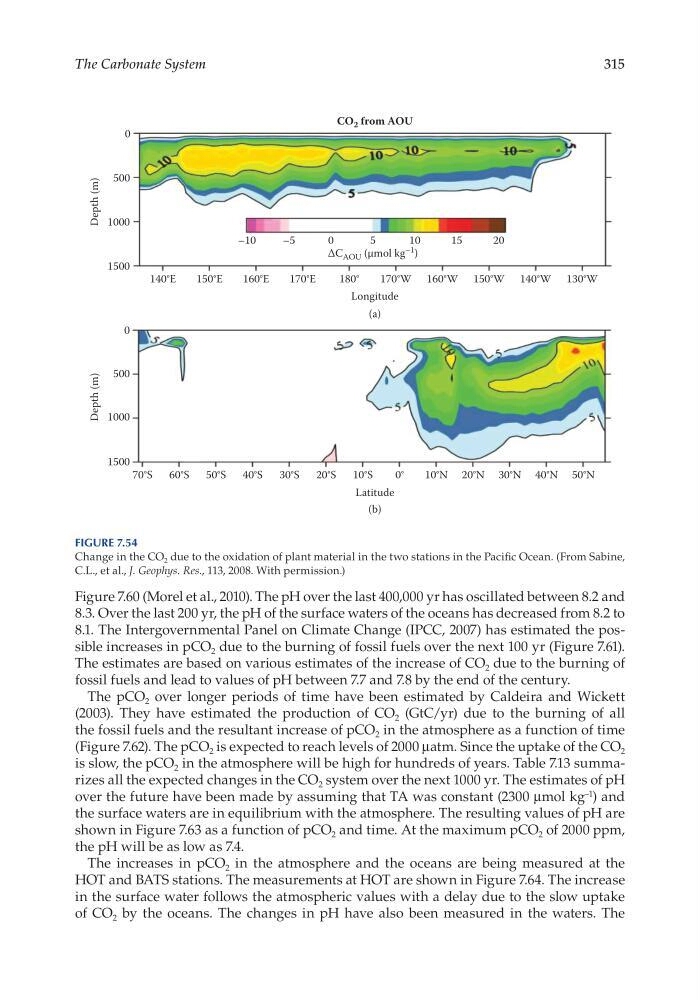
Figure 7.54
Change in the CO 2 due to the oxidation of plant material in the two stations in the Pacific Ocean. (From Sabine,
C.L., et al., J. Geophys. Res., 113, 2008. With permission.)
The Carbonate System
Figure 7.60 (Morel et al., 2010). The pH over the last 400,000 yr has oscillated between 8.2 and
8.3. Over the last 200 yr, the pH of the surface waters of the oceans has decreased from 8.2 to
8.1. The Intergovernmental Panel on Climate Change (IPCC, 2007) has estimated the possible increases in pCO 2 due to the burning of fossil fuels over the next 100 yr (Figure 7.61).
The estimates are based on various estimates of the increase of CO 2 due to the burning of
fossil fuels and lead to values of pH between 7.7 and 7.8 by the end of the century.
The pCO 2 over longer periods of time have been estimated by Caldeira and Wickett
(2003). They have estimated the production of CO 2 (GtC/ yr) due to the burning of all
the fossil fuels and the resultant increase of pCO 2 in the atmosphere as a function of time
(Figure 7.62). The pCO 2 is expected to reach levels of 2000 μatm. Since the uptake of the CO 2
is slow, the pCO 2 in the atmosphere will be high for hundreds of years. Table 7.13 summarizes all the expected changes in the CO 2 system over the next 1000 yr. The estimates of pH
over the future have been made by assuming that TA was constant (2300 μmol kg –1 ) and
the surface waters are in equilibrium with the atmosphere. The resulting values of pH are
shown in Figure 7.63 as a function of pCO 2 and time. At the maximum pCO 2 of 2000 ppm,
the pH will be as low as 7.4.
The increases in pCO 2 in the atmosphere and the oceans are being measured at the
HOT and BATS stations. The measurements at HOT are shown in Figure 7.64. The increase
in the surface water follows the atmospheric values with a delay due to the slow uptake
of CO 2 by the oceans. The changes in pH have also been measured in the waters. The
0
500
1000
1500
Depth (m)
0
500
1000
1500
Depth (m)
150°E
140°E
160°E
–10
–5
0
5
∆C AOU (µmol kg –1 )
10
15
20
170°E
180°
170°W
Longitude
CO 2 from AOU
(a)
(b)
160°W 150°W 140°W 130°W
60°S
70°S
50°S
40°S
30°S
20°S
10°S
10°N 20°N 30°N 40°N
0°
Latitude
50°N
Figure 7.54
Change in the CO 2 due to the oxidation of plant material in the two stations in the Pacific Ocean. (From Sabine,
C.L., et al., J. Geophys. Res., 113, 2008. With permission.)