

314
Chemical Oceanography, 4th Edition
They found pH changes of –0.0017 yr –1 and –0.0016 yr –1 , which are in excellent agreement
with the directly measured values in the HOT station of –0.0018 yr –1 and the ESTOC
(European Station for Time Series in the Ocean) Atlantic results of –0.017 yr –1 (Gonzalez
et al., 2100). As shown in Figure 7.59 (Byrne et al., 2010), these changes in pH affect waters
down to depths of ~ 700 m). Future CLIVAR measurements will see if this change in pH
is similar to other regions of the ocean and does not change with time.
7.7.1 Ocean acidification
The pCO 2 in the atmosphere will increase in the future because of the continued use of fossil fuels. The higher concentrations in the atmosphere cause the flux of CO 2 to increase and
dissolve more CO 2 in the surface ocean waters. The CO 2 in the waters reacts with water to
form carbonic acid:
CO 2 (g) = CO 2 (aq) → CO 2 (aq) + H 2 O = H 2 CO 3 → H + + HCO 3
–
This increase in the concentration of the proton causes lowering of the pH. This process
is called ocean acidification. One can estimate the past pH of the oceans by assuming that
the TA of surface waters did not change and the pCO 2 of the atmosphere can be estimated
from ice cores. The values of pCO 2 of surface waters calculated in this manner are shown in
0
500
1000
1500
Depth (m)
0
500
1000
1500
Depth (m)
150°E
140°E
160°E
–10
–5
0
5
∆C AOU (µmol kg
–1 )
10
15
20
170°E
180°
170°W
Longitude
(a)
(b)
160°W 150°W 140°W 130°W
60°S
70°S
50°S
40°S
30°S
20°S
10°S
10°N 20°N 30°N 40°N
0°
Latitude
50°N
Delta AOU
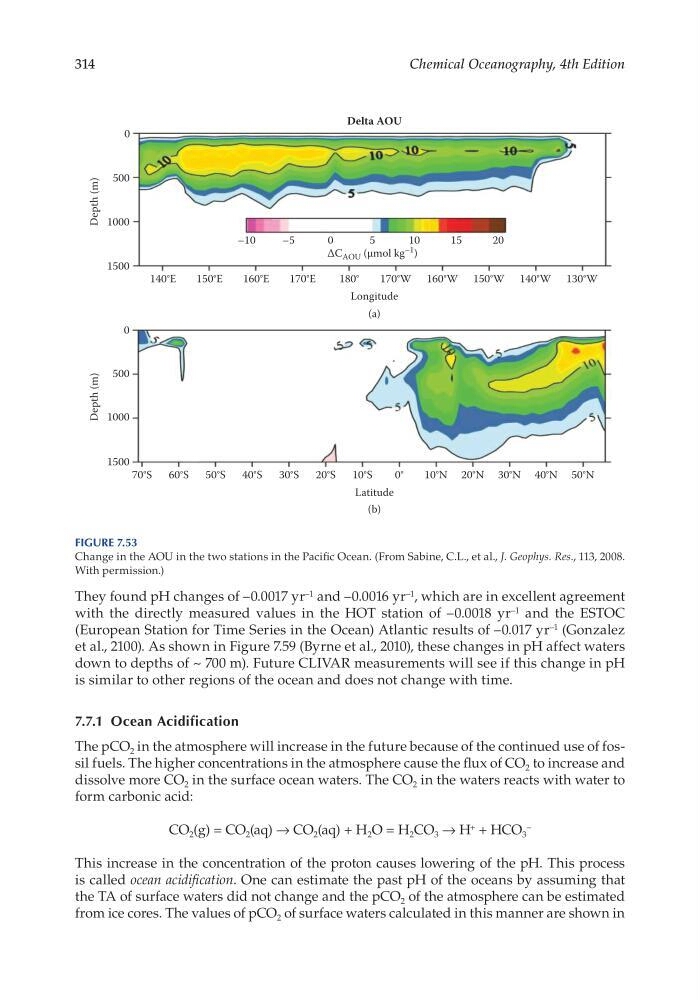
Figure 7.53
Change in the AOU in the two stations in the Pacific Ocean. (From Sabine, C.L., et al., J. Geophys. Res., 113, 2008.
With permission.)
Chemical Oceanography, 4th Edition
They found pH changes of –0.0017 yr –1 and –0.0016 yr –1 , which are in excellent agreement
with the directly measured values in the HOT station of –0.0018 yr –1 and the ESTOC
(European Station for Time Series in the Ocean) Atlantic results of –0.017 yr –1 (Gonzalez
et al., 2100). As shown in Figure 7.59 (Byrne et al., 2010), these changes in pH affect waters
down to depths of ~ 700 m). Future CLIVAR measurements will see if this change in pH
is similar to other regions of the ocean and does not change with time.
7.7.1 Ocean acidification
The pCO 2 in the atmosphere will increase in the future because of the continued use of fossil fuels. The higher concentrations in the atmosphere cause the flux of CO 2 to increase and
dissolve more CO 2 in the surface ocean waters. The CO 2 in the waters reacts with water to
form carbonic acid:
CO 2 (g) = CO 2 (aq) → CO 2 (aq) + H 2 O = H 2 CO 3 → H + + HCO 3
–
This increase in the concentration of the proton causes lowering of the pH. This process
is called ocean acidification. One can estimate the past pH of the oceans by assuming that
the TA of surface waters did not change and the pCO 2 of the atmosphere can be estimated
from ice cores. The values of pCO 2 of surface waters calculated in this manner are shown in
0
500
1000
1500
Depth (m)
0
500
1000
1500
Depth (m)
150°E
140°E
160°E
–10
–5
0
5
∆C AOU (µmol kg
–1 )
10
15
20
170°E
180°
170°W
Longitude
(a)
(b)
160°W 150°W 140°W 130°W
60°S
70°S
50°S
40°S
30°S
20°S
10°S
10°N 20°N 30°N 40°N
0°
Latitude
50°N
Delta AOU
Figure 7.53
Change in the AOU in the two stations in the Pacific Ocean. (From Sabine, C.L., et al., J. Geophys. Res., 113, 2008.
With permission.)