

313
The Carbonate System
that are strongly affected by physical and biological processes. This is due, for example,
to changes in the O 2 in the waters due to the oxidation of plant material and formation of
CO 2 (Figure 7.54). If one subtracts the change in CO 2 due to the oxidation of plant material,
the anthropogenic input of CO 2 is clearly shown (Figure 7.55). These results point out that
care is needed when using this method to examine the changes in the uptake of CO 2 with
time in ocean waters.
Most of the other studies resulting from CLIVAR repeat measurements are involved in
changes in the pH and saturation state of ocean water due to the uptake of CO 2 . Some of
these results are discussed in the next section.
The effects of ocean acidification on the saturation state of the waters in the Pacific Ocean
have been examined (Feely et al., 2012). The changes in the saturation states of aragonite
and calcite in Pacific waters were examined on a number of cruises (Figure 7.56). The
results for the changes in Ω for aragonite and calcite along the P16 north- south line are
shown in Figure 7.57 and 7.58, respectively. The average change was 0.345 yr –1 . The upward
migration of the saturation horizons was 1 to 2 m yr –1 . The shoaling in the South Pacific is
larger due to the uptake of anthropogenic CO 2 . If the CO 2 emissions continue over the next
100 yr, many coral reefs in the Pacific will be affected.
A number of recent studies have used the CLIVAR CO 2 measurements to examine the
decadal changes in the pH of ocean waters (Byrne et al., 2010; Waters and Millero, 2011).
0
500
1000
1500
Depth (m)
0
500
1000
Depth (m)
150°E
140°E
160°E
–10 –5
0
5
∆C total (µmol kg –1 )
10
15
20
170°E
180°
170°W
Longitude
Delta DIC
(a)
(b)
160°W 150°W 140°W 130°W
60°S
70°S
50°S
40°S
30°S
20°S
10°S
10°N 20°N 30°N 40°N
0°
Latitude
50°N
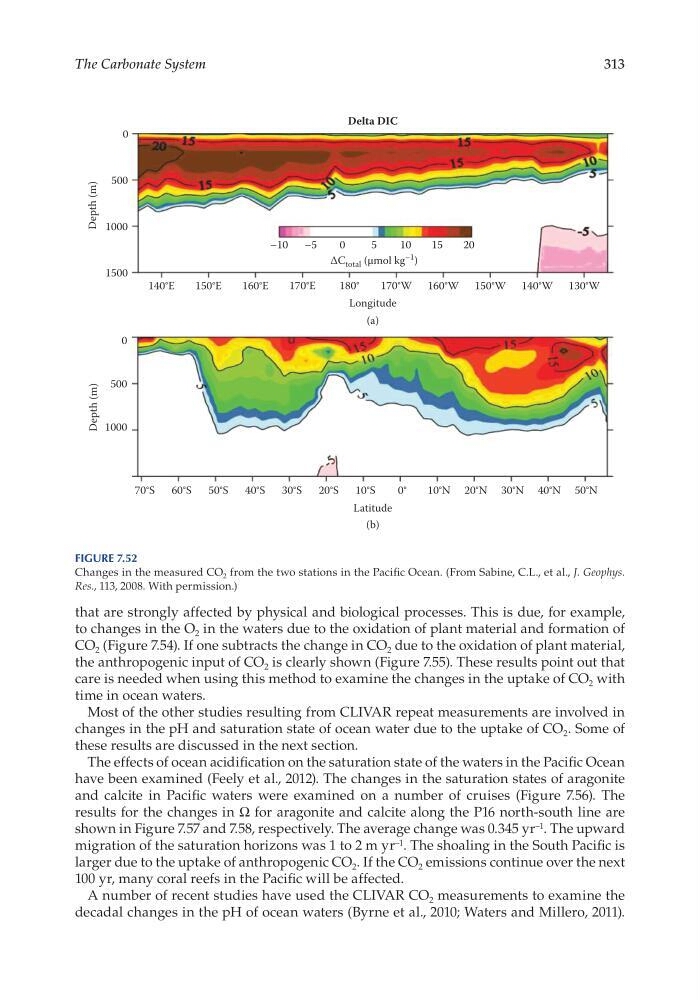
Figure 7.52
Changes in the measured CO 2 from the two stations in the Pacific Ocean. (From Sabine, C.L., et al., J. Geophys.
Res., 113, 2008. With permission.)
The Carbonate System
that are strongly affected by physical and biological processes. This is due, for example,
to changes in the O 2 in the waters due to the oxidation of plant material and formation of
CO 2 (Figure 7.54). If one subtracts the change in CO 2 due to the oxidation of plant material,
the anthropogenic input of CO 2 is clearly shown (Figure 7.55). These results point out that
care is needed when using this method to examine the changes in the uptake of CO 2 with
time in ocean waters.
Most of the other studies resulting from CLIVAR repeat measurements are involved in
changes in the pH and saturation state of ocean water due to the uptake of CO 2 . Some of
these results are discussed in the next section.
The effects of ocean acidification on the saturation state of the waters in the Pacific Ocean
have been examined (Feely et al., 2012). The changes in the saturation states of aragonite
and calcite in Pacific waters were examined on a number of cruises (Figure 7.56). The
results for the changes in Ω for aragonite and calcite along the P16 north- south line are
shown in Figure 7.57 and 7.58, respectively. The average change was 0.345 yr –1 . The upward
migration of the saturation horizons was 1 to 2 m yr –1 . The shoaling in the South Pacific is
larger due to the uptake of anthropogenic CO 2 . If the CO 2 emissions continue over the next
100 yr, many coral reefs in the Pacific will be affected.
A number of recent studies have used the CLIVAR CO 2 measurements to examine the
decadal changes in the pH of ocean waters (Byrne et al., 2010; Waters and Millero, 2011).
0
500
1000
1500
Depth (m)
0
500
1000
Depth (m)
150°E
140°E
160°E
–10 –5
0
5
∆C total (µmol kg –1 )
10
15
20
170°E
180°
170°W
Longitude
Delta DIC
(a)
(b)
160°W 150°W 140°W 130°W
60°S
70°S
50°S
40°S
30°S
20°S
10°S
10°N 20°N 30°N 40°N
0°
Latitude
50°N
Figure 7.52
Changes in the measured CO 2 from the two stations in the Pacific Ocean. (From Sabine, C.L., et al., J. Geophys.
Res., 113, 2008. With permission.)