

241
Dissolved Gases Other than CO 2
Kester (1975) has used these relations for Atlantic waters (t = 26°C and S = 36):
Δ Ne = 4.5 = δ P + 0.626 δ t + 12.47 δA
(6.40)
Δ Ar = 2.0 = δ P + 1.62 δ t + 4.22 δA
(6.41)
Δ He = 4.6 = δ P + 0.180 δ t + 14.16 δA
(6.42)
The solution gives δ P = –2.8%, δ t +1.7°C, and δA = 0.50 cm 3 air at STP per kilogram. The negative value of δ P indicates that P atm < 1 atm. A 1% increase in δ P can be caused by an increase
of 8 mm of Hg, an equilibration of air at 10 cm below the surface, or h = 65% at 25°C.
Deep ocean waters have been found to be injected by 0.5 to 1.0 cm 3 of air at STP per
kilogram of seawater. Helium can also be injected into the deep oceans from the seafloor.
The helium is produced by the radioactive decay of uranium and thorium in sediments
and rocks. Direct injection of He has also been found to come from hydrothermal fluids.
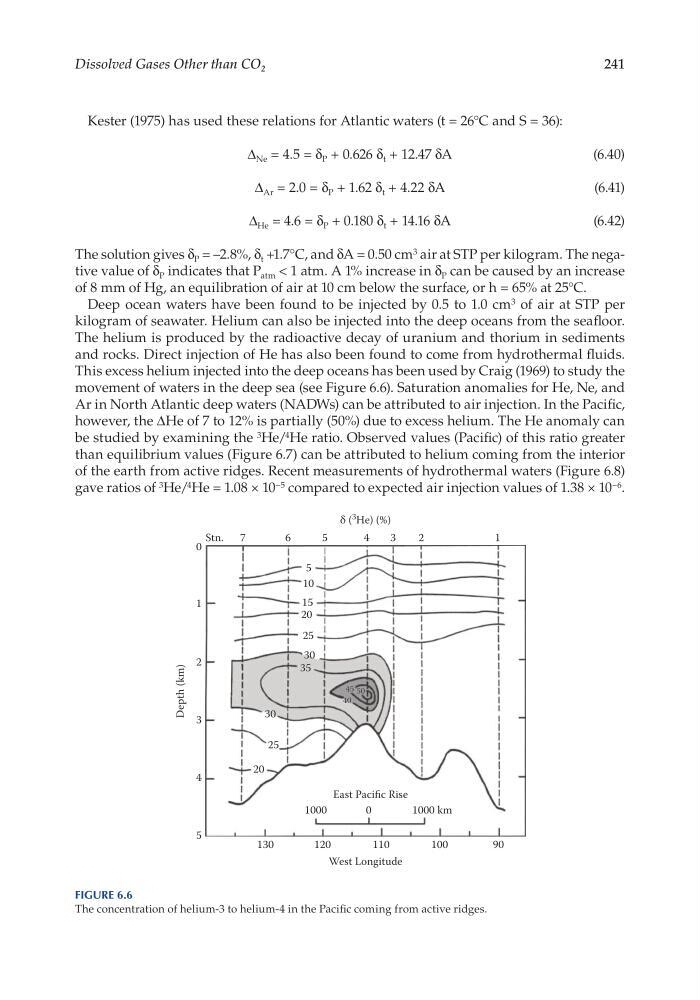
This excess helium injected into the deep oceans has been used by Craig (1969) to study the
movement of waters in the deep sea (see Figure 6.6). Saturation anomalies for He, Ne, and
Ar in North Atlantic deep waters (NADWs) can be attributed to air injection. In the Pacific,
however, the ΔHe of 7 to 12% is partially (50%) due to excess helium. The He anomaly can
be studied by examining the 3 He/ 4 He ratio. Observed values (Pacific) of this ratio greater
than equilibrium values (Figure 6.7) can be attributed to helium coming from the interior
of the earth from active ridges. Recent measurements of hydrothermal waters (Figure 6.8)
gave ratios of 3 He/ 4 He = 1.08 × 10 –5 compared to expected air injection values of 1.38 × 10 –6 .
90
100
1000
1000 km
0
East Pacific Rise
110
West Longitude
120
130
Depth (km)
5
4
20
25
30
35
30
25
20
15
10
5
40
45 50
3
2
1
0
Stn.
7
6
5
4
δ ( 3 He) (%)
3
2
1
Figure 6.6
The concentration of helium-3 to helium-4 in the Pacific coming from active ridges.
Dissolved Gases Other than CO 2
Kester (1975) has used these relations for Atlantic waters (t = 26°C and S = 36):
Δ Ne = 4.5 = δ P + 0.626 δ t + 12.47 δA
(6.40)
Δ Ar = 2.0 = δ P + 1.62 δ t + 4.22 δA
(6.41)
Δ He = 4.6 = δ P + 0.180 δ t + 14.16 δA
(6.42)
The solution gives δ P = –2.8%, δ t +1.7°C, and δA = 0.50 cm 3 air at STP per kilogram. The negative value of δ P indicates that P atm < 1 atm. A 1% increase in δ P can be caused by an increase
of 8 mm of Hg, an equilibration of air at 10 cm below the surface, or h = 65% at 25°C.
Deep ocean waters have been found to be injected by 0.5 to 1.0 cm 3 of air at STP per
kilogram of seawater. Helium can also be injected into the deep oceans from the seafloor.
The helium is produced by the radioactive decay of uranium and thorium in sediments
and rocks. Direct injection of He has also been found to come from hydrothermal fluids.
This excess helium injected into the deep oceans has been used by Craig (1969) to study the
movement of waters in the deep sea (see Figure 6.6). Saturation anomalies for He, Ne, and
Ar in North Atlantic deep waters (NADWs) can be attributed to air injection. In the Pacific,
however, the ΔHe of 7 to 12% is partially (50%) due to excess helium. The He anomaly can
be studied by examining the 3 He/ 4 He ratio. Observed values (Pacific) of this ratio greater
than equilibrium values (Figure 6.7) can be attributed to helium coming from the interior
of the earth from active ridges. Recent measurements of hydrothermal waters (Figure 6.8)
gave ratios of 3 He/ 4 He = 1.08 × 10 –5 compared to expected air injection values of 1.38 × 10 –6 .
90
100
1000
1000 km
0
East Pacific Rise
110
West Longitude
120
130
Depth (km)
5
4
20
25
30
35
30
25
20
15
10
5
40
45 50
3
2
1
0
Stn.
7
6
5
4
δ ( 3 He) (%)
3
2
1
Figure 6.6
The concentration of helium-3 to helium-4 in the Pacific coming from active ridges.