

240
Chemical Oceanography, 4th Edition
organic nitrogen under anoxic conditions, one may question the degree to which N 2 is
conservative. Benson and Parker’s measurements of the ratio of N 2 to Ar indicate that for
most ocean waters N 2 can be considered to be conservative to ±1%. Richards and Benson’s
(1961) measurements of N 2 /Ar in anoxic basins yielded ΔN 2 +2.3% for the Cariaco trench
and +3.6% for the Damsfjord. Due to the different solubility data used and the method of
reporting the results, it is difficult to make a detailed comparison of various N 2 studies at
the 1% level. Most ocean waters are generally within 1 to 2% of the saturation values except
in anoxic waters, which may be 2 to 4% supersaturated. As the analytical precision for N 2
has improved, the spread of Δ N2 has decreased.
The saturation anomalies of a gas can be attributed to three major components (Weiss, 1971):
Δ i = δ P + δ t + δ A
(6.36)
The factor δ P is due to differences in the effective and standard atmospheric pressure:
δ P
atm
S
S
P
h
P
P
Z
=
−
−
+
[
(
) ]
/100
100
1
10
(6.37)
where Z is the depth in centimeters at which the air bubble is equated. Since δ P does not
depend on a specific property of a gas, it is not possible to determine the various terms
separately. The factor δ t is due to changes in temperature δ t without gas exchange:
δ t = [–100 d ln[i]/d T] ΔT
(6.38)
where ΔT is the observed potential temperature minus the temperature at the time of
equilibration. This term applies to changes in temperature caused by radiative heating
or cooling and geothermal heating (not mixing of waters of different temperature). The
factor δA is the result of air injection and is given by
δA = X i 100 a/[i] 22,390
(6.39)
where a is the cubic centimeters of air at STP injected per kilogram of SW and 22,390 is the
molar volume of air in cubic centimeters at STP.
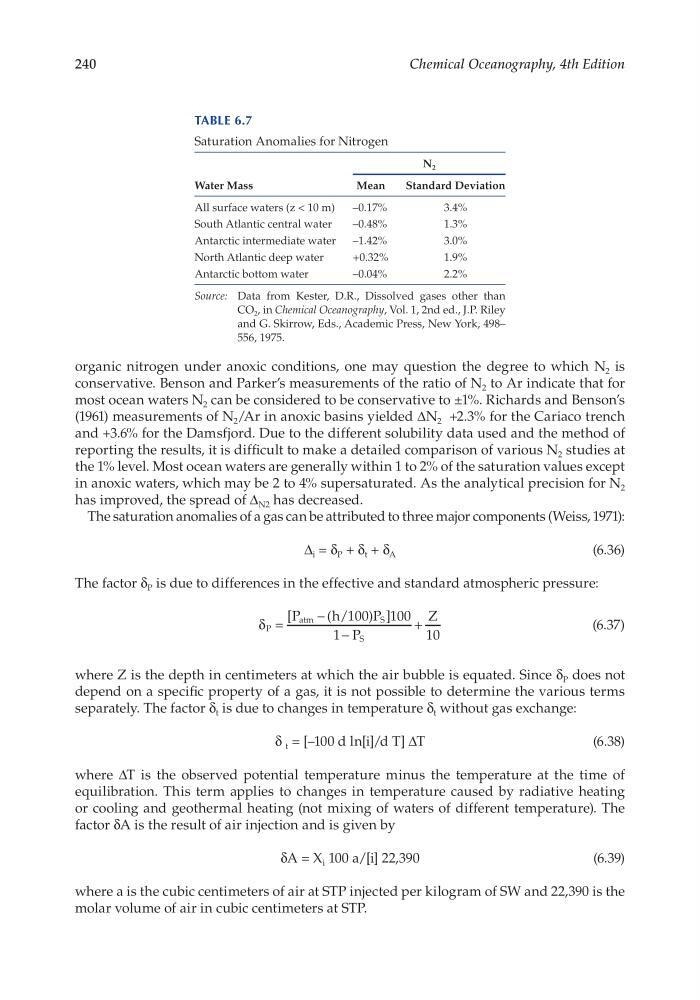
Table 6.7
Saturation Anomalies for Nitrogen
Water Mass
N 2
Mean
Standard Deviation
All surface waters (z < 10 m)
–0.17%
3.4%
South Atlantic central water
–0.48%
1.3%
Antarctic intermediate water
–1.42%
3.0%
North Atlantic deep water
+0.32%
1.9%
Antarctic bottom water
–0.04%
2.2%
Source: Data from Kester, D.R., Dissolved gases other than
CO 2 , in Chemical Oceanography, Vol. 1, 2nd ed., J.P. Riley
and G. Skirrow, Eds., Academic Press, New York, 498–
556, 1975.
Chemical Oceanography, 4th Edition
organic nitrogen under anoxic conditions, one may question the degree to which N 2 is
conservative. Benson and Parker’s measurements of the ratio of N 2 to Ar indicate that for
most ocean waters N 2 can be considered to be conservative to ±1%. Richards and Benson’s
(1961) measurements of N 2 /Ar in anoxic basins yielded ΔN 2 +2.3% for the Cariaco trench
and +3.6% for the Damsfjord. Due to the different solubility data used and the method of
reporting the results, it is difficult to make a detailed comparison of various N 2 studies at
the 1% level. Most ocean waters are generally within 1 to 2% of the saturation values except
in anoxic waters, which may be 2 to 4% supersaturated. As the analytical precision for N 2
has improved, the spread of Δ N2 has decreased.
The saturation anomalies of a gas can be attributed to three major components (Weiss, 1971):
Δ i = δ P + δ t + δ A
(6.36)
The factor δ P is due to differences in the effective and standard atmospheric pressure:
δ P
atm
S
S
P
h
P
P
Z
=
−
−
+
[
(
) ]
/100
100
1
10
(6.37)
where Z is the depth in centimeters at which the air bubble is equated. Since δ P does not
depend on a specific property of a gas, it is not possible to determine the various terms
separately. The factor δ t is due to changes in temperature δ t without gas exchange:
δ t = [–100 d ln[i]/d T] ΔT
(6.38)
where ΔT is the observed potential temperature minus the temperature at the time of
equilibration. This term applies to changes in temperature caused by radiative heating
or cooling and geothermal heating (not mixing of waters of different temperature). The
factor δA is the result of air injection and is given by
δA = X i 100 a/[i] 22,390
(6.39)
where a is the cubic centimeters of air at STP injected per kilogram of SW and 22,390 is the
molar volume of air in cubic centimeters at STP.
Table 6.7
Saturation Anomalies for Nitrogen
Water Mass
N 2
Mean
Standard Deviation
All surface waters (z < 10 m)
–0.17%
3.4%
South Atlantic central water
–0.48%
1.3%
Antarctic intermediate water
–1.42%
3.0%
North Atlantic deep water
+0.32%
1.9%
Antarctic bottom water
–0.04%
2.2%
Source: Data from Kester, D.R., Dissolved gases other than
CO 2 , in Chemical Oceanography, Vol. 1, 2nd ed., J.P. Riley
and G. Skirrow, Eds., Academic Press, New York, 498–
556, 1975.