

242
Chemical Oceanography, 4th Edition
6.6 Dissolved Oxygen in Seawater
By far the most studied gas (other than CO 2 ) in ocean waters is oxygen. This is largely
because it is easy to measure and is of interest to oceanographers studying advective processes and biologists studying photosynthesis and the oxidation of plant material. The
analysis of O 2 in natural waters is still made using the technique developed by Winkler in
1888 and modified by Carpenter in 1965. The collected sample is quickly fixed with MnSO 4
and NaOH. The reaction between NaOH and MnSO 4 forms manganous hydroxide:
Mn 2+ + 2 OH – → Mn(OH) 2
(6.43)
The Mn(OH) 2 reacts with the O 2 to form a tetravalent manganous compound:
2 Mn(OH) 2 + O 2 → 2 MnO(OH) 2
(6.44)
This fixes the O 2 . The solution is analyzed for O 2 after acidification in the presence of
excess NaI. The manganous compound oxidizes the I – to I 2 :
MnO(OH) 2 + 4 H + + 2 I – → Mn 2+ + I 2 + 3 H 2 O
(6.45)
The free I 2 formed is stabilized by the formation of I 3
– with the excess I – :
I 2 + I – → I 3
–
(6.46)
(
3 He/
4 He) Observed ÷ (
3 He/
4 He) Equilibrium
0.9
1.0
1.1
1.2
1.3
1.4
Depth (m)
0
1000
2000
3000
4000
5000
28°N – 122°W
31°S – 177°W
Figure 6.7
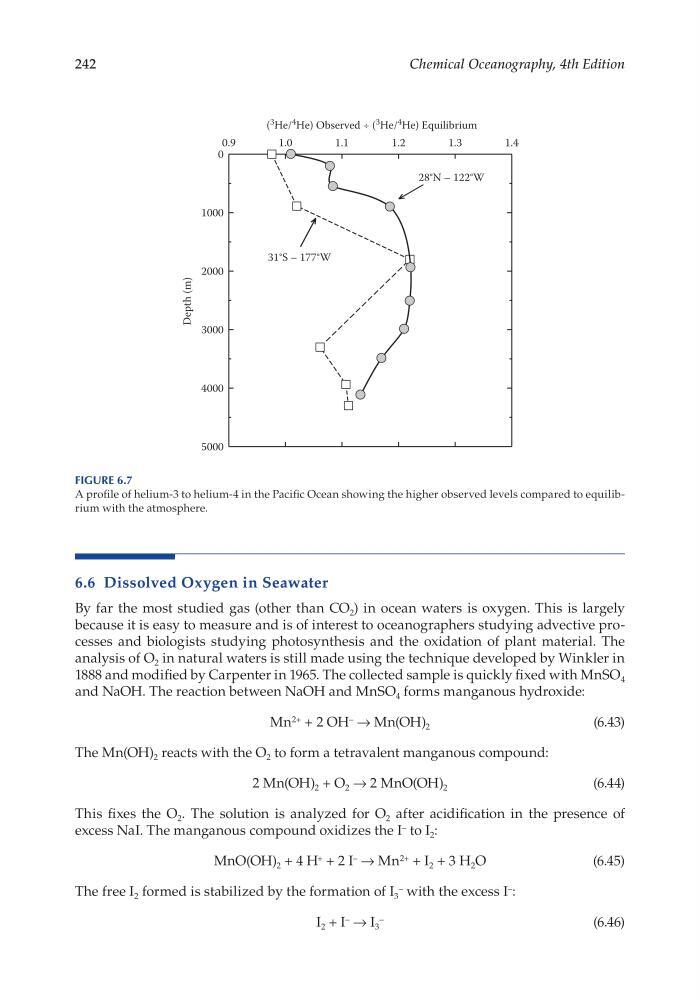
A profile of helium-3 to helium-4 in the Pacific Ocean showing the higher observed levels compared to equilibrium with the atmosphere.
Chemical Oceanography, 4th Edition
6.6 Dissolved Oxygen in Seawater
By far the most studied gas (other than CO 2 ) in ocean waters is oxygen. This is largely
because it is easy to measure and is of interest to oceanographers studying advective processes and biologists studying photosynthesis and the oxidation of plant material. The
analysis of O 2 in natural waters is still made using the technique developed by Winkler in
1888 and modified by Carpenter in 1965. The collected sample is quickly fixed with MnSO 4
and NaOH. The reaction between NaOH and MnSO 4 forms manganous hydroxide:
Mn 2+ + 2 OH – → Mn(OH) 2
(6.43)
The Mn(OH) 2 reacts with the O 2 to form a tetravalent manganous compound:
2 Mn(OH) 2 + O 2 → 2 MnO(OH) 2
(6.44)
This fixes the O 2 . The solution is analyzed for O 2 after acidification in the presence of
excess NaI. The manganous compound oxidizes the I – to I 2 :
MnO(OH) 2 + 4 H + + 2 I – → Mn 2+ + I 2 + 3 H 2 O
(6.45)
The free I 2 formed is stabilized by the formation of I 3
– with the excess I – :
I 2 + I – → I 3
–
(6.46)
(
3 He/
4 He) Observed ÷ (
3 He/
4 He) Equilibrium
0.9
1.0
1.1
1.2
1.3
1.4
Depth (m)
0
1000
2000
3000
4000
5000
28°N – 122°W
31°S – 177°W
Figure 6.7
A profile of helium-3 to helium-4 in the Pacific Ocean showing the higher observed levels compared to equilibrium with the atmosphere.