

220
Chemical Oceanography, 4th Edition
oxidized to SO 4
2– , while MSA is fairly stable and slowly oxidized to SO 2 . Other products
of the oxidation include dimethyl sulfoxide (DMSO) and dimethyl sulfone (DMSO 2 ). MSA
is a strong acid, and its atmospheric chemistry is dominated by aqueous processes. It is
thus very rapidly incorporated into aerosols by nucleation and coagulation. The sulfur
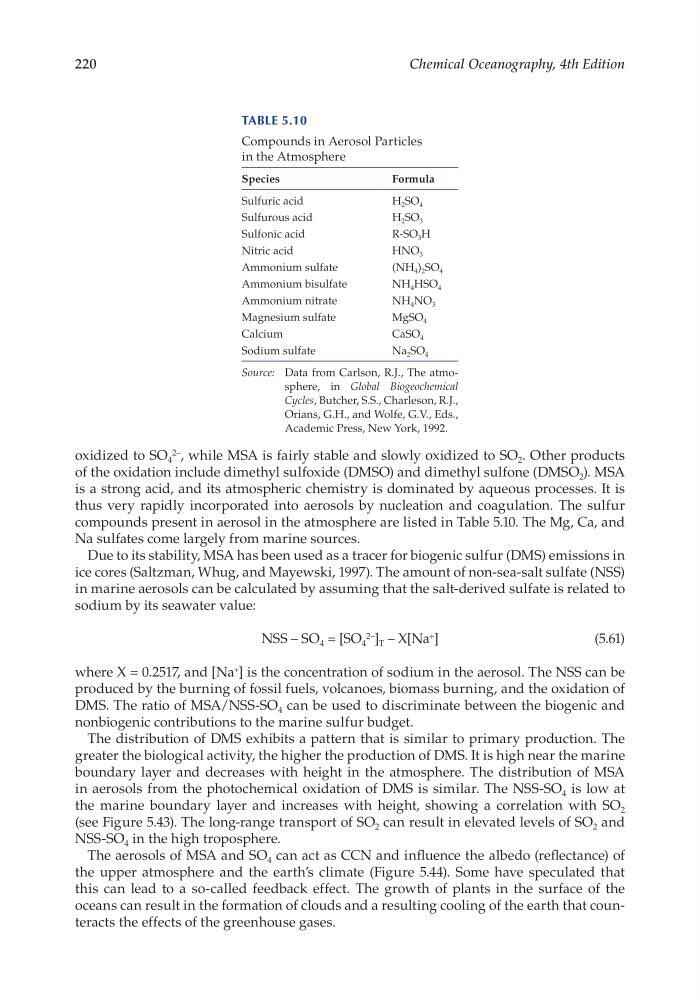
compounds present in aerosol in the atmosphere are listed in Table 5.10. The Mg, Ca, and
Na sulfates come largely from marine sources.
Due to its stability, MSA has been used as a tracer for biogenic sulfur (DMS) emissions in
ice cores (Saltzman, Whug, and Mayewski, 1997). The amount of non- sea- salt sulfate (NSS)
in marine aerosols can be calculated by assuming that the salt- derived sulfate is related to
sodium by its seawater value:
NSS – SO 4 = [SO 4
2– ] T – X[Na + ]
(5.61)
where X = 0.2517, and [Na + ] is the concentration of sodium in the aerosol. The NSS can be
produced by the burning of fossil fuels, volcanoes, biomass burning, and the oxidation of
DMS. The ratio of MSA/ NSS- SO 4 can be used to discriminate between the biogenic and
nonbiogenic contributions to the marine sulfur budget.
The distribution of DMS exhibits a pattern that is similar to primary production. The
greater the biological activity, the higher the production of DMS. It is high near the marine
boundary layer and decreases with height in the atmosphere. The distribution of MSA
in aerosols from the photochemical oxidation of DMS is similar. The NSS- SO 4 is low at
the marine boundary layer and increases with height, showing a correlation with SO 2
(see Figure 5.43). The long- range transport of SO 2 can result in elevated levels of SO 2 and
NSS- SO 4 in the high troposphere.
The aerosols of MSA and SO 4 can act as CCN and influence the albedo (reflectance) of
the upper atmosphere and the earth’s climate (Figure 5.44). Some have speculated that
this can lead to a so- called feedback effect. The growth of plants in the surface of the
oceans can result in the formation of clouds and a resulting cooling of the earth that counteracts the effects of the greenhouse gases.
Table 5.10
Compounds in Aerosol Particles
in the Atmosphere
Species
Formula
Sulfuric acid
H 2 SO 4
Sulfurous acid
H 2 SO 3
Sulfonic acid
R- SO 3 H
Nitric acid
HNO 3
Ammonium sulfate
(NH 4 ) 2 SO 4
Ammonium bisulfate
NH 4 HSO 4
Ammonium nitrate
NH 4 NO 3
Magnesium sulfate
MgSO 4
Calcium
CaSO 4
Sodium sulfate
Na 2 SO 4
Source: Data from Carlson, R.J., The atmosphere, in Global Biogeochemical
Cycles, Butcher, S.S., Charleson, R.J.,
Orians, G.H., and Wolfe, G.V., Eds.,
Academic Press, New York, 1992.
Chemical Oceanography, 4th Edition
oxidized to SO 4
2– , while MSA is fairly stable and slowly oxidized to SO 2 . Other products
of the oxidation include dimethyl sulfoxide (DMSO) and dimethyl sulfone (DMSO 2 ). MSA
is a strong acid, and its atmospheric chemistry is dominated by aqueous processes. It is
thus very rapidly incorporated into aerosols by nucleation and coagulation. The sulfur
compounds present in aerosol in the atmosphere are listed in Table 5.10. The Mg, Ca, and
Na sulfates come largely from marine sources.
Due to its stability, MSA has been used as a tracer for biogenic sulfur (DMS) emissions in
ice cores (Saltzman, Whug, and Mayewski, 1997). The amount of non- sea- salt sulfate (NSS)
in marine aerosols can be calculated by assuming that the salt- derived sulfate is related to
sodium by its seawater value:
NSS – SO 4 = [SO 4
2– ] T – X[Na + ]
(5.61)
where X = 0.2517, and [Na + ] is the concentration of sodium in the aerosol. The NSS can be
produced by the burning of fossil fuels, volcanoes, biomass burning, and the oxidation of
DMS. The ratio of MSA/ NSS- SO 4 can be used to discriminate between the biogenic and
nonbiogenic contributions to the marine sulfur budget.
The distribution of DMS exhibits a pattern that is similar to primary production. The
greater the biological activity, the higher the production of DMS. It is high near the marine
boundary layer and decreases with height in the atmosphere. The distribution of MSA
in aerosols from the photochemical oxidation of DMS is similar. The NSS- SO 4 is low at
the marine boundary layer and increases with height, showing a correlation with SO 2
(see Figure 5.43). The long- range transport of SO 2 can result in elevated levels of SO 2 and
NSS- SO 4 in the high troposphere.
The aerosols of MSA and SO 4 can act as CCN and influence the albedo (reflectance) of
the upper atmosphere and the earth’s climate (Figure 5.44). Some have speculated that
this can lead to a so- called feedback effect. The growth of plants in the surface of the
oceans can result in the formation of clouds and a resulting cooling of the earth that counteracts the effects of the greenhouse gases.
Table 5.10
Compounds in Aerosol Particles
in the Atmosphere
Species
Formula
Sulfuric acid
H 2 SO 4
Sulfurous acid
H 2 SO 3
Sulfonic acid
R- SO 3 H
Nitric acid
HNO 3
Ammonium sulfate
(NH 4 ) 2 SO 4
Ammonium bisulfate
NH 4 HSO 4
Ammonium nitrate
NH 4 NO 3
Magnesium sulfate
MgSO 4
Calcium
CaSO 4
Sodium sulfate
Na 2 SO 4
Source: Data from Carlson, R.J., The atmosphere, in Global Biogeochemical
Cycles, Butcher, S.S., Charleson, R.J.,
Orians, G.H., and Wolfe, G.V., Eds.,
Academic Press, New York, 1992.