

221
Atmospheric Chemistry
5.7 Atmospheric Aerosols
In recent years, a number of studies have shown that aerosols from the continents can have
an effect on climate (Evan et al., 2011; Booth et al., 2012) and the input of chemicals (Fe) to
the oceans (Prospero et al., 2002; Le Roux et al., 2011; Sholkovitz et al., 2012; Trapp, Millero,
and Prospero, 2010). The input of aerosols to the Atlantic come from the Sahara desert and
those into the Pacific come from the Gobi desert (Figure 5.45). The average dust input to the
Atlantic Ocean is shown in Figure 5.46.
(nmol m –3 )
0.0 0.1 0.2 0.3
0
1
2
3
4
5
6
(nmol m –3 )
0 2 4 6 8 10
(nmol m –3 )
0.0
0.5
1.0
1.5
km
0
1
2
3
4
5
6
(nmol m –3 )
0.0
0.5
1.0
1.5
DMS
nss-SO 4
SO 2
MSA
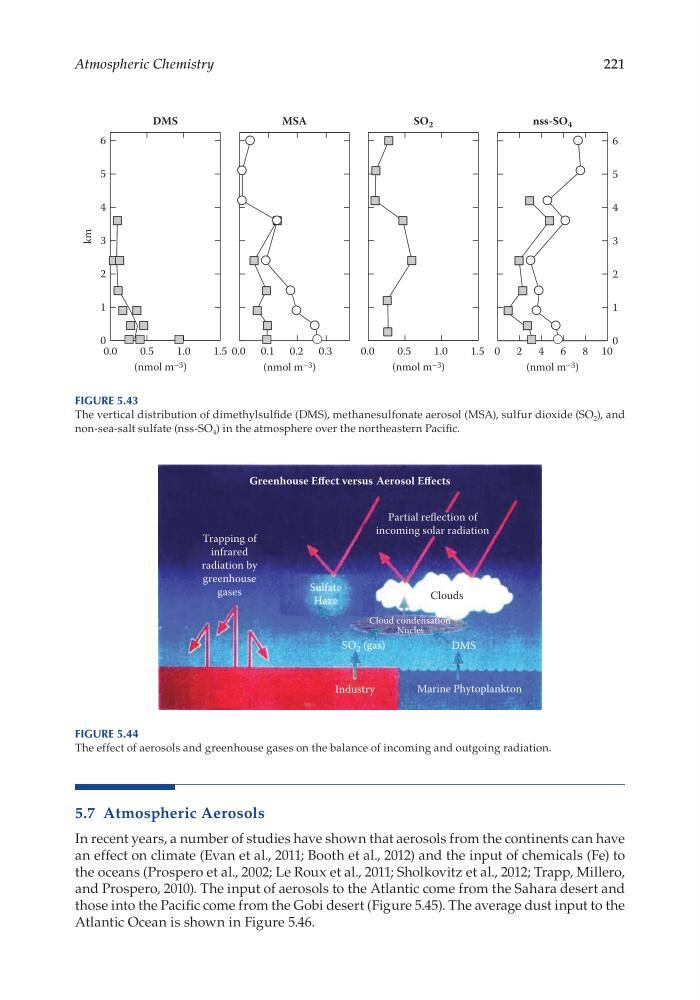
Figure 5.43
The vertical distribution of dimethylsulfide (DMS), methanesulfonate aerosol (MSA), sulfur dioxide (SO 2 ), and
non- sea- salt sulfate (nss- SO 4 ) in the atmosphere over the northeastern Pacific.
Marine Phytoplankton
Industry
Sulfate
Haze
Partial reflection of
incoming solar radiation
Greenhouse Effect versus Aerosol Effects
Trapping of
infrared
radiation by
greenhouse
gases
DMS
SO 2 (gas)
Cloud condensation
Nuclei
Clouds
Figure 5.44
The effect of aerosols and greenhouse gases on the balance of incoming and outgoing radiation.
Atmospheric Chemistry
5.7 Atmospheric Aerosols
In recent years, a number of studies have shown that aerosols from the continents can have
an effect on climate (Evan et al., 2011; Booth et al., 2012) and the input of chemicals (Fe) to
the oceans (Prospero et al., 2002; Le Roux et al., 2011; Sholkovitz et al., 2012; Trapp, Millero,
and Prospero, 2010). The input of aerosols to the Atlantic come from the Sahara desert and
those into the Pacific come from the Gobi desert (Figure 5.45). The average dust input to the
Atlantic Ocean is shown in Figure 5.46.
(nmol m –3 )
0.0 0.1 0.2 0.3
0
1
2
3
4
5
6
(nmol m –3 )
0 2 4 6 8 10
(nmol m –3 )
0.0
0.5
1.0
1.5
km
0
1
2
3
4
5
6
(nmol m –3 )
0.0
0.5
1.0
1.5
DMS
nss-SO 4
SO 2
MSA
Figure 5.43
The vertical distribution of dimethylsulfide (DMS), methanesulfonate aerosol (MSA), sulfur dioxide (SO 2 ), and
non- sea- salt sulfate (nss- SO 4 ) in the atmosphere over the northeastern Pacific.
Marine Phytoplankton
Industry
Sulfate
Haze
Partial reflection of
incoming solar radiation
Greenhouse Effect versus Aerosol Effects
Trapping of
infrared
radiation by
greenhouse
gases
DMS
SO 2 (gas)
Cloud condensation
Nuclei
Clouds
Figure 5.44
The effect of aerosols and greenhouse gases on the balance of incoming and outgoing radiation.