

219
Atmospheric Chemistry
5.6 The Global Sulfur Cycle
In recent years there has been interest in the global sulfur cycle (Saltzman and Cooper,
1989). This interest is related to the production of reduced sulfur compounds from the
burning of sulfur fuels (SO 2 ) and the production of reduced sulfur compounds from plants
(dimethylsulfide [DMS]). These compounds can be oxidized to H 2 SO 4 , which can serve as
CCN and affect the climate. The estimates of the natural sulfur emissions (Tmol S yr –1 ) are
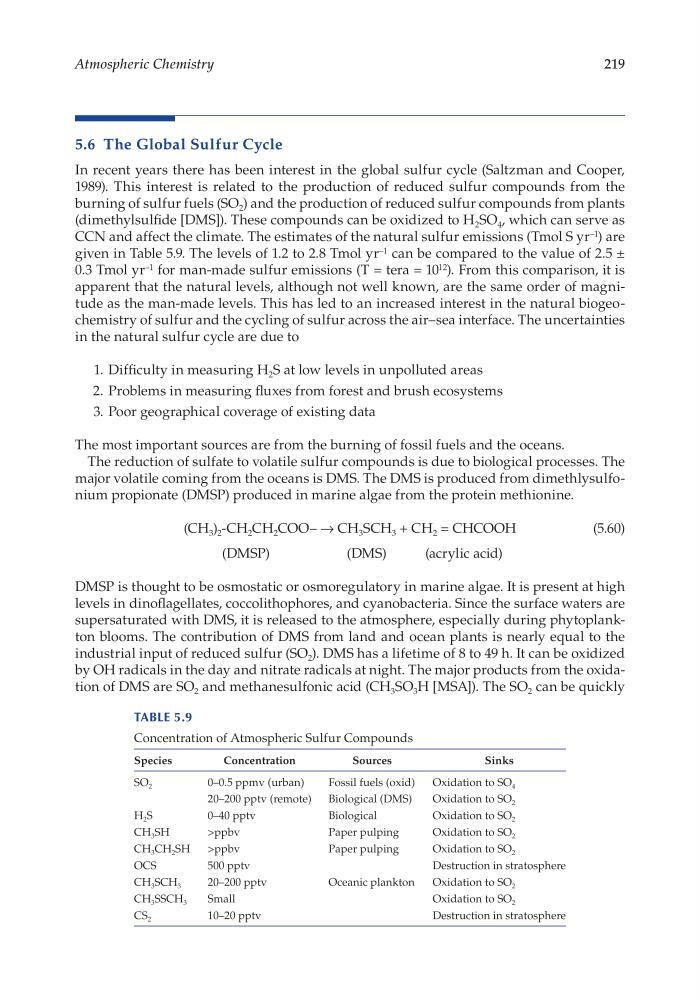
given in Table 5.9. The levels of 1.2 to 2.8 Tmol yr –1 can be compared to the value of 2.5 ±
0.3 Tmol yr –1 for man- made sulfur emissions (T = tera = 10 12 ). From this comparison, it is
apparent that the natural levels, although not well known, are the same order of magnitude as the man- made levels. This has led to an increased interest in the natural biogeochemistry of sulfur and the cycling of sulfur across the air–sea interface. The uncertainties
in the natural sulfur cycle are due to
1. Difficulty in measuring H 2 S at low levels in unpolluted areas
2. Problems in measuring fluxes from forest and brush ecosystems
3. Poor geographical coverage of existing data
The most important sources are from the burning of fossil fuels and the oceans.
The reduction of sulfate to volatile sulfur compounds is due to biological processes. The
major volatile coming from the oceans is DMS. The DMS is produced from dimethlysulfonium propionate (DMSP) produced in marine algae from the protein methionine.
(CH 3 ) 2 -CH 2 CH 2 COO– → CH 3 SCH 3 + CH 2 = CHCOOH
(5.60)
(DMSP)
(DMS)
(acrylic acid)
DMSP is thought to be osmostatic or osmoregulatory in marine algae. It is present at high
levels in dinoflagellates, coccolithophores, and cyanobacteria. Since the surface waters are
supersaturated with DMS, it is released to the atmosphere, especially during phytoplankton blooms. The contribution of DMS from land and ocean plants is nearly equal to the
industrial input of reduced sulfur (SO 2 ). DMS has a lifetime of 8 to 49 h. It can be oxidized
by OH radicals in the day and nitrate radicals at night. The major products from the oxidation of DMS are SO 2 and methanesulfonic acid (CH 3 SO 3 H [MSA]). The SO 2 can be quickly
Table 5.9
Concentration of Atmospheric Sulfur Compounds
Species
Concentration
Sources
Sinks
SO 2
0–0.5 ppmv (urban)
Fossil fuels (oxid)
Oxidation to SO 4
20–200 pptv (remote)
Biological (DMS)
Oxidation to SO 2
H 2 S
0–40 pptv
Biological
Oxidation to SO 2
CH 3 SH
>ppbv
Paper pulping
Oxidation to SO 2
CH 3 CH 2 SH
>ppbv
Paper pulping
Oxidation to SO 2
OCS
500 pptv
Destruction in stratosphere
CH 3 SCH 3
20–200 pptv
Oceanic plankton
Oxidation to SO 2
CH 3 SSCH 3
Small
Oxidation to SO 2
CS 2
10–20 pptv
Destruction in stratosphere
Atmospheric Chemistry
5.6 The Global Sulfur Cycle
In recent years there has been interest in the global sulfur cycle (Saltzman and Cooper,
1989). This interest is related to the production of reduced sulfur compounds from the
burning of sulfur fuels (SO 2 ) and the production of reduced sulfur compounds from plants
(dimethylsulfide [DMS]). These compounds can be oxidized to H 2 SO 4 , which can serve as
CCN and affect the climate. The estimates of the natural sulfur emissions (Tmol S yr –1 ) are
given in Table 5.9. The levels of 1.2 to 2.8 Tmol yr –1 can be compared to the value of 2.5 ±
0.3 Tmol yr –1 for man- made sulfur emissions (T = tera = 10 12 ). From this comparison, it is
apparent that the natural levels, although not well known, are the same order of magnitude as the man- made levels. This has led to an increased interest in the natural biogeochemistry of sulfur and the cycling of sulfur across the air–sea interface. The uncertainties
in the natural sulfur cycle are due to
1. Difficulty in measuring H 2 S at low levels in unpolluted areas
2. Problems in measuring fluxes from forest and brush ecosystems
3. Poor geographical coverage of existing data
The most important sources are from the burning of fossil fuels and the oceans.
The reduction of sulfate to volatile sulfur compounds is due to biological processes. The
major volatile coming from the oceans is DMS. The DMS is produced from dimethlysulfonium propionate (DMSP) produced in marine algae from the protein methionine.
(CH 3 ) 2 -CH 2 CH 2 COO– → CH 3 SCH 3 + CH 2 = CHCOOH
(5.60)
(DMSP)
(DMS)
(acrylic acid)
DMSP is thought to be osmostatic or osmoregulatory in marine algae. It is present at high
levels in dinoflagellates, coccolithophores, and cyanobacteria. Since the surface waters are
supersaturated with DMS, it is released to the atmosphere, especially during phytoplankton blooms. The contribution of DMS from land and ocean plants is nearly equal to the
industrial input of reduced sulfur (SO 2 ). DMS has a lifetime of 8 to 49 h. It can be oxidized
by OH radicals in the day and nitrate radicals at night. The major products from the oxidation of DMS are SO 2 and methanesulfonic acid (CH 3 SO 3 H [MSA]). The SO 2 can be quickly
Table 5.9
Concentration of Atmospheric Sulfur Compounds
Species
Concentration
Sources
Sinks
SO 2
0–0.5 ppmv (urban)
Fossil fuels (oxid)
Oxidation to SO 4
20–200 pptv (remote)
Biological (DMS)
Oxidation to SO 2
H 2 S
0–40 pptv
Biological
Oxidation to SO 2
CH 3 SH
>ppbv
Paper pulping
Oxidation to SO 2
CH 3 CH 2 SH
>ppbv
Paper pulping
Oxidation to SO 2
OCS
500 pptv
Destruction in stratosphere
CH 3 SCH 3
20–200 pptv
Oceanic plankton
Oxidation to SO 2
CH 3 SSCH 3
Small
Oxidation to SO 2
CS 2
10–20 pptv
Destruction in stratosphere