

218
Chemical Oceanography, 4th Edition
to predict the loss of O 3 in the global atmosphere. As humans continue to add gases that
upset the natural balance to the atmosphere, there will continue to be changes in the climate that affect life on the earth.
Work has also indicated that iodine may be important along with chlorine and bromine
in the destruction of ozone. The loss of ozone in temperate regions above 20 km have
puzzled scientists for years. Chlorine and bromine are important at higher altitudes, but
they cannot account for the loss in the lower stratosphere. The reaction sequence for iodine
is postulated to be (Solomon and Ravishankara, 1994):
HO 2 + IO → HOI + O 2
(5.56)
HOI + hυ → OH + I
(5.57)
I + O 3 → IO + O 2
(5.58)
OH + O 3 → HO 2 + O 2
(5.59)
The possible effect of iodine on the depletion of ozone is complicated by the fact that trifluoromethyl iodide (CF 3 I) has been proposed as a possible replacement for ozonedepleting halons used to fight fires. It was thought that this compound would not pose a
problem for the depletion of the ozone layer because the carbon iodine bonds are readily
photolysed by sunlight and never reach the stratosphere. Naturally formed methyl iodine
produced by marine life is thought to be much higher than the present industrial emissions. As scientists rush to make further measurements of iodine, the jury will remain out.
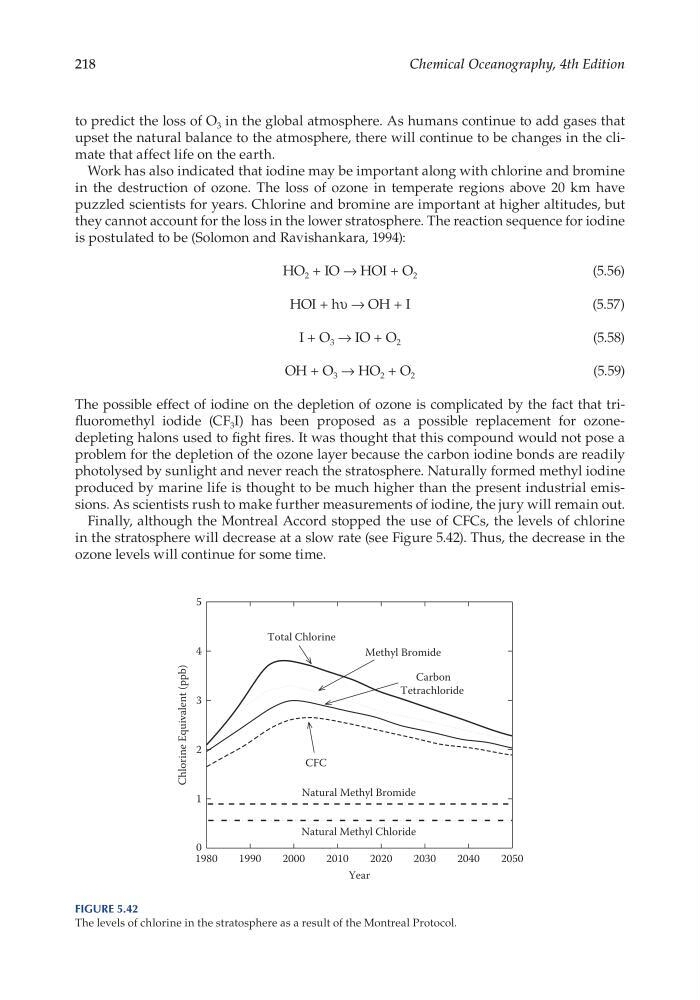
Finally, although the Montreal Accord stopped the use of CFCs, the levels of chlorine
in the stratosphere will decrease at a slow rate (see Figure 5.42). Thus, the decrease in the
ozone levels will continue for some time.
Year
1980
1990
2000
2010
2020
2030
2040
2050
Chlorine Equivalent (ppb)
0
1
2
3
4
5
Total Chlorine
Methyl Bromide
Natural Methyl Bromide
Natural Methyl Chloride
CFC
Carbon
Tetrachloride
Figure 5.42
The levels of chlorine in the stratosphere as a result of the Montreal Protocol.
Chemical Oceanography, 4th Edition
to predict the loss of O 3 in the global atmosphere. As humans continue to add gases that
upset the natural balance to the atmosphere, there will continue to be changes in the climate that affect life on the earth.
Work has also indicated that iodine may be important along with chlorine and bromine
in the destruction of ozone. The loss of ozone in temperate regions above 20 km have
puzzled scientists for years. Chlorine and bromine are important at higher altitudes, but
they cannot account for the loss in the lower stratosphere. The reaction sequence for iodine
is postulated to be (Solomon and Ravishankara, 1994):
HO 2 + IO → HOI + O 2
(5.56)
HOI + hυ → OH + I
(5.57)
I + O 3 → IO + O 2
(5.58)
OH + O 3 → HO 2 + O 2
(5.59)
The possible effect of iodine on the depletion of ozone is complicated by the fact that trifluoromethyl iodide (CF 3 I) has been proposed as a possible replacement for ozonedepleting halons used to fight fires. It was thought that this compound would not pose a
problem for the depletion of the ozone layer because the carbon iodine bonds are readily
photolysed by sunlight and never reach the stratosphere. Naturally formed methyl iodine
produced by marine life is thought to be much higher than the present industrial emissions. As scientists rush to make further measurements of iodine, the jury will remain out.
Finally, although the Montreal Accord stopped the use of CFCs, the levels of chlorine
in the stratosphere will decrease at a slow rate (see Figure 5.42). Thus, the decrease in the
ozone levels will continue for some time.
Year
1980
1990
2000
2010
2020
2030
2040
2050
Chlorine Equivalent (ppb)
0
1
2
3
4
5
Total Chlorine
Methyl Bromide
Natural Methyl Bromide
Natural Methyl Chloride
CFC
Carbon
Tetrachloride
Figure 5.42
The levels of chlorine in the stratosphere as a result of the Montreal Protocol.